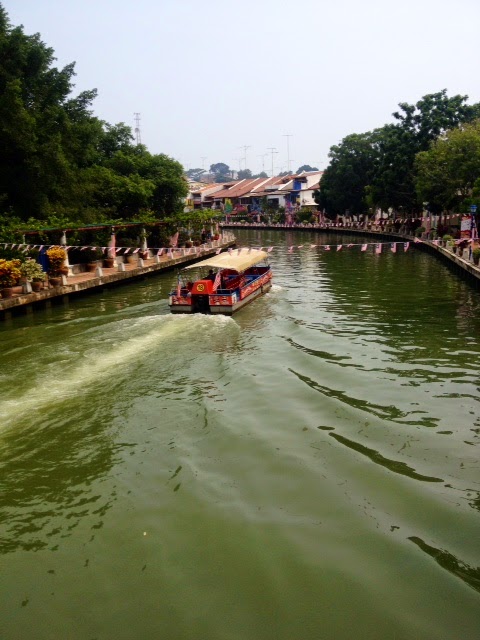

If you are short on time in Melaka, or just want to really get an excellent feel of the old parts of the city, a tour along the river is the best way to go. Afterwards, visit one of the cafes or restaurants along the atmospheric river walk for a cup of coffee or a beer and watch the boats cruise past.
Church of St. Francis Xavier
The Gothic-style Church of St. Francis Xavier is named after Melaka’s most famous priest, the founder of the Society of Jesus (Jesuits) who spent quite a bit of time in Melaka. The namesake of Pope Francis is called the “Apostle of the East”. Constructed in 1856, the Church of St. Francis Xavier is the center of Roman Catholicism in the city, and free to visit and look around.
 http://stfrancisxaviermelaka.blogspot.com/
The church is open to visitors. It’s cool, quiet, and peaceful inside. Many people come in to pray or to sit and reflect in the quiet sanctuary.

The Stadhus, the administrative center of Dutch colonialism in Melaka, was built in 1650, making it the oldest remaining Dutch building in all of Asia!

Statue of St. Francis Xavier and the Ruins of St. Paul’s
Neither the Church of St. Francis Xavier nor Christ Church however are the most important church in town. That honor goes to, despite being a ruin, the Church of Saint Paul. Built in 1521, St. Paul’s served as the home base for St. Francis Xavier himself as he undertook his missions across Asia. St. Francis was buried at the church after his death in 1552 before his body was moved to Goa, India. At this time, the bones of St. Francis’ right hand were removed for the creation of a relic.

Although the church is now an empty ruin, there is more to see on the hill. The church’s historic graveyard is open to visitors, and is worth exploring and looking around.
Independence Memorial
Another site worth visiting is the Independence Memorial, a free museum detailing Malaysia’s independence and unification. Malaysia is a federation made up of thirteen states or sultanates and ruled by a king elected from among the Malaysian sultans. The sultanates are ruled by hereditary sultans, and the states, where the monarchy was abolished by the colonial rulers, have governors. Modern Malaysia was formed in 1963 after gaining independence from the United Kingdom.

After visiting, explore the “Forbidden Gardens” that surround the old wooden palace.
Cheng Hoong Teng Temple
Malaysia is a melting pot of people from all over the world. One of the largest ethnic communities in the country are the Chinese-Malay, who first arrived in the country hundreds of years ago as traders. The Cheng Hoong Teng Temple (“Temple of the Green Cloud”) dates back to the 16th century, though the building has been rebuilt and restored a few times since.
 Singapore and Kuala Lumpur.
 LB convert