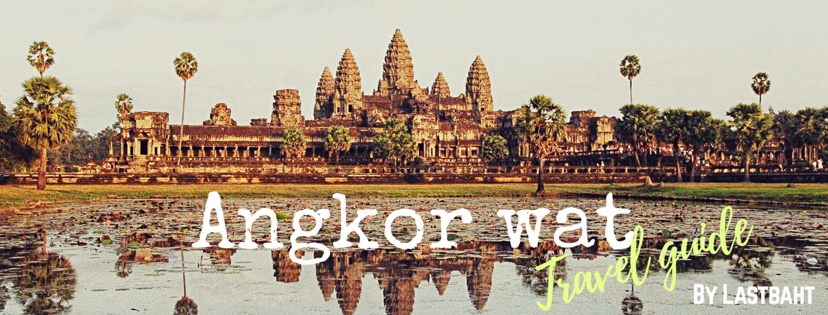
Angkor Wat Travel Guide by Last Baht

Getting There and Around
You can see Angkor Wat by motorbike, hired car, or tuk-tuk. Renting a motorbike from your guesthouse is probably the cheapest way to get around, but the Historical Park complex is massive, and it’s easy to get lost or turned around. If you are short on time and really don’t want to miss the top sites, hiring a driver is the most reliable way to get around. You can arrange this through your hotel or guesthouse the day before you want to visit the historical park.
When to go
You can visit Angkor Wat at any time of the year, but if you are going to be visiting during the monsoon season (around May-November) be prepared for the chance of rain.
Tickets
Tickets to the Angkor Wat Historical Park, although worth the cost, are a bit pricey for a traveler on a budget. A price increase in 2017 nearly doubled the ticket price, so if you are on a tight budget, pick up a one-day pass and hit up these top sites on a one-day whirlwind tour. Tickets can be bought as you arrive at Angkor Wat Historical Park.
1 Day – $37
3 Day – $62
7 Day – $72
Angkor Historical Park in a One-Day Visit
Sunrise at Angkor Wat
Wake up at 4:30am to begin your adventure long before the sun begins to rise. Meet your driver and head to Angkor Wat in the dark. Try to find a good spot to stand or sit to watch as the sun rises directly behind the famous Khmer-style spires of Angkor Wat. It’s crowded, but for good reason: watching the sun rise behind Angkor Wat is the world’s largest religious monument, and one of Southeast Asia’s most magical experiences.

monks at Angkor Wat
Inside, pay special attention to the intricate and incredibly well-preserved carvings of Hindu mythology and cosmology. Although constructed as a Hindu temple, Angkor Wat is now an important Buddhist site as well, and it’s common to see saffron-robed Theravada monks walking through the stone passages of the ancient complex.

Angkor Thom
Angkor Thom’s most impressive feature is the Bayon, the ancient temple sitting right at the center of Angkor Thom. Bayon is decorated in spires carved into giant, serene faces. Unlike most of the Angkor temples, Bayon is Buddhist, and not Hindu. Bayon was the last State Temple of the Khmer Empire, constructed after the empire’s official conversion from Hinduism to Buddhism.

Before Angkor Thom was abandoned during the fall of the Khmer Empire around 1600, it is believed to have supported a population of somewhere around 150,000, just a bit smaller than that of London at the time.
Ta Prohm
Visiting Ta Phrom feels like discovering a wonderful secret hidden deep in the jungle. While Angkor Wat and Angkor Thom have been partially restored, Ta Prohm still looks very much the same as it did when re-discovered by 19th century French explorers. Ta Prohm, a 12th century Mahayana Buddhist monastery and university, is overgrown with the roots of a gnarled jungle tree.

The “Monastery of Kings” was a dedicated Buddhist temple, one of the very few Buddhist temples in the predominantly Hindu Khmer Empire, though few Buddhist carvings remain. A theory suggests that Hindu priests may have destroyed some of the temple’s more overtly Buddhist features after the death of the king. Regardless, it’s one of the most incredible and highly-recommended sites in the entire Historical Park.
Kbal Spean
Off the beaten track is the Kbal Spean, which means “Bridge Head”, a sacred waterfall and archaeological site northeast of Angkor Wat.

Today, only Cambodians are allowed to swim in the sacred pool beneath the waterfall. You might see local people having a picnic along the banks. Foreigners, though, are not allowed to bathe or swim in the natural pool.
Beng Mealea
A bit far out, but absolutely worth the trip, Beng Mealea is one of the most incredible sites surrounding Siem Reap. This temple is located about 40 km away from the other main sites, which takes some time by tuk-tuk, but the trek is worth it.

Be careful on the slippery moss-covered stones! The ground is not completely stable, so move slowly and carefully through the ancient ruin. In my opinion, this is probably the coolest site in Siem Reap!
Pre-planned tours
Hire a tuk-tuk driver for one of the two “circuit” tours to hit all the most popular sites.
The Small Circuit
Angkor Wat, Angkor Thom, Ta Phrom, Banteay Kdei, and a number of smaller but still interesting ruins in a comprehensive loop of the park’s most famous sites. Good for a one-day visit.
The Grand Circuit
Small Circuit plus Preah Khan, Preah Neak Pean, among other smaller and less-known sites. The Grand Circuit is much longer, and is recommended only if you have enough time or interest in the less famous and popular historical sites. Usually requires two or more days to complete.
Other Great Activities in Siem Reap
Five Things to do in Siem Reap (Besides Visiting More Temples)
 Take a bus to the south of Cambodia and rough it with the macaques on Koh Rong (Monkey Island)!

Read about my adventures in Cambodia in The Long Road From Pub Street , my first book! Available now on Amazon.com!
 LB convert