Saigon, also known as Ho Chi Minh City, with its traffic and perpetual construction, may not be the most pedestrian-friendly city in the world, although there are plenty of places that are easy to get around on foot. Many of the city’s most famous and iconic sights are located within a block of each other in the city center, clustered around the old historic city hall. Visit these top sights in all of Saigon!
Rex Hotel Downtown Saigon
Top sights in Central Saigon
Notre Dame Saigon Cathedral
Officially the Notre Dame Cathedral Basilica of Our Lady of the Immaculate Conception of Saigon
Constructed by the French Cochinchina colonial government in 1863
The cathedral was constructed in a European Romanesque architectural style
In 1960, Pope John XXIII made the cathedral a basilica
The cathedral is famous for its beautiful stained glass windows
The statue of St. Mary is famous for an incident in 2007, when the statue supposedly was witnessed by hundreds shedding tears, drawing Catholics from all over the world to witness the sight
The interior of the cathedral is closed for massive renovations, which are projected to finish in 2020
Notre Dame Saigon Cathedralthe famous and mysterious weeping statue
Saigon Central Post Office
The Saigon Central Post Office was constructed in 1886 by the French colonial government
Though still an active post office, it is now one of the city’s big tourist attractions
The post office is famous for its beautiful architecture and interior murals depicting the telegraph lines in southern Vietnam
The old bank of telegraphs has been replaced with modern ATMS
Saigon Central Post Officemural of telegraph lines in Cochinchina
Saigon Opera House (Municipal Theater)
The 800 seat Saigon Opera House was built in 1897
From 1965 until 1975 the Opera House was used as a meeting hall for the lower house of the South Vietnamese (State of Vietnam) parliament
In 1995 the Opera House was restored for its original purpose
Today, you can buy tickets ONLINE for plays, concerts, operas, and cultural performances
the storied Saigon Opera House
Book Street
Nguyen Van Binh Street, better known as Book Street, is located just past the cathedral and post office
Book Street opened in 2016, and has become a paradise for book lovers
Dozens of bookshops line this pedestrian-only walking street
You can find many English books, both new and secondhand
Book Streeta shop on Book Street in Saigon
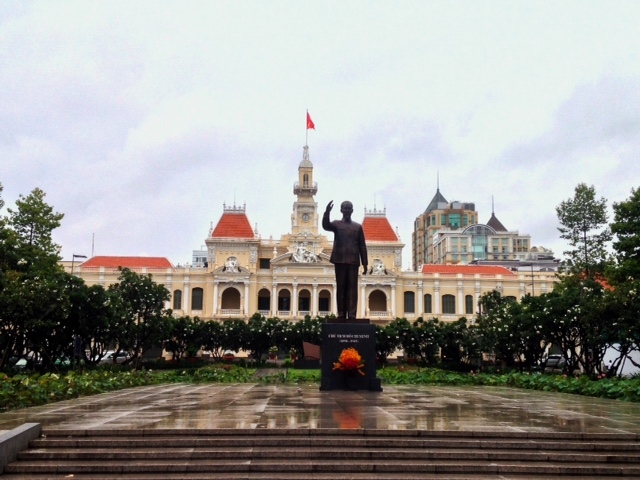
Ho Chi Minh City Hall
Also known as the Hôtel de Ville de Saïgon
The Ho Chi Minh City Hall was constructed by the French Indochina government in 1902
Today, the City Hall is home to the Ho Chi Minh City People’s Committee
The HCMC City Hall is not open to the public, but is a great place to take some photographs
There is a large park and garden in front of the city hall where locals like to sit, relax, and take photographs
Visit at night to see this grand old building lit up with beautiful lights
Ho Chi Minh City Hall
The Propaganda Bistro
The Propaganda Bistro is one of many trendy restaurants located near the Ho Chi Minh City Hall
This cool and funky bistro is decorated with murals depicting the iconic Communist propaganda artwork from Vietnam that has now become part of the pop culture
The Propaganda Bistro boasts a large range of local Vietnamese craft beer!
Try a delicious banh mi sandwich
The prices are a bit higher than in other parts of the city, but the food is excellent
murals at the Propaganda BistroBanh mi sandwich for lunch at the Propaganda Bistro in Saigon (HCMC)
Tucked away in a side street deep within Saigon’s District 1, paying a visit to the Jade Emperor Pagoda (Chùa Ngọc Hoàng) is one of Saigon’s best free cultural experiences. This hundred year-old Taoist temple was constructed by Saigon’s Chinese-Vietnamese community in 1909, and today is a vibrant, colorful, and beautiful spot to visit in the city. Escape the traffic and commercialism of Saigon (Ho Chi Minh City) to see the lesser-known spiritual side of Vietnam’s largest city.
The Jade Emperor Pagoda Saigon (Ho Chi Minh City)
Visiting the Jade Emperor Pagoda
The Jade Emperor Pagoda is open to all visitors, regardless of nationality or religious beliefs. Visitors must be dressed appropriately to enter a temple, though. That means no sleeveless shirts (men or women) and no shorts for women.
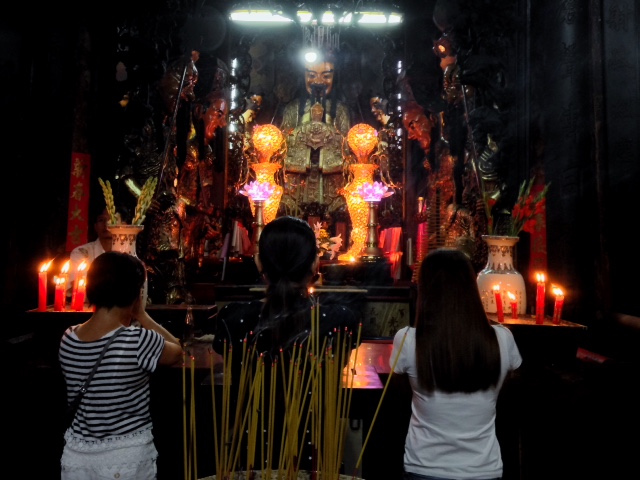
As soon as you step inside the quiet, dark wooden temple, with its flickering candles and spirals of fragrant incense smoke, you leave the bustling world of Saigon far behind. The main shrine in the center of the temple is dedicated to the Jade Emperor, the chief god of heaven in Taoism, who is seen as the judge of all of humankind.
shrine to the Jade Emperor
Although the Jade Emperor Pagoda is a Taoist temple, there are a number of Buddhist shrines as well. Vietnamese religion tends to follow the “triple teaching” of Buddhism, Confucianism, and Taoism, and there tends to be not much distinction between the three paths. Rather, they are seen to compliment one another.
As you walk through the temple, don’t miss the narrow wooden stairs leading up on the right side of the main hall. The stairs lead up to a landing with access to a balcony, from where you can look down over the temple grounds and see the city all around you.
Buddhist shrine in the Jade Emperor Pagoda
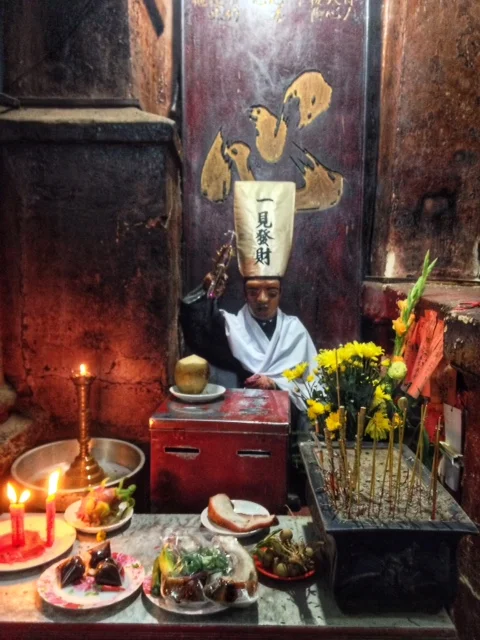
A door on the left side of the man hall leads down a hallway to the shrine of the city god. There is a special ritual that one can perform here. A temple volunteer hands visitors a small square of folded red paper. Say a prayer and make a wish, and circle the red paper around the burning flame from the lantern next to the city god. It is said that luck and prosperity will come to those who do this.
the Saigon City God
A lot of visitors complain that Saigon lacks the cultural experiences of Hanoi or Hue. While it’s true that the city can feel much more commercial, modern, and busy, there is still plenty of amazing history and culture to be found if you know where to look. Step back from the night life and the shopping malls, and you’ll find a Saigon with a rich history befitting the grand old city.
Guanyin Shrine
Location of the Jade Emperor Pagoda, Saigon
The Jade Emperor Pagoda is located in Saigon District 1
73 Đường Mai Thị Lựu VN, 73 Đường Mai Thị Lựu, Đa Kao, Quận 1, Hồ Chí Minh, Vietnam
Opening hours and entrance fee at the Jade Emperor Pagoda
The Jade Emperor Pagoda is open from 7:00 am – 6:00 pm
There is no entrance fee or admission ticket. Entrance to the temple is completely FREE to all visitors
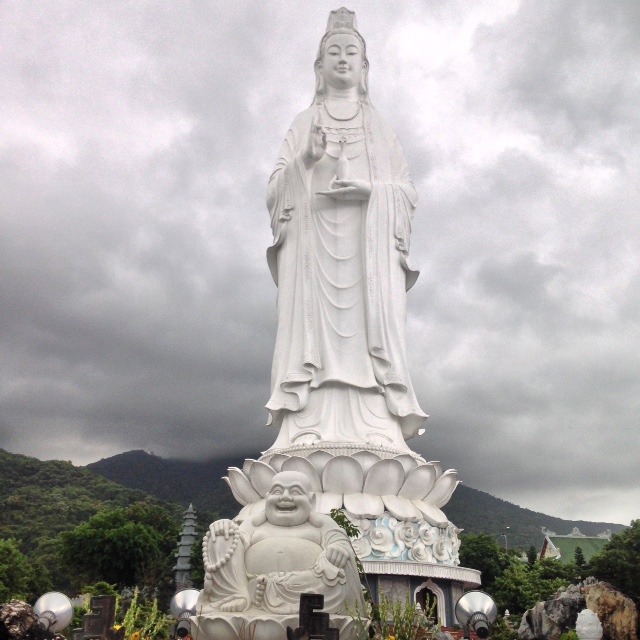
The Lady Buddha statue, a 67-meter tall marble statue of Guanyin, the Chinese goddess of mercy. The statue looks out from high up on Monkey Mountain on the Son Tra Peninsula, just north of Da Nang. On a clear day, it can be seen from Da Nang, or even as far away as An Bang Beach in Hoi An.
Son Tra Peninsula
Just 10 kilometers north of Da Nang City, the Son Tra Peninsula, commonly known by its nickname “Monkey Mountain”, is one of the most popular spots to spend a day outside of Da Nang. It’s close to the city, undeveloped, and offers unparalleled views over the city and the bay far below. It’s easily accessible by motorbike, although a ride on the city’s Coco Tour Bus is a fun way to take a relaxing and scenic ride along the coast and up into the hills of the peninsula.
Linh Ung Pagoda
The most famous and remarkable site on the peninsula is the Linh Ung Pagoda, home of the iconic and elegant Lady Buddha statue. This Buddhist temple, the largest in Da Nang, is built in a traditional Chinese-Vietnamese architectural style, and is completely free to visit.
The temple is home to a number of peaceful shrines and temple halls, and offers amazing views of the bay far below. The Lady Guanyin statue is said to offer peace and protection from storms to local fishermen.
How to get to Son Tra Peninsula (Monkey Mountain)
Da Nang’s pink tourist bus goes directly to the Linh Ung Pagoda
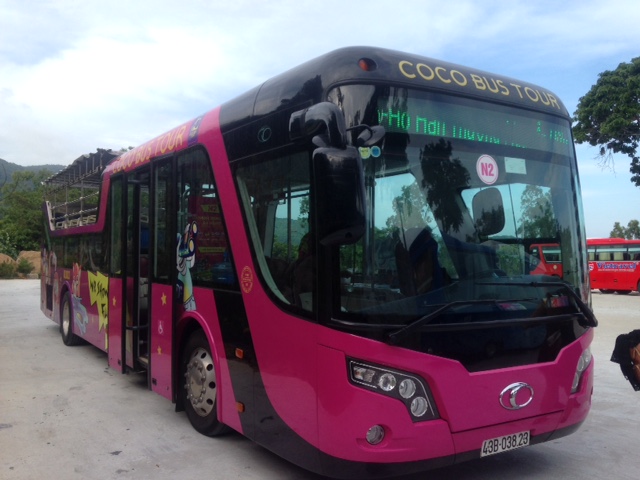
The easiest way to get to the Linh Ung Pagoda (Lady Buddha) on Son Tra Peninsula is by taking the bright pink Coco Tour Bus, which runs in a route directly to the temple.
You can not say that you have been to Hoi An until you have tried these unique local dishes…
1. White rose dumplings, or Banh Bao Banh Vac
white rose dumplings
This special dish is found only in Hoi An! The dish is called “white rose dumplings” because of the way that they are arranged on a plate, looking something like the petals of a large flower. White rose dumpling are made from rice paper stuffed with meat (usually shrimp). The dumplings are steamed until they are perfectly cooked, garnished with fried onions and shallots, and served with sweet chili dipping sauce.
2. Cao Lau or Hoi An noodle
Cau lau
Cao lầu is made out of a special type of Hoi An noodle, served with the meat of your choice and topped with fried wontons, veggies, and herbs. Cao lầu must be prepared with a certain traditional technique, and the ingredients used make it unique and very special. Local lore suggests that only Hoi An water is able to give the noodles their unique flavor and texture. Cao lầu noodles are a bit firm and chewy, but not too hard. The noodles are unlike any noodle that I have ever tried. The meat that I ordered was a soft and tender marinated BBQ pork – a perfect combination between salty and sweet.
3. Banh Dap or smashed rice cracker
banh dap
Banh Dap, or “smashed rice paper” in English, is one dish that originated in this charming little town. Banh Dap is different from any other rice paper that you will see here in Vietnam. This menu is good for snacking and as a side dishe. Banh Dap is made from two pieces of rice paper smashed together – one crispy and one soft – and folded together like a sandwich. The cracker is dipped into a sauce made of fish sauce, dry onion, and chili. I like the texture of this menu. I didn’t know what this dish would be like, but it looked like it would be very crispy from the outside, so my brain had already imagined the sounds of the rice paper cracking when I chew it. BUT it’s not exactly like that! The texture of crispy and soft rice cracker mixed together was very interesting.
4. Banh Trang Nuong or grilled rice paper
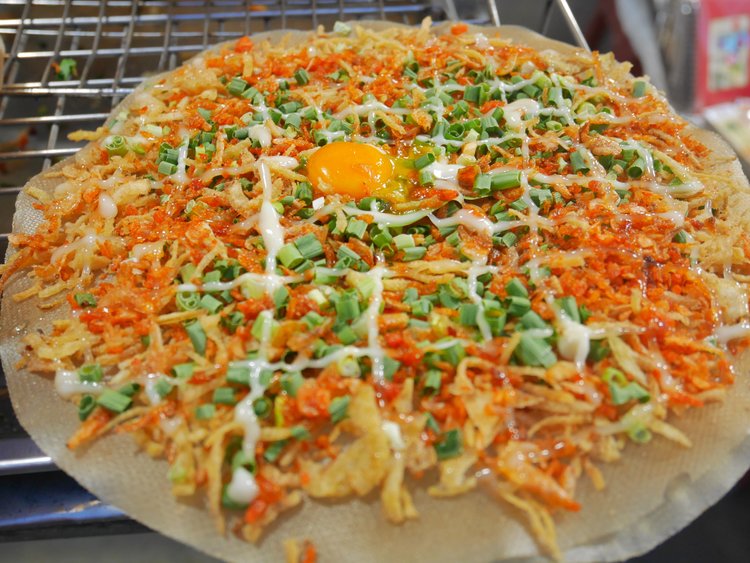
banh trang nuong
Spend an evening in the Hoi An Night Market! There are lots of souvenirs that you can find, especially the city’s iconic beautiful lanterns to take home. Most importantly, you can always find lots and lots of food and snacks! As you walk through the busy market, there are so many street vendors who want to to sell you stuff like frog on a stick, rolled ice cream, and fresh fruits. What stood out for me, though, was this Banh Trung Noung, or grilled rice paper. This local snack food is made out of rice paper as a base, grilled until crispy, and topped with shredded pork, fried onion, shallot, quail egg, and chili sauce. It’s then folded in half like a taco to be easy to take home or eat as you walk. It’s crispy, salty and sweet – what could be a better snack?!
5. Bun Thit Nuong or grilled pork noodles
bun thit nuong
Bún thịt nướng is served with fish sauce for dipping, just like most other dishes in Hue which all have their own special dip for each item. Bún thịt nướng, or grilled pork noodles, come with tasty grilled pork served over rice noodles and fresh veggies (such as sweet basil, banana blossoms, and bean sprouts). The fatty grilled pork, which has already been marinated with a special recipe, tastes so delicious and goes great with the rice noodles. Fresh veggies add a crispiness and a healthy herbal aroma to the dish. Pick up each bite of noodles in your chopsticks and dip it into the sauce for extra flavor!
If you like discovering delicious local dishes from all across the world, please check out our sister blog, World of Street Food! There, we post all of the amazing things that we eat as we make our way around the world.
One of the most fun ways to get around Da Nang, Vietnam is with the city’s iconic pink hop-on-hop-off Coco Tour Bus. The bus runs past many of the city’s most popular destinations. If you are on a budget and short on time, consider taking the Coco Bus to hit up all of the best spots in Da Nang! The Coco Tour Bus is run by the Cocobay Resort, but anyone can hop on one of these double-decker buses for a tour around the city with a panoramic view from the upper level.
Where does the Coco Tour Bus go?
The bus runs in three routes: a city route that heads all the way to Da Nang’s northern peninsula from the airport; a beach route that runs south along the most popular beaches to the Cocobay Resort; and a brand-new Hoi An route that runs from Cocobay Resort all the way to
The buses run in a circuit around the city. It’s easy to spot the bright pink bus stops! The Coco Tour Bus shares a lot of stops with Da Nang’s city bus, and you can’t miss the big pink buses pulling up.
Simply hop on (you can buy a ticket on board if you don’t already have one), tell the on-board tour guide where you want to go, and they will tell you when to hop off, while giving you information (in English) about your destination and any interesting sites you may pass along the way.
You’ll save on taxi fare, get an amazing view of the city, and get information from fun and knowledgeable local guides as you ride along.
How to buy a ticket for the Coco Tour Bus
You can buy a ticket for the Coco Tour Bus on board the bus from the on-board tour guides, at the Cocobay Resort just south of Da Nang, or at the Da Nang City Airport.
How much does a Coco Tour Bus ticket cost?
A ticket for the Coco Tour Bus costs 175.000 VND (about $7.50) and is valid for 24 hours. During the validity period, you can ride the bus as much as you want, hopping on and off at any stop. The bus runs as far as the Linh Ung Pagoda on Da Nang’s far northern peninsula, the Marble Mountains, and Hoi An city center. If you are planning on seeing more than a few sites in a day, it is completely worth the price.
Taking the bus to Hoi An
The Coco Bus recently began running a brand-new route all the way to Hoi An! The new N3 bus line runs from Cocobay Resort all the way to the city center in Hoi An, about twenty minutes away. To get to Hoi An, you can take the N1 Cocobay Beach Tour Bus from Da Nang City to Cocobay Resort, then switch to the N3 Hoi An Bus. It’s easy, and you don’t need to buy any extra tickets; a Coco Bus ticket is valid for 24 hours on all routes.
A visit to central Vietnam is not complete without spending at least a day or two in Hoi An, a UNESCO World Heritage City with a long and colorful past. Once considered by merchants from across Asia to be the center of the world, Hoi An is home to a number of ancient temples, shop houses, and clan houses for the different trading missions that made port in the city. Today, Hoi An is a protected city, and walking through the pedestrian-only old town is like stepping back in time. The government forbids the construction of any modern buildings in the old town in an attempt to preserve this delightful city’s unique culture and history.
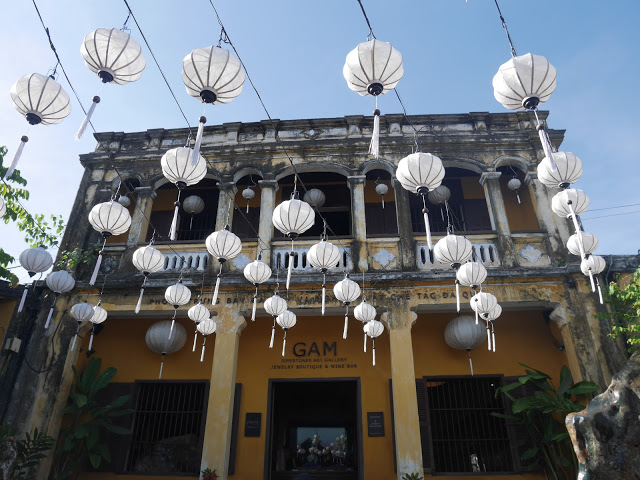
traditional shop with lanterns in Hoi An, Vietnam
1. Buy a ticket and explore the ancient city
a walk through the streets of Hoi An
Hoi An’s Ancient City is home to 22 fascinating historic shophouses, temples, and museums. A ticket to the Ancient City is required to enter these sites, although there are plenty of free things to see around the town too. A ticket is available at the entrance to the Ancient City or at the tourist center. A ticket costs 120.000 VND and is good for entrance to five sites, so if you are on a tight budget, you may have to think carefully about which sites you really want to see.
120.000 VND isn’t so expensive for the value that you get out of the ticket, however. Each of the 22 sites is impressive and informative. The most famous site of all being the Japanese Bridge in the western side of the Ancient Town. This historic bridge, the symbol of Hoi An, is the only covered temple bridge of its kind outside of Japan, and was constructed by Japanese merchants who traded at the city hundreds of years ago.
The Ancient Town is closed off from traffic, making for a peaceful and relaxing walk past charming cafes, restaurants, and shops under brightly-colored lanterns that hang above the street. The town is small enough that you can easily walk, but many people choose to rent a bicycle to get around.
Hoi An’s Japanese Covered Bridge
2. Shop and eat at the Hoi An Night Market
Ho An night market street
Hoi An, though small, is a city that never sleeps! After the sun goes down and the city’s thousands of colorful paper lanterns are lit, the night market just across the river from the Ancient Town comes alive with activity! It’s the best place in the city for shopping.
The night market has everything from souvenirs (don’t forget to bargain!), beautiful traditional lanterns, and bars, to street food, local desserts, clothes and accessories.
For those who loves nature and a little adventure, don’t miss out on the highly-recommended “Coconut Village” (Cam Thanh village). The Coconut Village is named so because of its location deep in a water coconut grove. Enjoy floating in a traditional handmade basket boat through the flooded water coconut forest. You will get to see a beautiful look at a traditional way of life, including trying your hand at a traditional fishing method and learning how to catch a crab. As you float slowly along the quiet, muddy waters of the coconut forest, you’ll come to a bare clearing, a war site that is still scarred from bombs.
If you are lucky, your guide might even give you a little handmade gift form the forest! For the people who a little bit more adventurous, you can try spinning in the basket boat! The guide will use the oar to begin spinning the boat fast… faster… faster until you are dizzy and screaming!
You will get to try your hand at traditional net fishingSpinning in a basket boat (you better have strong arms to hold on tight!)
Once a month, on the night of the full moon, Hoi An’s river comes alive with light and color as hundreds of people head out on wooden rowboats to launch paper lanterns into the water to make a wish and pray for good luck. This is the most popular time to visit Hoi An, and for good reason. This special festival is a beautiful and unforgettable moment in your travels through Vietnam.
5. Go boating on the river and enjoy a Hoi An evening
Along the river of Hoi An City, there are so many people offering to take you on a ride along the river. It’s most popular in evening when it’s less hot. You will get to enjoy the cool air and a bit of night life on a local boat. The historic city is especially pretty at night when all of the colorful lights and decorated lanterns are lit. If you just want a short tour, you can bargain for a 15 to 30 minute trip up and down the river so that you can see all of the city’s colorful lanterns reflected in the water.
I highly recommend to bargain the price before you hop on the boat. The rate I paid was 200.000 VND/30 mins (3 people). Maybe you can get it cheaper, but the first person I talked to gave me a much higher rate than this for 15 mins. This is the most fun during the night of the monthly Lantern Festival.
6. Chill at An Bang Beach
An Bang Beach outside of Hoi An and Da Nang, Vietnam
An Bang beach is only about 4 km away from Hoi An’s city center. Although the beach isn’t so far from Da Nang, it feels far away from the hustle and bustle and the crowds of the city. This is a peaceful place where people come out and relax. It’s definitely not a party beach, but more of a family-friendly beach for relaxing on the sand and playing in the water.
The sand and water are very clean, and the surf tends to be fairly calm. There are many activities that you can do at the beach such as parasailing, having a massage, taking a basket boat ride, laying on a banana boat, flying a kite, etc. It can get crowded in the evening when most of the local people like to come.
seashells along An Bang Beach
I hope the local people will be aware of the nature and educate their kids to not destroy the natural beauty of the beach. During the few hours that I spent there, I saw many kids (with their parents), hold plastic bags in their hands and collecting these beautiful hermit crabs without noticing if the shells were empty or not. I hope they will be more concerned about this before it’s to late and becomes empty like many beaches. Although the beach was fairly clean, I was disappointed to see many people littering and leaving their trash on the beach.
7. Have lunch at Central Market
Central market is another popular tourist spot where you can find cheap and famous local Hoi An food. The market, located near the entrance to the pedestrian zone of the Ancient Town, has two parts. In the front you can find lots of amazing local food, and in the back you’ll find the local market where people come to shop for veggies, meat, household goods, and more. Be sure to order a big bowl of Cao Lau, a Hoi An specialty!
If you don’t like coffee, why are you even bothering to go to Vietnam?
I’m joking, of course. The country is a beautiful, rich, vibrant, and colorful land full of incredible culture, food, and history. But if you are a coffee lover, you have something very exciting to look forward to!
It’s been said that Vietnamese coffee is among the best in the world. Vietnam was a part of French Indochina for parts of the 19th and 20th centuries. Saying that colonialism brings with it a few bad things is, of course, an understatement. However, you can’t deny that the French left quite an impression on Vietnam. After the French left Vietnam for good, they left behind them hundreds of beautiful Catholic churches and cathedrals, a love of delicious baguettes and fresh-baked bread, and of course, coffee and a thriving European-style cafe culture.
What makes Vietnamese coffee so good?
Why is Vietnamese coffee so famous? Well, it’s delicious, and we’ve got both science and history to thank for that. Vietnam is the world’s second-largest exporter of coffee beans (after Brazil). Vietnam grows the Robusta bean, which tends to be stronger and sharper, and higher in caffeine than the slightly more popular and common Arabica bean. This makes a cup of Vietnamese coffee stronger and richer than coffee grown in other parts of the world. The soil and ecology of the Vietnamese highlands also contributes to the country’s richer and stronger coffee.
phin coffee with views of a coffee plantation via Pixabay
Additionally, Vietnamese coffee is almost always brewed using a phin, a traditional stainless-steel coffee filter that sits on top of a small cup, dripping a heavily-concentrated brew. Phin-brewed coffee is much more highly-concentrated and stronger than French press or peculator coffee, and the flavor is also much stronger and more rich. All of these factors combine to give Vietnamese coffee a distinct strong aroma and rich, slightly bitter taste. Of course, every cup of Vietnamese coffee is usually mixed with sweetened condensed milk at a 7/3 ratio, giving it an additional sweet, rich flavor.
Don’t miss these three coffee drinks in Vietnam
Cafe Sua Da: Iced Coffee with Milk
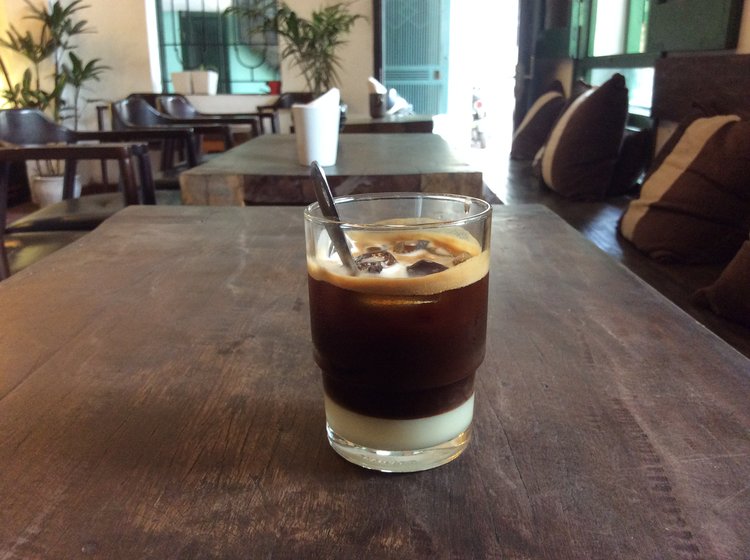
a traditional glass of Vietnamese cafe sua da
What is Cafe Sua Da?
Cafe Sua Da is the ubiquitous Vietnamese coffee. Phin-dripped ice coffee is served with sweetened condensed milk over ice. This might as well be Vietnam’s official national drink! It can be found on literally every street corner, and nobody in the country would dream of starting his or her day without a cup of this strong, sweet, rich brew. During the three months that we stayed in Vietnam, we too took up the tradition of starting our morning with a cup of rich and cold Cafe Sua Da before heading out to explore the city.
Where to get Cafe Sua Da?
Literally everywhere. Seriously! Cafe Sua Da is as common as water in Vietnam, and just as cheap! Every cafe and street-side shop will serve a cup of rich Vietnamese coffee dripped over condensed milk. This drink can be found in every single city and town across the country, and is the standard go-to coffee drink of millions.
How much does Cafe Sua Da cost?
A glass of Cafe Sua Da is cheap – anywhere from 10.000 VND ($0.40) at a small local shop to around 40.000 VND ($1.75) at the priciest upscale cafe.
Cafe Trung: Egg Coffee
What is Cafe Trung?
Learn more about Egg Coffee by clicking HERE and HERE
Cafe Trung, or “Egg Coffee”, is a Hanoi specialty. Egg coffee was created way back in 1946 at the Giang Cafe, a Hanoi landmark. During that time, Vietnam was suffering from a shortage of milk, so Mr. Giang, an industrious and creative former bartender, had the idea of mixing a whipped egg yolk into the coffee in its place. The result was Cafe Trung, a rich, sweet, and creamy mix that is much more delicious than it might sound! Cafe Trung tastes almost like a sweet, vanilla milkshake! Give it a try and you won’t be disappointed at all! It’s equally delicious hot or served over ice.
Where to get Cafe Trung?
You can find Egg Coffee all over Hanoi, but the first place you should try it is at Cafe Giang, the cafe where it all began. Of course, don’t miss the fantastic Note Cafe, which serves up a great Egg Coffee alongside an incredible view of Hoan Kiem Lake and the service of awesome and friendly staff.
How much does Cafe Trung cost?
A glass of Cafe Trung is a bit more expensive than Cafe Sua Da, running somewhere around 40.000 VND.
Cafe Muoi: Salt Coffee
What is Cafe Muoi?
Cafe Muoi literally means “Salt Coffee”. It’s a drink that you can only find in and around Hue, Vietnam’s ancient imperial capital. Salt Coffee, though it may sound really strange, is a deliciously sweet and creamy drink. The salt counteracts some of the natural bitterness of the Robusta bean, bringing out the more nuanced and hidden sweet flavors of the coffee. A glass of Cafe Muoi, served as phin coffee dripped over a salty whipped cream, tastes almost like caramel. It’s surprisingly sweet and delicious.
Cafe Muoi is relatively cheap, only running around 15.000 VND per glass! Don’t miss this incredible drink! In fact, it was my favorite coffee drink in all of Vietnam, and that’s saying something!
So, what do you think of Vietnamese coffee? Is there an incredible brew that we have missed? Please let us know in the comments below. Please. I’m afraid that my time in Vietnam has made me a little bit addicted to the stuff…
Don’t bother spending money on a package tour; you can easily visit the Marble Mountains on your own! Visiting Da Nang’s Marble Mountains on your own is easy, cheap, and a lot more fun than traveling with a big tour group.
Marble Mountains, Da Nang, Vietnam
The Marble Mountains of Da Nang, Vietnam
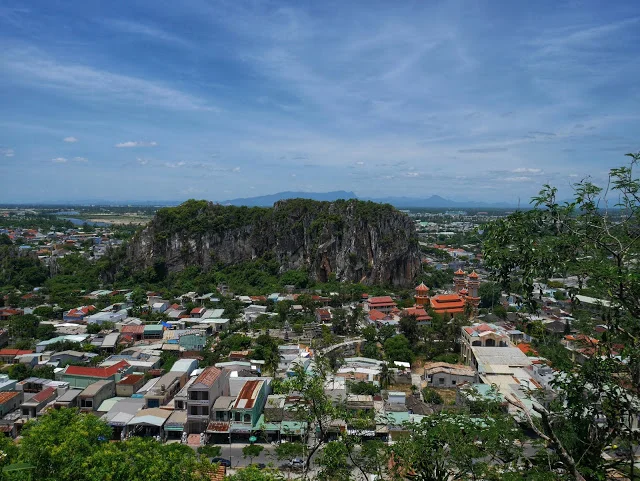
The Marble Mountains are one of central Vietnam’s most stunning and unique sights to see. The five mountains – made from marble as their name suggests – rise dramatically out of a flat plain just outside of Da Nang, looking almost impossibly out of place. The five natural marble mountains are each named for one of the five natural elements of Chinese feng shui: Fire, Earth, Air, Water, and Metal, and are an important sacred site to Vietnamese Buddhists.
Although many people visit the mountains as a part of a package tour from Da Nang, it’s easy to save money and visit at your own pace on a self-guided tour from Da Nang. Here’s how!
Marble Mountains near the beach in Da Nan
How to get to the Marble Mountains without a package tour
There are a few ways that a tourist visiting Da Nang can get to the Marble Mountains, which are about 20 minutes outside of the city, without taking a package tour. Here are some options:
Take the public bus – Bus #1 runs from Da Nang bus station to Hoi An several times throughout the day, making a stop near the Marble Mountains.
Take the Coco Tour Bus – this bright pink hop on / hop off bus runs all day, making stops at Da Nang’s most popular sites. One of the final stops on the route is at the Marble Mountains. The public bus and the Coco Bus share a bus stop, which is just a few minutes walk away from the entrance to the mountains
Hire a taxi – you can hire a metered cab, or book a driver through an app like Grab. This is the quickest way, and will take you directly to the mountain. On your way out, there will be plenty of drivers waiting to take you back to the city.
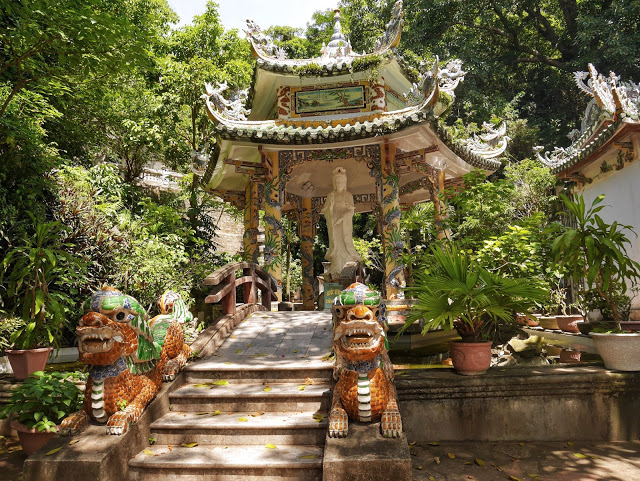
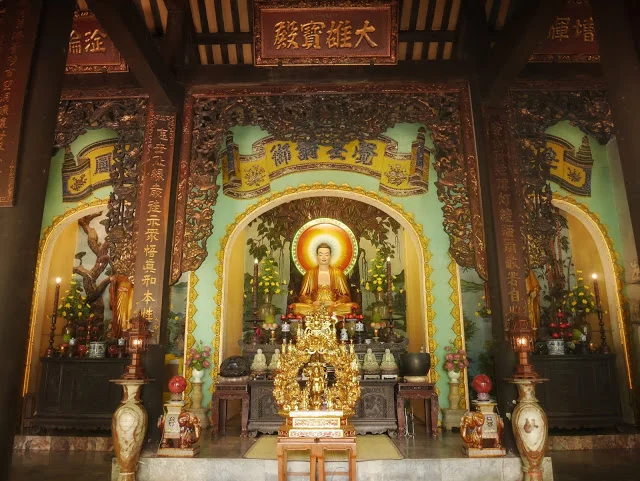
a Buddhist temple in the Marble Mountains
What to see and do at the Marble Mountains
For generations the mountains were mined by local marble carvers who reside in the craftsman’s villages just below the hills. Nowadays, craftsmen mostly import their marble, and the five mountains have become something of a sacred site. Upon arriving, ignore all of the souvenir shops – you can buy anything much cheaper elsewhere – and head directly to the ticket office.
The entrance and ticket office is located at Thuy Son, the Water Mountain, the only mountain that is climbable. When you purchase a ticket (40,000d) , you have the option of buying an additional ticket to take the elevator up the mountain (20,000d) and a map (15,000d). Skip the elevator. Although the stairs up the mountain can be a bit steep, taking the elevator will cause you to miss some of the shrines and viewpoints along the way up. The map is worth every dong though. More than just a map, the thick booklet comes packed with information and history, as well as several postcards!
The mountain is dotted with hundreds of caves, shrines, statues, and pagodas. As you make your way up the first set of steps to the first landing, you’ll soon comet the first small Buddhist temple. Every sight and stop along the trail up the mountain is unique and well-worth a visit.
Marble Mountains and Da Nang during the Vietnam War
The Marble Mountains played an important role during the Vietnam War as well. Although located just adjacent to the Marble Mountains Air Facility, a United States Marine Corps Air Base, the mountains themselves were the location of a secret Vietcong field hospital. The Vietcong apparently thought so little of the US military that they didn’t even question setting up their secret base on the grounds of existing an American base. The US military, unfamiliar with jungle warfare and unaccustomed to the guerilla tactics of the Vietcong, remained ignorant of the nearby base throughout the war.
a stone pagoda halfway up the Marble Mountains
Now, both bases are long gone, and the mountain is no longer a place of war, but a place of peace. It’s been re-dedicated as a sacred site to reclaim it from its violent past. Dozens of sacred Buddhist grottoes dot the mountainside, along with temples and statues of Buddha, Guanyin, Budai, and other Buddhist figures carved directly into the stone.
a marble statue of Buddha in the forest
As you climb higher up the steep and sometimes slippery marble steps, occasionally the thick jungle surrounding the path will clear, giving an unparalleled view of the breathtaking My Khe (China Beach) nearby. If you are feeling really adventurous, head to the highest point on the mountain for an incredible view of the sea and surroiunding landscape.
“China Beach” in Da Nang
Cave Temples at the Marble Mountains
Some of the most beautiful and interesting sites on the Marble Mountain are the dozens of small cave temples and shrines that have been carved right into the side of the natural rock of the mountain.
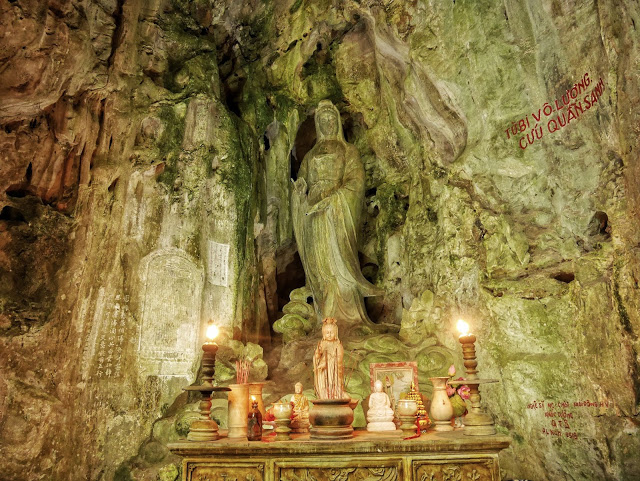
cave shrine to Guanyin
The mountain’s biggest cavern is home to several small shrines. The air there is cool and damp, and thick with the fragrant smell of incense.
one of the many caves at the Marble Mountainslight coming in through the cave roof
This cave is the spot on the mountain that feels the most sacred. While there are always plenty of tourists, there are many more local Buddhists who visit the cave to light incense and pray. It’s definitely a popular tourist site, but it’s still an important place for Vietnamese Buddhists as well.
a shrine carved out of the rock inside the cave
If you get hungry or thirsty, there are a few vendors who have set up shop along the path on the mountain, but be warned! The vendors have to carry all of their wares up the mountain on foot, making them far more expensive than they would be back in Da Nang. It’s advised to bring your own bottle of water with you.
one of the temples outdoorstemple gates at the Marble Mountains
Budget Self-Guided Visit to the Marble Mountains
Don’t bother taking a tour – you can see more, save money, and visit at your own pace
Do take the bus! If the local bus is too difficult to find, take the Coco Tour Bus – tickets are available on board, and the on-board tour guides can give you plenty of advice and help
Don’t buy any souvenirs – just pass on buy the souvenir stalls. Everything is very expensive here!
Don’t take the elevator – it’s not a very far climb as long as you are moderately fit, and you’ll miss some of the sights if you take the lift. Besides, that’s cheating! 😉
Do spend a little extra to get the map. It’s well worth the extra price and comes with lots of post cards
Do bring your own water – water on the mountain costs 5x what it costs at the local convenience store in Da Nang
Do dress appropriately – there are many shrines and temples on the mountain, and proper dress is required
At least! Thanks to its French colonial past and the efforts of hardworking missionaries dating back hundreds of years, Vietnam has a sizable Catholic population. Vietnam is famous for its beautiful churches and cathedrals, many of which are among the top sights in nearly every city! The Vietnamese churches are never plain or boring, however. Nearly every major church has some unique features taken from elements of traditional Vietnamese design – such as the country’s love of vibrant colors.
Pink Cathedral Da Nang, the “Rooster Church”
Lovingly nicknamed “Con Ga”, the “Rooster Church”, because of its pink color and the rooster weather vane atop the steeple, the Da Nang Cathedral is one of the top destinations for tourists in this incredibly colorful central Vietnamese city.
Da Nang Cathedral was built in 1923, and is the seat of the Bishop of the Diocese of Da Nang. Conveniently located right in the city center, the huge old Gothic-style cathedral is one of the most unique and beautiful architectural sites in all of the city.
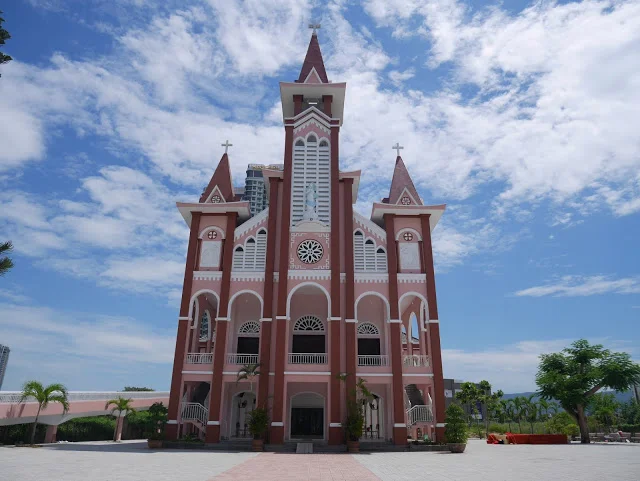
There is another pink church in Da Nang! Across the river, just past Vincom Plaza Shopping Mall you’ll find another pink church. Unfortunately, we were unable to find the name or information about this church. We actually stumbled upon it while searching for the Da Nang Cathedral (who knew that “the pink church” wouldn’t be specific enough?) It’s beautiful, and is open for visitors.
This pink church is located across the river from the cathedral, just past Vincom Plaza on the main road and along the river.
a beautiful pink church along the river in Da Nang, Vietnam
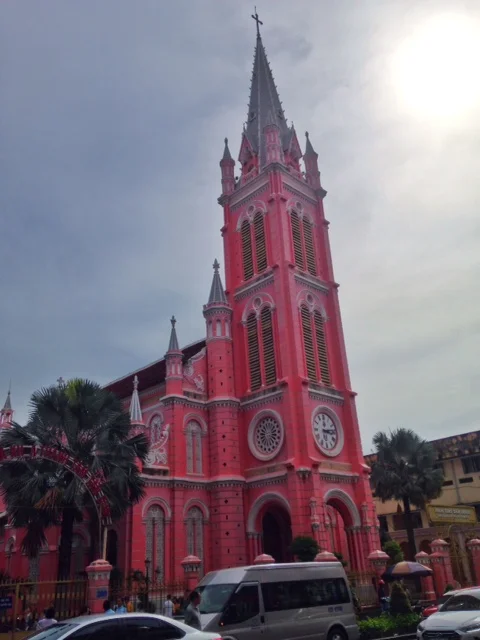
Tan Dinh Church in Saigon (Ho Chi Minh City)
Tan Dinh Church was by far the pink-est church we saw in Vietnam! This old church, a Saigon landmark, was built way back in 1874. It’s located in District 1, right in the heart of the city near a lot of the major tourist attractions. As a matter of fact, the church is something of a tourist attraction in and of itself! It’s always packed with visitors admiring the unique and outstanding color of this historic church building.
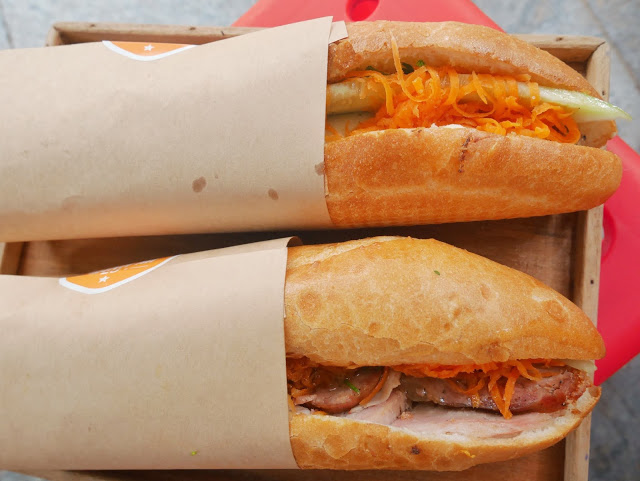
Banh Mi is a traditional Vietnamese food that you can find on just about every corner of Vietnam. Banh mi is a foot-long baguette stuffed with delicious ingredients. This popular lunch dish is a remnant of the influences of Vietnam’s colonial period, when the country was a constituent of French Indochina in the 19th and 20th centuries. Here in Vietnam, you’ll never go hungry, especially when there is a banh mi shop just around the corner!
Banh mi are usually stuffed full of all sorts of delicious ingredients – often pate, fried egg, barbecued pork, and lots and lots of fresh herbs and veggies, and drizzled in a chili sauce. You can always order a banh mi just the way you like it.
Where to find Banh Mi in Hanoi?
You can find Banh Mi (or “Banh My”, as it’s sometimes spelled) all throughout Hanoi. In fact, it would be difficult to find a street corner without a banh mi shop or two! Although this ubiquitous food is easy to find, we scoured the city’s Old Quarter around the Hoan Kiem Lake area to find some of the best and most delicious banh mi shops in all of Hanoi.
Some top banh mi shops in Hanoi’s Old Quarter (in no particular order)
1. Pate Banh Mi at phố cổ -11 Hàng Gà
A secret gem of the corner of 11th street:
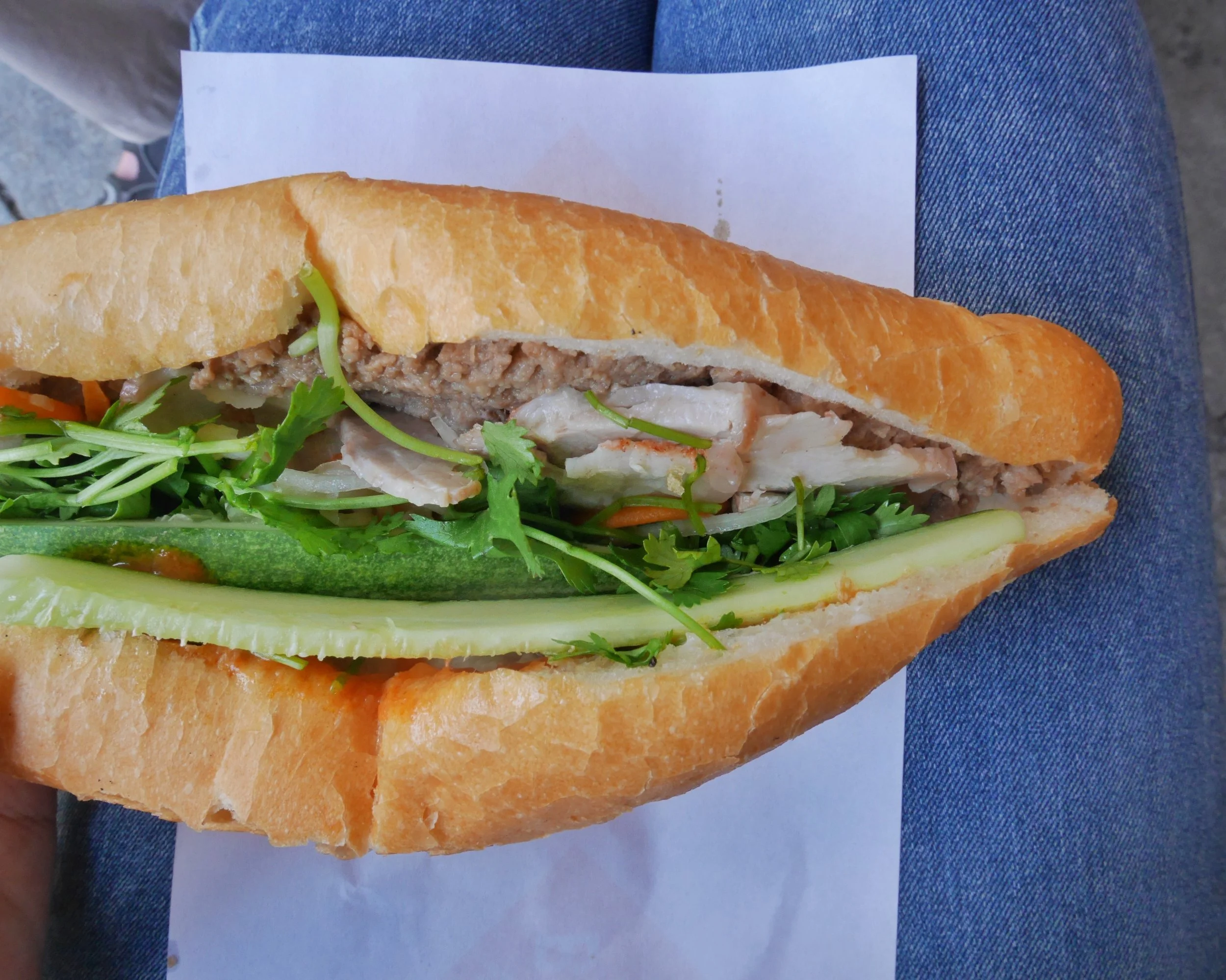
Bread roll with pate and BBQ pork
As I wandered around to find delicious banh mi, I stumbled on this place by accident. What makes it so special? This banh mi is stuffed with lots of good stuff. This fresh and crispy baguette is stuffed full with fatty BBQ pork, very rich patê, fresh veggies (cucumber, cilantro, raw papaya, and carrot) with additional chili sauce. If you can handle a little spice, I highly recommend you to say YES to the chili sauce! It’s not too spicy, TRUST ME 😉 and it gives the sandwich a delicious kick. I think this could be love at first bite!
This isn’t so much a restaurant as an open-air street-side shop. It’s located on the sidewalk at the corner of 11th street. So grab a tiny plastic stool, order an ice cold beer, and enjoy your delicious banh mi right on the side of the busy street!
Banh Mi with everything (pate, egg, fatty BBQ pork, and veggie)
Lots of fillings – the lady who makes the sandwiches stuffs them so full!
Lots of delicious and healthy veggies
Cheap price
Cool open-air location – eat like a local on a plastic stool outside of an old temple
One of the most famous and popular shops among tourists and locals:
Delicious Fresh and crispy at Banh Mi 25
So many reviewers wrote absolutely glowing reviews of Banh Mi 25. Some have gone as far as to say that it’s the best banh mi in all of Hanoi! I had to come for lunch myself to find out. Banh mi 25 offers so many different types of sandwiches, with an excellent selection of vegetarian options. The first banh mi that I ordered was a vegetarian sandwich: oyster mushroom with fired garlic. I also ordered one with honey chicken grilled.
This really is a wonderful restaurant, and they have lots of places to sit looking out over the busy street too. They give lots of ingredients stuffed in the bread, and of course big pieces too! They have a nice area to sit and sip some beers or juice. It’s very clean and open air. This place is very popular and can be quite busy during lunch time. Don’t be confused when you order; the shop has 2 sections across the street from one another. One side is the kitchen and cashier where you place your order and pay. You can order and take a seat in the area across the street. They will come serve you. After your meal, you have to cross the tiny road to pay at the cashier.
a bit more expensive than other banh mi shops, but totally worth the extra price
great atmosphere and comfortable seating
amazing vegetarian options – nearly half the menu is vegetarian
a great place to sit with a nice beer while enjoying your lunch
they give lots and lots of ingredients in the banh mi!
Delicious Banh Mi at Banh Mi 25, Hanoi Old Quarter
3. Banh Mi Lan Ong
Banh Mi Lan Ong Famous Pate Banh Mi
Banh Mi Lan Ong is a famous pate banh mi shop that is very close to Hoan Kiam Lake. I heard that they have been making fresh homemade patê every day in the traditional style for three generations! I ordered one of their famous banh mi pate. It’s their special family recipe, and it is wonderful! They add fried onion to the sandwich as an ingredients, and that’s just one thing that makes this banh mi different from other banh mi in Hanoi. Their savory and rich patê is stuffed together with pork, veggies, and ham. This shop is a nice restaurant with proper tables and chairs.
special homemade pate is made every morning with the secret family recipe
Grilled pork Banh Mi from Bread More, Old quarter of Hanoi
I visited Bread More for lunch. This is a trendy and modern shop with a great menu. I ordered one of their recommended grilled pork sandwiches, which surprisingly had a lot more than only grilled pork inside! This banh mi also came stuffed with omelette, pâté, lots of veggies (mostly carrot, raw papaya and cucumber), some sort of delicious peppery sauce, and mayonnaise. If you want, you can even add a few extra chilies to your sandwich for a bit of extra flavor and spice! The baguette was freshly baked out of the oven and served warm. In fact, they were still baking the bread when we walked in out of the rain!
As for the taste, it’s just perfect! The grilled pork came in big pieces (not too much fat), and all of the flavors are blended so well together that non overpowered any other. I really love the pepper sauce and veggies so much! Besides banh mi, they also sell milk tea! The shop is very close to Hoan Kiem Lake. They have seats and tiny tables inside for customers.
Of course, these are only just a few of the many incredible banh mi restaurants throughout Hanoi’s Old Quarter! Try a few for yourself! If you visit any other banh mi shops that you think are amazing, leave a comment!






















 LB convert