The first thing that you need to know is that ANY elephant in this part of the world that is being used for tourist rides, performances, or logging has been through a process called “phajaan” or “breaking”, and is exactly what it sounds like. It is usually inflicted on very young elephants who have been taken from their mothers. Elephants are beat from a very young age to break their spirit to make them docile and obedient.
Another thing to be aware of is that the seat and harness that many of the elephants are forced to wear is not only extremely painful for the elephant to wear, but also damages their spine over time. Also, the animals are kept chained when they are not being used, which leads to some very strange behaviors which are not seen in wild, free elephants. This is a syndrome called “zoochosis” and it’s just plain sad.
Please don’t ride the elephants
So when you are in Chiang Mai or Ayutthaya or Kanchanaburi (or anywhere, really), please don’t ride the elephants. Doing so is supporting and putting money into the pockets of people who inflict great cruelty on these beautiful animals for profit.
These organizations offer both one-day programs and overnight programs. They may be a bit expensive, but the price goes towards a very good cause: rescuing and rehabilitating previously abused elephants.
Read more! Another blogger’s thoughts on elephant welfare.
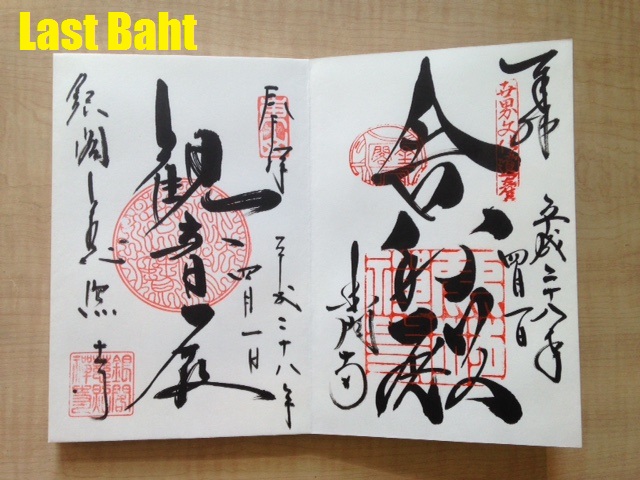
If you are traveling to Japan, one of the coolest souvenirs you can buy is a Goshuin-cho!
Goshuin-cho is a book for collecting the unique seal of each temple that you visit in Japan.
You can get books with plain covers, but it’s popular to buy a book with the cover depicting your first seal. The covers come in all sorts of colors and designs.
I picked up my first Goshuin-cho at Kiyomizu-dera Temple in Kyoto, Japan. The front cover shows the most famous view of the temple embossed in gold.
Because it’s a beautiful and unique way to preserve memories, I think it’s one of the greatest souvenirs you can bring back from a trip to Japan… besides a Tokyo Banana, of course!
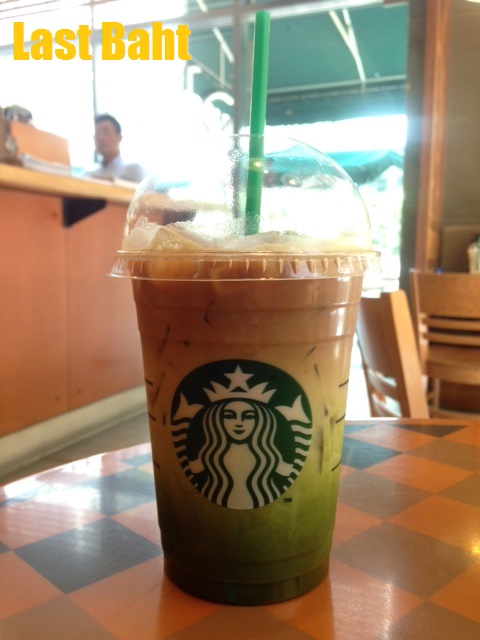
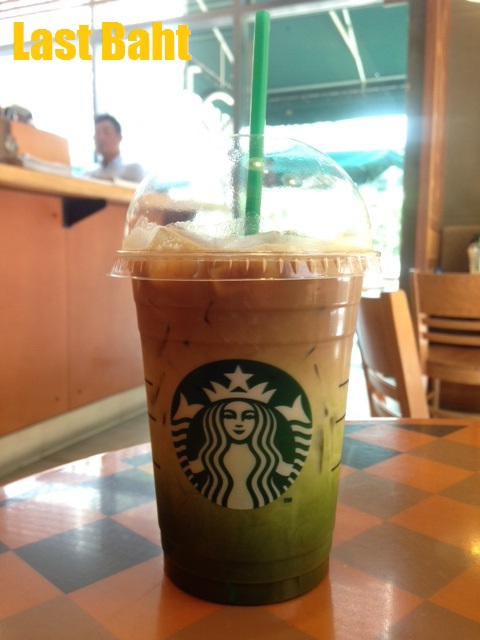
Starbucks has released a “new tea experience” with the recent launch of Teavana is Starbucks store locations throughout Asia.
One of the more intriguing new menu items is the “Espresso Matcha Fusion”, which is supposed to be a sort of blend between east and west.
So is the drink any good?
I think so! Especially if you like either tea or coffee. It’s a bit of an unusual flavor, but the sweetness of the matcha tea cancels out the bitterness of the expresso for a really nice, smooth flavor.
Available in hot or iced (but iced is best, in my opinion, for a hot afternoon in Thailand!)
Spend a weekend – or longer – in one of Thailand’s most scenic provinces, Kanchanaburi.
The province is probably most famous internationally as the site of the infamous “Burmese Death Railway”, built by the Imperial Japanese Army using Allied POW labor during the Second World War. This tragic period has been made famous thanks to films such as Bridge on the River Kwai starring Sir Alec Guinnes, and The Railway Man starring Colin Firth.
Getting there
Getting to Kanchanaburi from Bangkok is easy; it’s just a short ride west by bus, although by far the more atmospheric, scenic, and meaningful experience is to take the train, which still travels along the Death Railway itself.
Train
You can get to Kanchanaburi easily by bus, but going by train is an infinitely better experience. As the train leaves Bangkok and heads west, the city slowly gives way to villages and fields, which in turn give way to mountains and jungles as you get closer to Kanchanaburi.
See More from The Man in Seat 61
The journey from Bangkok to Kanchanaburi is one of the most atmospheric and enjoyable rail journeys in Thailand. As you ride along, spare a moment to think of the POWs who toiled building the first railway west through the country.
Bus
If you don’t like trains, or if you can’t make one of the departure times, you can easily reach Kanchanaburi by bus. It’s not nearly as fun, nor scenic, but it’s fast and easy.
Buses depart from Mo Chit Bus Terminal fairly frequently, and cost 100-200 baht, depending on class. The journey by bus takes around three hours.
Where to stay
There is no shortage of hostels and guesthouses in town.
Some of the best lodgings are found along the river! There are several “floatels” in Kanchanaburi, which are built on barges on the banks of the river. Facing west, you can watch the stunning views as the sun sets behind the river and mountains.
What to see and do
Bridge on the River Kwai
*novel or seen the 1957 *film starring Sir Alec Guinness, you’ll know the significance of this bridge. During the Second World War, Allied prisoners of war, mostly British, Australian, and Dutch, along with captured Asian laborers from Singapore, were forced under extremely brutal conditions to construct a railway across Thailand to Burma, which the Japanese occupied.
The bridge still stands, although two sections of it were destroyed in an Allied bombing during the war. Those two sections are constructed with straight spans, rather than curved, to differentiate between the original bridge and the sections that have been rebuilt.
Just on the other bank, across the bridge, is a Chinese temple. Feel free to explore.
Thai-Burma Railway Museum
Next to the cemetery in the town’s center, you’ll find the excellent Thailand-Burma Railway Museum. Entry costs 80 baht, and is well worth it.
The two-floor museum is full of interesting displays and artifacts from the workers on the Death Railway.
The second-floor has a small cafe and beautiful views looking out over the cemetery. Pay special attention to the magnificent stained-glass windows depicting the lives of the POWs and laborers on the railway.
It’s a somber experience, but something very much worth seeing.
Mueang Sing Historical Park
If you are more interested in ancient history, take a trip to the Prasat Mueang Sing Historical Park, about an hour outside of town. You can go by motorbike or hire a driver.
Admission costs 100 baht and goes towards maintaining and protecting the ancient ruins. As of now, visitors are still allowed to enter, climb on, and explore the ruins. Be respectful, especially in the central shrine area of the ruined temple, which still holds a statue where locals leave offerings and make prayers.
You can reach the park by motorbike or hire a driver. Alternately, you can catch a direct bus to the national park from Kanchaburi bus station. This is cheaper, but you will be constrained to the bus schedule. If you want to go early, stay late, or go at your own pace, it’s easiest to take your own transportation.
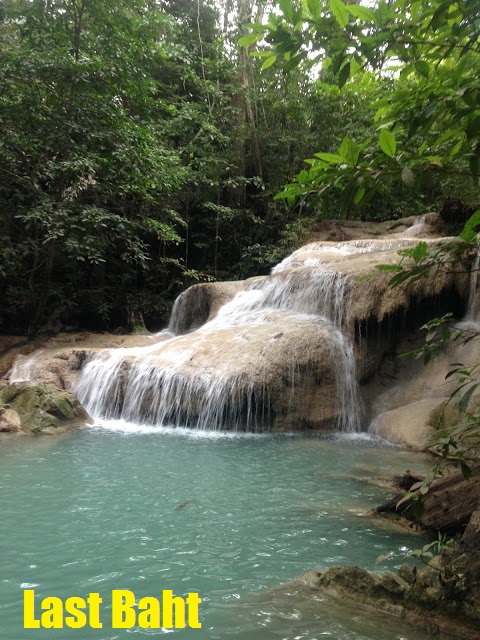
The best hike at the park is a trail that takes you past all seven tiers of the waterfall! The hike isn’t too hard, but takes 1-2 hours, depending on how long you stop at each tier. After the fifth tier, going gets a bit more tricky, but nothing too technical.
You can stop and swim at most of the clear, cool pools beneath each tier.
If you have time, it’s worth it to spend at least a day at Erawan. Besides the falls, there are plenty of hiking trails to explore.
You can buy water at the park. You can expect the weather to be generally warm and humid year-round. Bring a swimsuit and take a dip in the cold water beneath the falls!
You are free to walk along the tracks, but be careful! There is no railing!
Certain trains still run along this stretch of the railway.
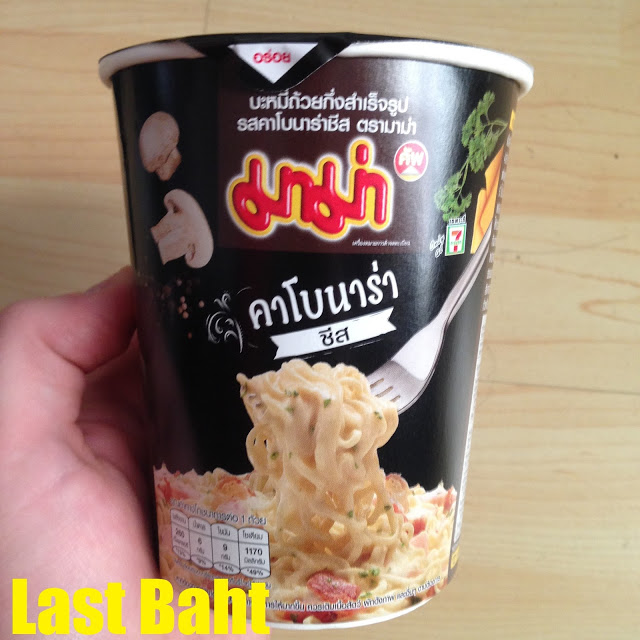
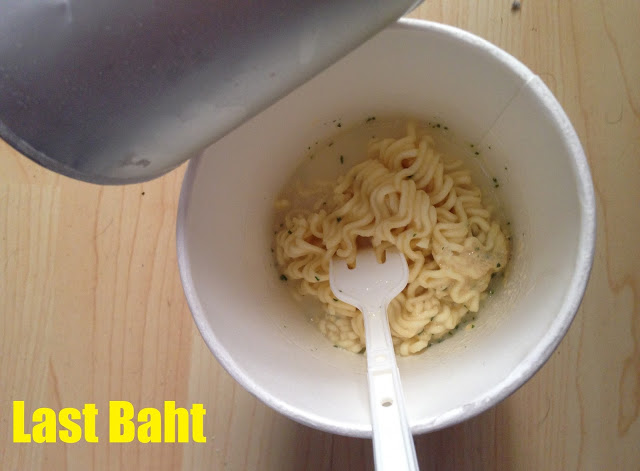
I picked up something new at the convenience store the other day!
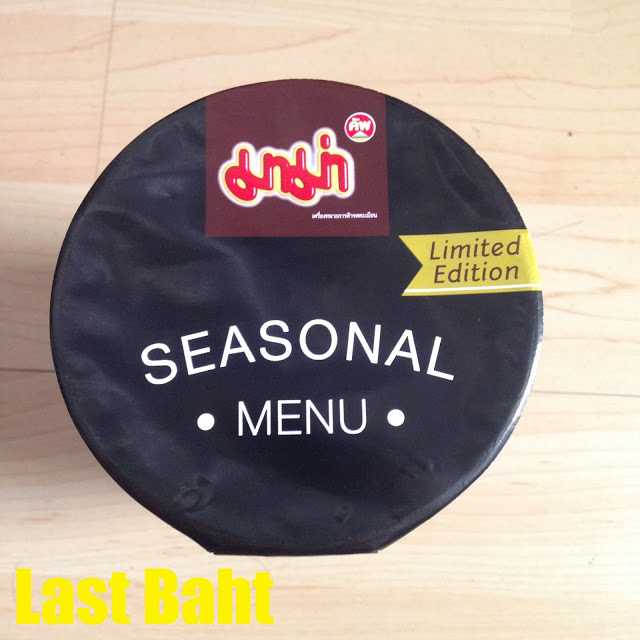
Apparently this is a limited edition seasonal menu. For… winter, I guess? Is spaghetti carbonara a winter food? Maybe…
So, does it taste like spaghetti carbonara? Well… not really. But it is cheesy and creamy and different from the usual selection of seafood/tom yum/spicy pork instant noodles usually available in Thailand. It’s not bad at all, actually kind of good, if only for a change. I would definitely have it again.
Mama Instant Cup Noodles Carbonara Cheese Flavor (Seasonal Menu) is available for a limited time at select 7-11 convenience stores in Thailand for 15 baht.
Introducing Last Baht Guides to Living and Working in Bangkok!
Guide #1 – Guide to Transportation in Bangkok 2017
How do I get to downtown Bangkok from the airport? How do I take a river
boat to the Grand Palace? How do I purchase a ticket or fare card for
the subway?
This guide book will answer all those questions and more!
Included
are sections on getting two and from BOTH of Bangkok’s international
airports, the different types of public transportation available and how
to use them, and a section all about how to take the city’s efficient
public transportation system to some of the biggest destinations in
Bangkok. Written by a long-term expatriate, this guide book shares
experience and knowledge all about how to navigate and get around the
Big Mango!
This book includes every stop on the BTS Silom Line, BTS Sukumvit Line, MRT Blue Line, and Airport Rail Link. It also includes information about several of the most important Chaophraya river boat piers, how to get to and from each of Bangkok’s two international airports, and a section all about how to reach some of the top destinations in the city.
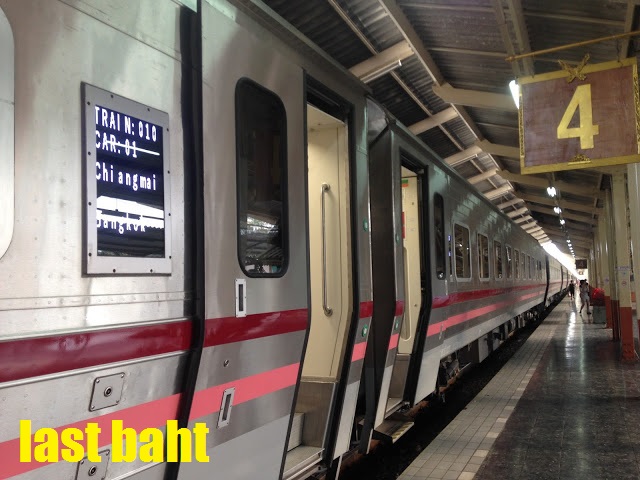
The Thai Ministry of Transportation and the State Railway of Thailand caused a lot of excitement with travelers recently when they unveiled their brand-new night trains, which started running between Bangkok and Chiang Mai last year.
What is is like taking the night train? What does it cost? How does it compare to the older trains that still run the southern route for now?
A second-class ticket gets you a comfortable seat which porters will fold into a bunk bed around 9pm. The loser bunk is a bit larger and more expensive, but is slightly more comfortable and comes with a view.
The upper bunk is a bit cheaper, more narrow, and lacks a view.
First-class is more expensive, but gets a private compartment with room service. The beds are larger and more comfortable, and the compartment has a sink.
The difference between the old and new trains is immediately noticeable.
Second-class feels much lighter and more spacious than on the old trains. Each seat comes with an electrical outlet and plenty of storage room for your luggage.
Unfortunately, we haven’t yet had the chance to experience a first-class compartment on these new trains.
What to Expect on a Thai Night Train
The trains are patrolled through the night by guards, and feel safe and comfortable. In second-class especially, there are lots of opportunities to make friends with fellow travelers. The dining car is a great place to meet new people!
The seats get turned down into bunks around 9:00pm, and turned back up around 8:00am, in time for breakfast and a cup of coffee.
It’s especially nice to have an electrical outlet at each bunk and free wifi provided on the train.
All in all, it’s generally a nicer experience than flying or taking a long-distance bus journey, and offers some of the best views of the countryside.
Cost
Tickets between Bangkok and Chiang Mai will cost the following:
First-class A/C Sleeper: 1,453 baht ($48) per person (sleeps two)
(Lower bunk) Second-class A/C Sleeper: 881 baht ($29) per person
Upper bunk costs approximately 100 baht less than the upper bunk. If available, the lower bunk is highly recommended for a more comfortable night’s sleep and much better view.
Michael’s family is in Thailand, and he convinces them to travel by night train to Chiang Mai, the kingdom’s great northern city. There’s only one problem… someone forgot to book the first-class tickets…
In this travelogue video we explore first and second-class on an OLD Thai night train, visit Chiang Mai’s sacred mountain, and walk the historic old town.
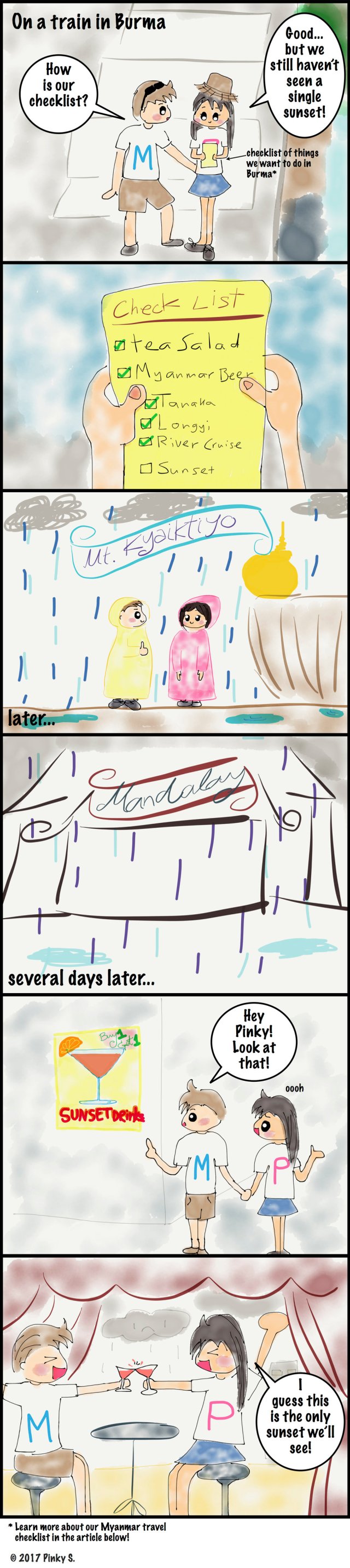
Before we travel, we always research and create a list of the top experiences we want to have wherever we are! This gives us a challenge to do as much as possible on our adventures.
*Our list for Burma included:
Tea Salad – Burma is one of the only countries in the world that consumes the whole tea leaf! (It was a little bit sour, but very good)
Myanmar Beer – we especially wanted to have a pint at the world-famous Strand Hotel in Yangon
Wear Tanaka – this is a sandalwood paste that is popular in Burma. People wear it on their cheeks to act as a cosmetic, insect repellent, and sunblock
Wear a Longyi – a longyi is the national outfit of Myanmar. It’s a skirt-like article of clothing that both men and women wear daily. It’s much more common than pants. It’s nearly always required to wear one when visiting a temple.
Cruise down the Irawaddy – take a relaxing day-long cruise from Mandalay to Bagan down the slow muddy waters of the famous Irawaddy River
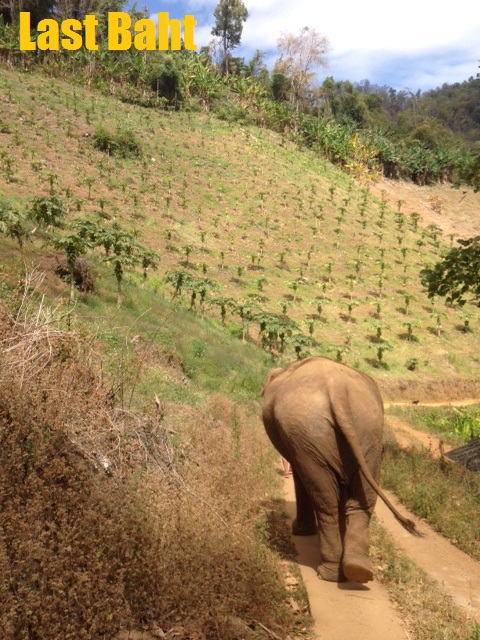

 Elephant Nature Park and BEES (Burm and Emily’s Elephant Sanctuary), both near Chiang Mai, are safe to visit. Also Elephant’s World in Kanchanaburi Province runs an excellent elephant rescue center, and the location is quite beautiful as well.
 Read more! Another blogger’s thoughts on elephant welfare.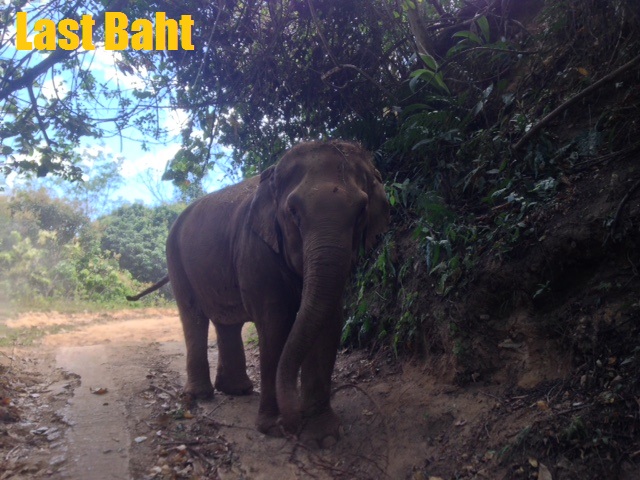



 See More from The Man in Seat 61
 *novel or seen the 1957





 Visit some amazing and historical temples

 LB convert