While Thailand may have a very open and relaxed attitude towards drinking alcohol, many foreign tourists are surprised to learn that the country has strict restrictions on when alcohol can be sold and served. Alcohol is only legally able to be sold during certain hours of the day, and there are several days per year when the sale of alcohol is restricted entirely.
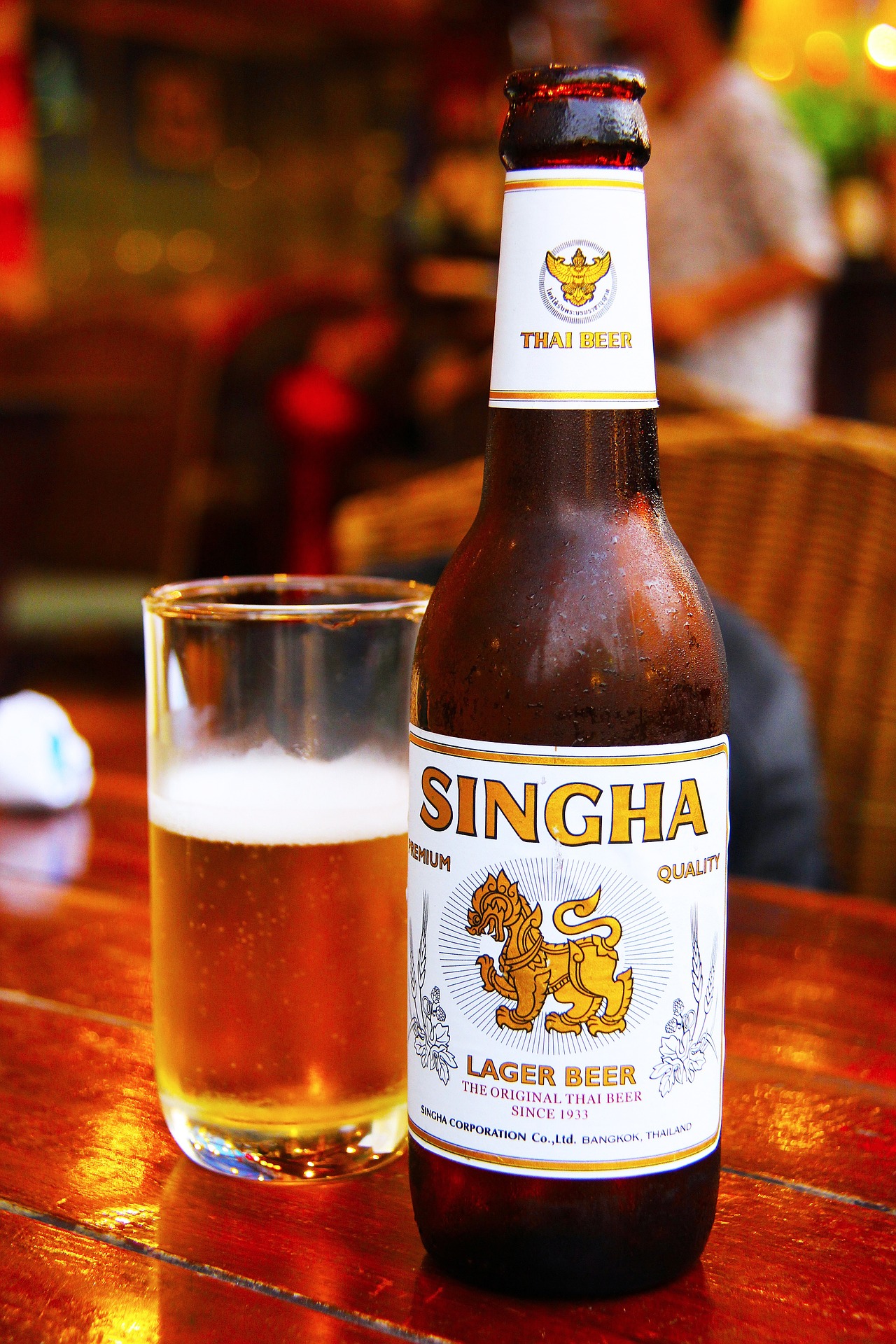
a bottle of Singha Beer in Thailand; alcohol can only be served during certain times of the day
When can I buy beer during the day?
Alcohol sales in Thailand, whether at a bar or restaurant, supermarket, or minimart, are only permitted between 11:00 to 14:00 and from 17:00 to midnight.
Selling alcohol outside of these permitted times can land vendors in hot water. If you’re like me and would love to enjoy a cold beer after work around 16:00, you are out of luck! You’ll just have to wait an hour.
a notification of alcohol restrictions in Thailand
When are alcohol sales in Thailand restricted?
Alcohol cannot be sold at convenience stores, supermarkets, bars, or restaurants (i.e. anywhere) on certain days in the Thai calendar. Alcohol sales are banned completely on a number of religious and national holidays, and during national elections.
Alcohol sales are restricted on royal holidays in Thailand:
28 July – the birthday of HM King Rama X
12 August – the birthday of HM Queen Sirikit
13 October – the date of the passing of HM King Rama IX
5 December – the birthday of HM the late King Rama IX
Alcohol sales are restricted on Buddhist religious festival days in Thailand:
Makha Bucha Day (lunar; February or March)
Visakha Bucha Day (lunar; May or June)
Asahna Bucha Day (lunar; July or August)
Khao Phansa – the beginning of Buddhist Lent (lunar; July or August)
Awk Phansa – the last day of Buddhist Lent (lunar; October)
Alcohol sales are also restricted on:
The days leading up to national elections
Certain other national days at the government’s discretion
This information is always posted in advance, so just plan well, and make sure to keep a few cold beers in your fridge for these days!
Which casinos in Macau to visit and what to see there
What do you picture when you think of Macau? Do you think of the city’s amazing museums, historical Portuguese colonial architecture, or delicious food? Probably not. While Macau has all of those that and more, chances are that you you think of Macau, you think of casinos… and for good reason! Macau is home to some of the biggest, most luxurious, and most impressive casinos anywhere in the world.
The Golden Lotus is the symbol of Macau Special Administrative Region
Even if you aren’t a big spender and don’t feel like trying your luck at the casinos, it can still be well worth your time to spend a day (or two!) touring around the casinos. Macau’s casinos offers a very different look at the city than anything else you’ll see, and are probably the most impressive and iconic part of the city.
If you don’t have time to visit every casino in Macau, try to visit at least a few of the ones listed here. These are the casinos that have the most to offer a visitor (even if you don’t want to gamble). These casinos have exciting attractions for tourists, amazing sights to see, and impressive collections to wonder at.
Macau is the ONLY place in China where gambling is legal, and the casinos are the Special Administrative Region’s biggest moneymaker, drawing millions of tourists and billions of dollars every year. In fact, since 2007, Macau has passed Las Vegas in casino revenue!
How to get around the casinos in Macau – the FREE Macau Casino Shuttle
There is a free shuttle bus that runs between the airport, ferry terminal, and casinos in Macau. This service is operated by the casinos and is complimentary for use by anyone. You can catch the shuttle outside of any major casino, or ask at the front desk for help. While it is possible to walk from casino to casino (I did this), it’s much easier and more relaxing to ride the free bus from place to place.
Grand Lisboa – home of the ACTUAL Dragon Throne
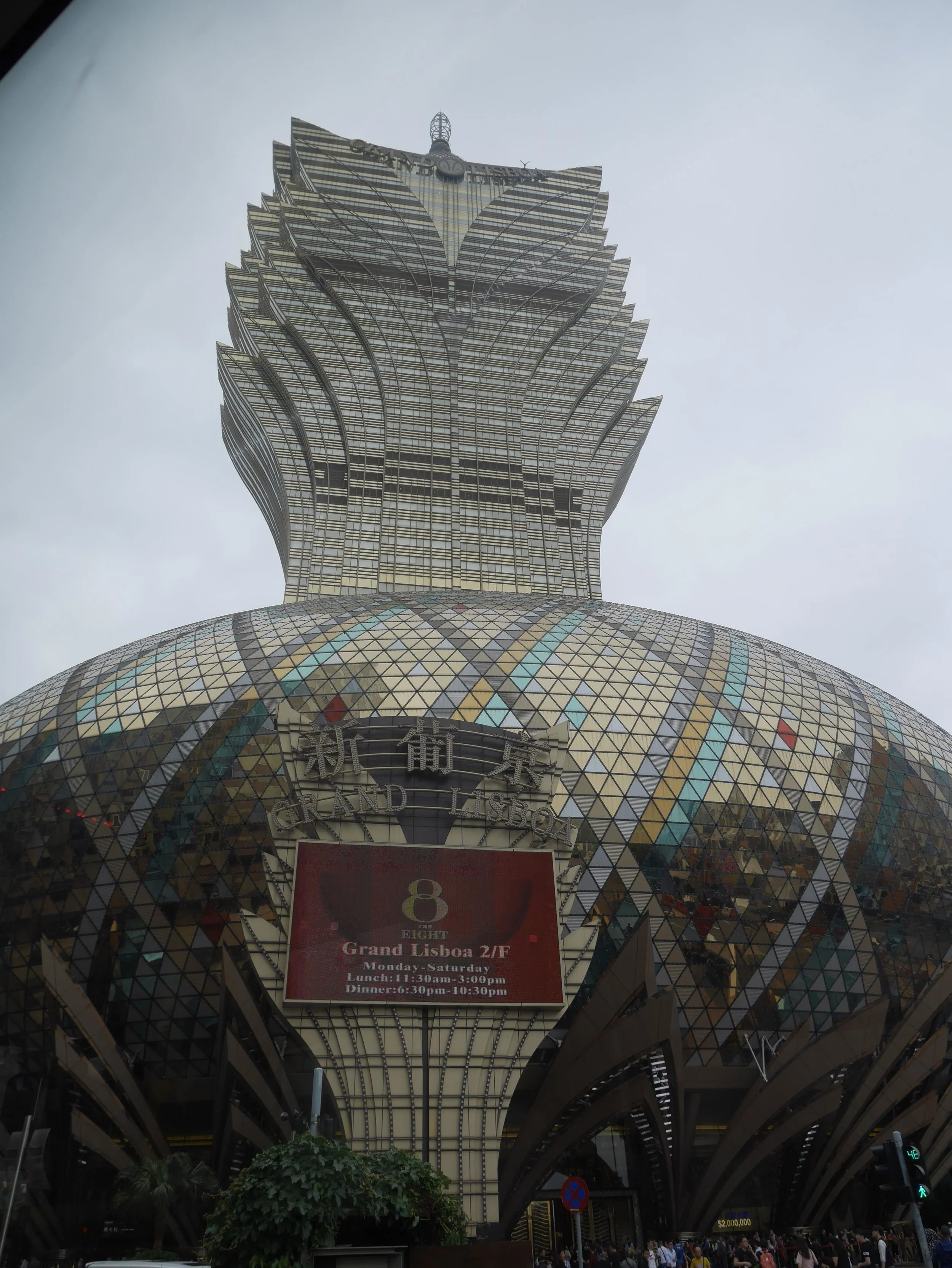
The Grand Lisboa is the tallest building in Macau
The hotel tower at the Grand Lisboa is not only the tallest building in all of Macau, it’s also one of the most impressive casinos in the city. The Grand Lisboa is a very distinctive part of Macau’s skyline, and can be seen from all over the peninsula.
While the hotel and casino is massively impressive on its own, it’s worth visiting for the art collection in the lobby alone. The Grand Lisboa has an amazing display of priceless treasures that can be seen for free just by walking through the hotel’s lobby.
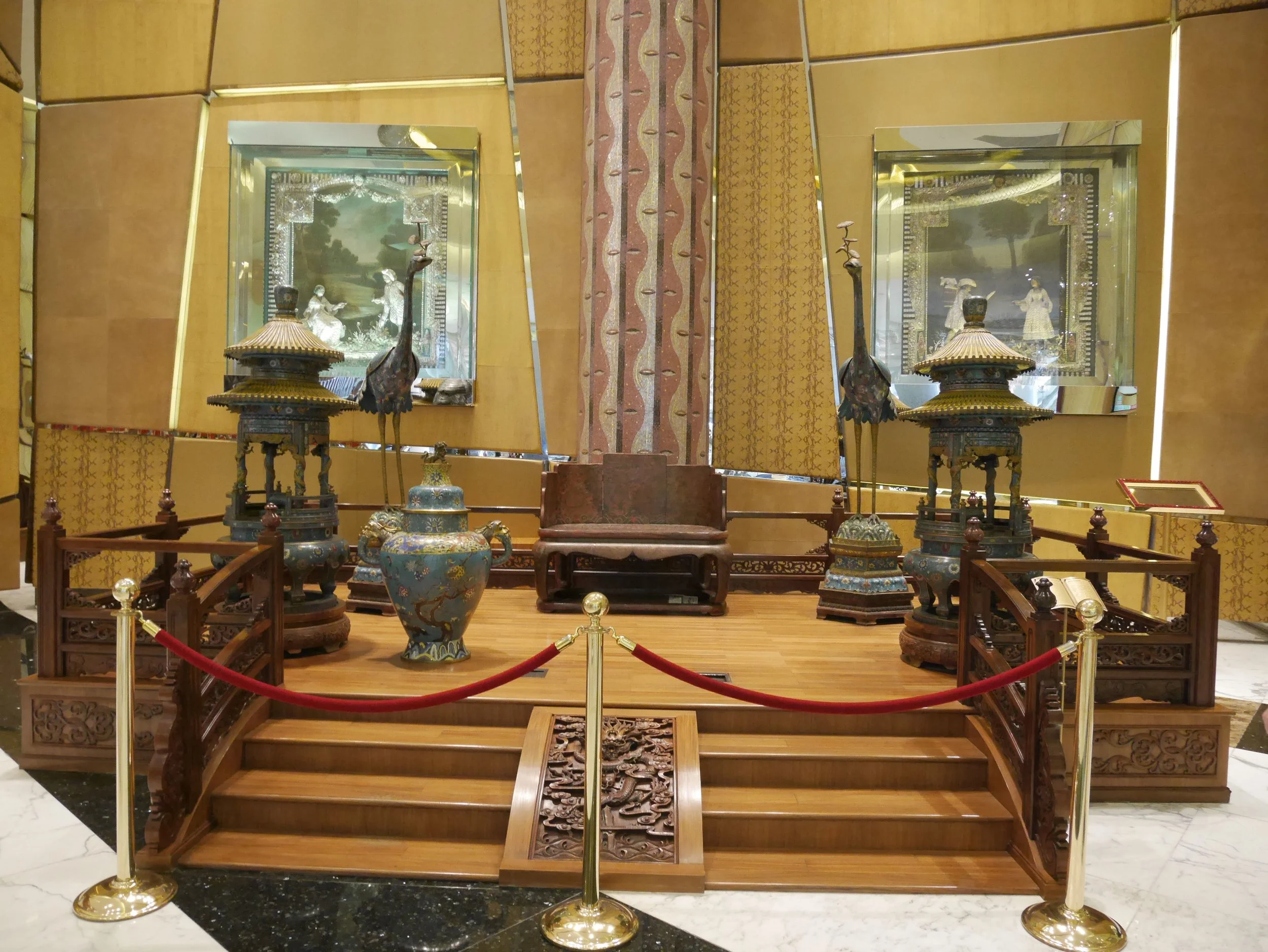
Take, for instance, the Dragon Throne. The real, actual, honest-to-God Dragon Throne where the last emperors of China once sat.
The Dragon Throne of the Chinese Emperors is on display in the lobby of the Grand Lisboa Macau.
The lobby also displays the fossilized tusk of a woolly mammoth which has been carved into an intricate and delicate representation of the Great Wall of China.
The tusk of a woolly mammoth is carved with a highly detailed depiction of the Great Wall of China – found in the lobby of the Grand Lisboa Macau.
The Grand Lisboa also features one of the world’s largest diamonds, and the wine list at the hotel features nearly 15,000 wines! In short, everything about the Grand Lisboa is pure luxury.
Even if you can’t afford to stay at the Grand Lisboa, you can always explore the lobby, or have a cup of tea at one of the hotel’s cafes. The Grand Lisboa is located on the southern tip of the Macau Peninsula, and is easily reached from all parts of the city.
Galaxy – get lost here for HOURS
Galaxy Macau
I’m not joking, I actually got lost inside this mega hotel and casino! Galaxy Macau is actually five different hotels connected together into one massive resort compound. The interior contains one of Macau’s most popular shopping malls; it’s where expats like to go to do a lot of their shopping.
the exterior of the Galaxy Macau hotel and casino
The interior is impressive, but it’s the scale of Galaxy that really stuns me. The hotels have a combined 2,200 rooms, and the mall boasts 50 different retailers. Galaxy even has an artificial beach and wave pool for guests staying at the resort.
interior fountain at the Galaxy Macau hotel and casino
The Parisian Macau – go ice skating atop the Eiffel Tower
The Parisian is one of Macau’s newer casinos, but it is already on its way to becoming a landmark and icon of the city. This casino and hotel, which opened in 2016, is designed to remind visitors of the City of Lights.
Parisian Macau domed roof above the lobby
Walking through the halls of the Parisian actually does feel like being outside on a city street. Occasionally, the “sky”, which normally looks like a clear, early evening, lights up in loud and brightly colored videos advertising the various shows and attractions at the casino. This in itself is quite a spectacle!
areas inside the Parisian Macau are designed to look like the streets of a French village
If you find yourself becoming tired or hungry after walking around all of the casinos you’ve visited, the Parisian has an excellent and reasonably-priced food court. You can buy a variety of western and Cantonese dishes, mainly fast food and noodle options. Pull up a seat, order a bowl of noodles, and wash it all down with a bottle of crisp Macau Beer Golden Ale!
the food court at the Parisian Macau
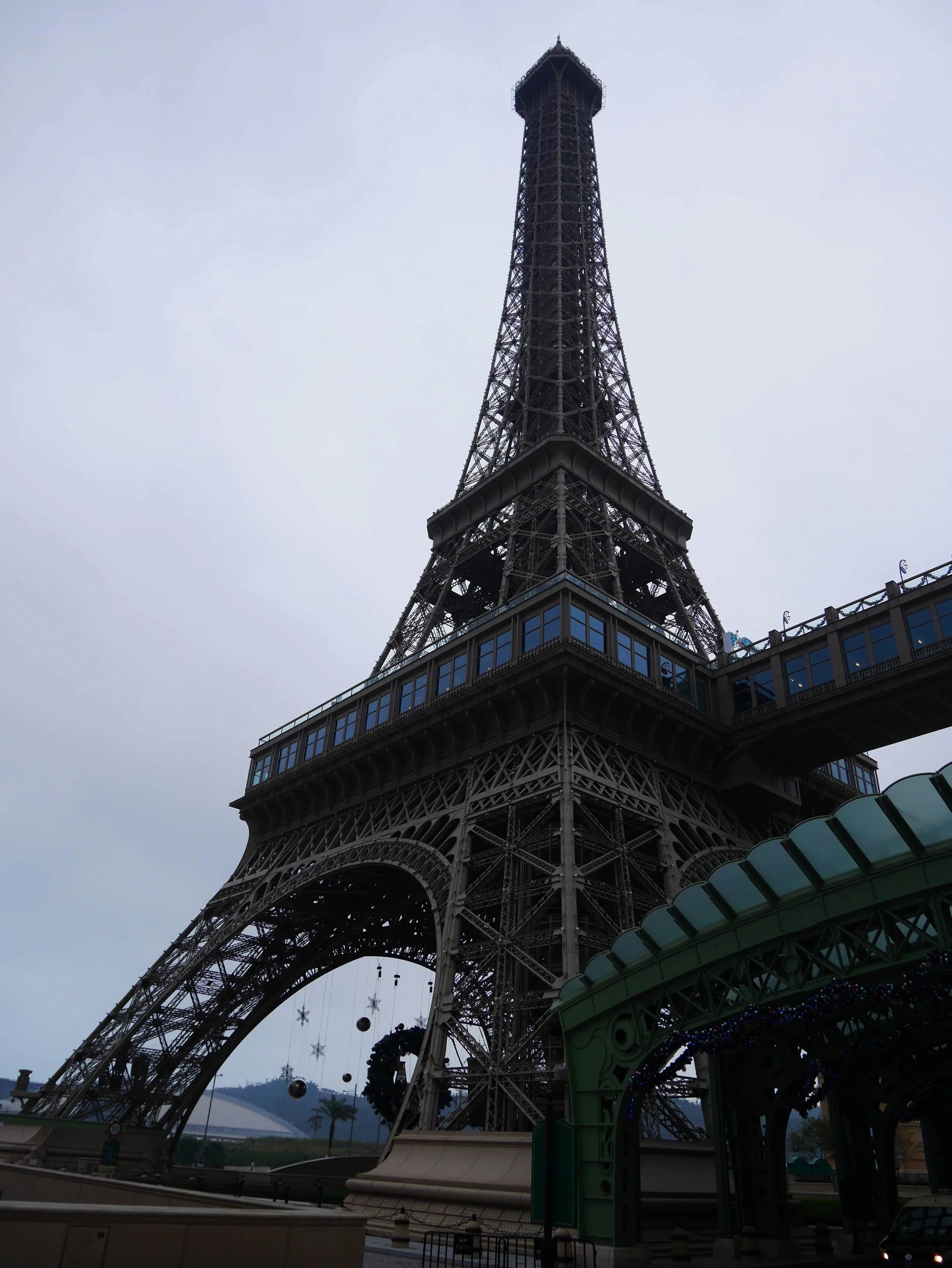
The main feature and attraction at the Parisian, however, is the half-scale replica of the Eiffel Tower. Like the real Eiffel Tower in Paris, visitors can purchase a ticket to ride an elevator to the top, from where they are treated to amazing neon views of the Cotai casino strip.
Although it’s not free to go up the Eiffel Tower, it’s definitely worth it if you want to get amazing views across Cotai. There are two observation decks, on the seventh and thirty-seventh floors, and during the winter, the seventh floor is transformed into an ice skating rink!
the half-scale Eiffel Tower at the Parisian Macau
The Venetian Macau – ride a gondola along the canals of Venice
the interior and lobby at the Venetian Macau
Our last casino to recommend is the Venetian, an icon in Macau in its own right. The Venetian is the largest casino in the world and the largest hotel in all of Asia! The Venetian has one of the most stunningly beautiful building interiors that I’ve ever seen. Spend some time wandering around the lobby area before heading to…
inside the Venetian Macau
…the canals of Venice!
The Venetian has three canals: the San Luca Canal, the Marco Polo Canal, and the Grand Canal. Each canal runs through a luxury shopping mall and dining area.
there are many shops and restaurants at the canal area of the Venetian Macau
After you are through shopping, why not hire a singing gondolier to give you a tour of the canal? It’s just like you are actually in Venice!
gondolas are available to hire for rides at the Venetian Macau
The casinos in Macau are amazing, and are undoubtedly a highlight of any visit to the city. In fact, visiting Macau just wouldn’t feel complete without spending a day at least touring the city’s most iconic casinos. However, the city has a ton more to offer that visitors often overlook, especially when it comes to museums, history, and culture. You might be interested in a few of my other posts where I write about some of the less-known treasures in Macau.
When you are traveling, you should always be prepared for an emergency. If you get bit by a dog, monkey, or other animal, you should immediately begin treatment with the rabies vaccination. If you receive a cut, puncture, or other injury, you might need to get a tetanus booster.
When you are in another country where you don’t speak the language, it can be hard to know where to go or what to do. This can cause a lot of stress and worry, and can even ruin a good trip.
If you are in Cambodia and you need emergency vaccination, here’s what you need to do:
Pasteur Institute, Phnom Penh, Cambodia – where to get vaccines and medical treatment
When I needed an emergency vaccination, I did a lot of research. I was just traveling in Phnom Penh for a short time and didn’t know the city very well. I didn’t know where the hospitals were, how good they were, and if anyone would be able to speak English. In short, I was stressed, panicked, and worried.
But when I found the Pasteur Institute, I immediately felt better. Here was a clean, bright, efficient, western-style clinic with very professional doctors. I was seen by a doctor almost as soon as I arrived. The doctors can speak Khmer and French, and most can speak some English. I was able to explain what I needed, and the doctor was immediately able to send me to the next room to receive my jabs.
inside the Pasteur Institute clinic in Phnom Penh, Cambodia
I was given my shot and an international vaccination card, and was out the door again just $34 and 45 minutes later. I was so impressed with the efficiency and comfort of the Pasteur Institute. While it definitely caters to international tourists and expats, the institute has a mission of eradicating rabies and other tropical viruses in Cambodia.
The clinic is open on weekdays from 7:00 – 17:00; on Saturdays from 7:00 – 11:30; and is closed on Sundays.
Western-trained doctors can speak Khmer and French, and some English. The clinic maintains international standards, and can issue internationally-recognized and accepted vaccination cards.
Vaccines and treatment are reasonably-priced.
The clinic is very efficient, and you will rarely have to wait.
Remember, nothing is more important than your health. If you get bit by an animal or injured, you should seek medical treatment immediately!
Milk Tea is as “Hong Kong” as noodles and dim sum. This popular beverage is drank and enjoyed throughout the day and night, and Hong Kong residents drink over 900 million cups of Hong Kong Milk Tea every year! Like the culture of the city itself, Hong Kong Milk Tea evolved as a fusion between traditional Chinese culture and its British colonial influence.
Traditionally, Hong Kong Milk Tea is served at the city’s traditional tea houses and 24-hour diners, served in small ceramic cups of strong Ceylon tea and evaporated milk. The drink is almost always served hot and unsweetened, but customers can add sugar to taste. The key criteria to high-quality Hong Kong Milk Tea is its smoothness; real traditional milk tea should be smooth, rich, and creamy.
a more traditional cup of Hong Kong Milk Tea served at Tsui Wah Restaurant in Kowloon, Hong Kong
When I first moved to Asia over six years ago, I made a promise to myself not to eat any American fast food for the year. After I extended my contract and decided to move to Bangkok permanently, I relaxed my rule a little bit. Even though I eat it rarely, if ever, I have to admit that I actually really like fast food.
Now, when I travel to a new country, I sometimes make a compromise. Every country has some very unique menu items that can’t be found anywhere else in the world. Whenever I’m in a new country, I like to see what the local McDonald’s restaurants have to offer.
I really love tea, so how could I pass up the chance to sample and review a cup of Hong Kong Milk Tea from McDonald’s?? I found this while waiting for my flight at the Hong Kong Airport, however it’s available at all McDonald’s throughout the city.
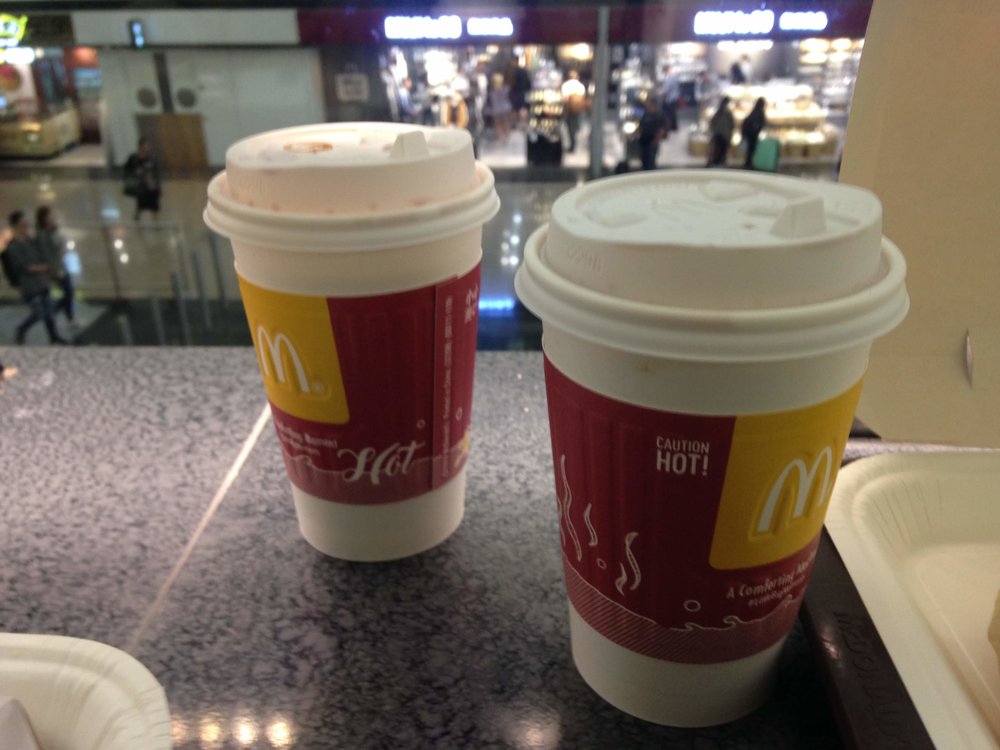
local milk tea from McDonald’s Hong Kong at Hong Kong International Airport
A cup of local milk tea from a McDonald’s in Hong Kong costs $16 HKD (small) or $17.50 HKD (large).
I may not be an expert, but I do drink a lot of milk tea. In my opinion, the local milk tea served at McDonald’s is really very good!
The local milk tea is made with the traditional 100% black Ceylon tea and unsweetened milk. I always add a little bit of sugar to my milk tea, but that’s just my personal preference. The milk tea at McDonald’s may be a little less creamy than you might find at a more local tea shop, but it’s still rich and very tasty.
Especially on a rainy morning, or late at night, this tea really does the trick. Highly recommended!
hot Hong Kong Milk Tea ordered from McDonald’s Hong Kong
Rather than relying on taxis or tuk-tuks to get around Bangkok, you can save money and lots of time by avoiding traffic and traveling on the BTS Skytrain, which travels on an elevated rail across the busiest and most popular parts of the city.
The Skytrain is fast, modern, comfortable, and air-conditioned, and is a cheap and quick way to cross the city to wherever you want to go. Here’s everything you need to know about riding the BTS Skytrain in Bangkok, including new rules about how to register a BTS Rabbit Card.
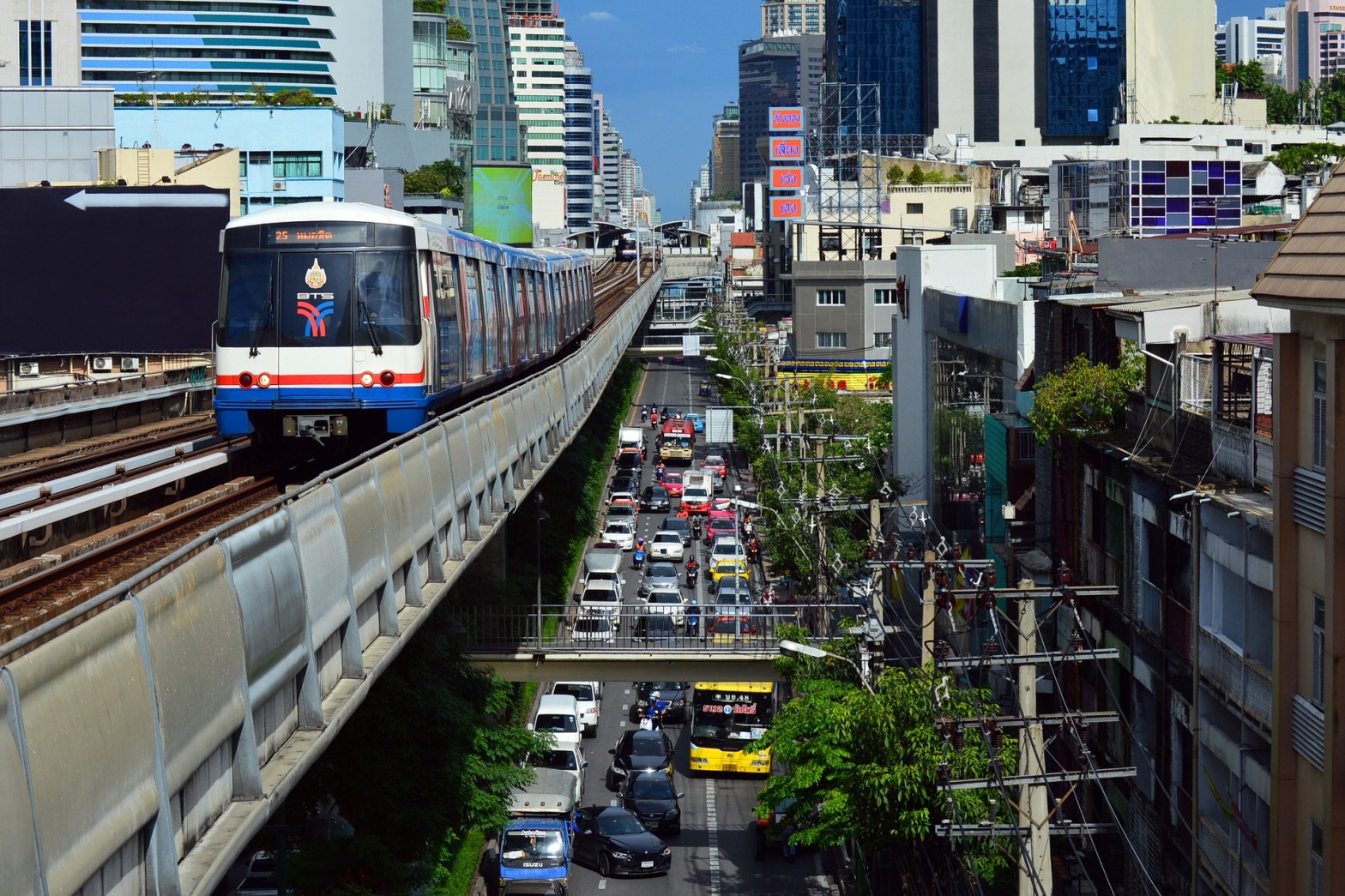
The Bangkok BTS Skytrain in downtown Bangkok, Thailand
Where does the Bangkok Skytrain go?
The Bangkok Mass Transit System, usually referred to as the “BTS” or the “Skytrain” is the city’s elevated rail network. It currently has two lines: Light Green and Dark Green, although more are in various stages of planning and construction. Why they couldn’t have chosen a slightly less confusing way to color the two lines, I have no idea, but most people simply refer to them as the Sukhumvit Line and the Silom Line respectively.
The Sukumvit (Light Green) Line runs between Mo Chit Terminal (in Chatuchak District) and Kheka Station (in Samut Prakan), spanning some 37 kilometers. Many of the busiest areas of the city are located along this line.
The Silom (Dark Green) Line is shorter, and runs 14 kilometers between National Stadium Terminal and Bang Wa Station. This line crosses the Chaophraya River into Thonburi, and is the easiest way to access the river boats and old town.
Transferring from the Skytrain to the Subway (MRT)
The two Skytrain lines cross at Siam (Central) Station.
The Sukumvit Line meets the MRT Subway at Mo Chit Terminal Station and Asok Station.
The Silom Line meets the MRT Subway at Sala Daeng Station.
Unfortunately, the BTS and MRT have never been able to come to an agreement regarding fare cards. As such, the two companies utilize entirely different ticketing systems. If you want to transfer between the BTS and MRT, you will need to purchase a separate ticket, or use a different fare card (MRT tickets and fare cards are available inside the subway stations).
How much does it cost to ride the Bangkok Skytrain?
A single journey ticket can be purchased at the ticketing counter or the ticket machine inside the Skytrain station. The cost of the ticket is dependent upon the destination and how many stops the user will be traveling. Fare starts at THB 16 for one stop and goes up to THB 44.
Buying a ticket for the BTS Skytrain
You can purchase a single-use ticket from the machine just before the ticket gates. Please note that these machines ONLY accept 10 baht coins. You can make change from the employee at the ticket booth.
Next to the machine is a map displaying each station and the fare from where you are to that station. Select the fare amount and receive a paper ticket.
To use the ticket, insert it into the ticket gate. When it pops back up the top, retrieve the ticket, and the gate will open. At your destination, insert the ticket into the ticket gate in the same way. The gates will open, but the machine will reserve your ticket.
Examples of various types of BTS Skytrain cards – Rabbit Card and One-Day Pass
Bangkok Skytrain Card (Rabbit Card): re-usable fare card
The BTS fare card is called a “Rabbit Card”. There are three types: a regular (orange) card, a senior (purple) card, and a student (green) card. The senior and student cards receive a slight discount on fare.
Each trip will cost you a certain amount of money, depending on the distance. When your card is empty, you can “top it up” by bringing the card and a 100 baht note (or however much you would like to load onto the card) to the ticket agent. The card belongs to you, and you can continue topping it up and using it indefinitely.
The Rabbit Card can also be used like a pre-loaded debit card to make purchases at various shops and restaurants (7-11, Starbucks, McDonalds, etc) throughout Bangkok.
It costs THB 200 to purchase a new Rabbit Card. This comes with THB 100 of stored value that you can top-up and re-load at any BTS station. The minimum amount to re-load onto the card is THB 100. When you use a Rabbit Card, ever trip will automatically deduct the fare from your card. Using a Rabbit Card will save you time and money instead of buying a one-way ticket each trip.
Additionally, instead of adding cash to your card to be deducted as fare, you can purchase a number of trips (15 trips starting at THB 465).
UPDATED 2019: As of February 2019, all Rabbit Cards must be registered before use. In order to register a BTS card, you must have your Thai national ID card or passport. (See more below)
Buying a day pass or Rabbit Card
If you are staying in Bangkok for a short time, you may wish to purchase a one-day pass instead of a Rabbit Card or a single-use ticket.
One day passes, which are valid for unlimited trips on any BTS line until midnight on the day of purchase, cost THB 140.
New rules about registering a Skytrain (Rabbit) Card
As of February 2019, all Rabbit Cards must be registered in order to add value to the cards. This is a one-time process, and can be done by presenting your Rabbit Card along with your Thai National ID Card or passport at the BTS ticketing office. The process takes a few minutes.
Once your Rabbit Card is registered, you may continue to use it as usual.
This does not only apply to newly-purchased cards, although from now on, everybody must present his or her ID card or passport to purchase a new Rabbit Card.
Even old Rabbit Cards must now be registered in order to continue using it.
Macau, often overshadowed by neighboring Hong Kong, is almost exclusively known by foreigners for its glamorous five-star casinos. While visiting the casinos can be a fun experience while traveling in Macau, China’s tiny Special Administrative Region has a ton of culture and history to offer to interested visitors as well.
There are dozens of cool museums to visit in Macau, and I tried to visit as many of them as I could (because I’m a huge museum nerd). In this post, I want to share with you some of the most interesting museums (in my opinion) that will give a visitor a really great look at the both the history and culture of Macau.
Macau Museum at Monte Forte
The entrance to the Macau Museum
If you only have time for one museum in Macau, be sure not to miss the fantastic Macau Museum, located at the top of Fortress Hill (Monte Forte) next to the Ruins of St. Paul’s in the city’s old town area.
This museum is dedicated to showing the history of Macau, from its ancient past to the Portuguese colonial era to Macau’s current status as a Special Administrative Region in China.
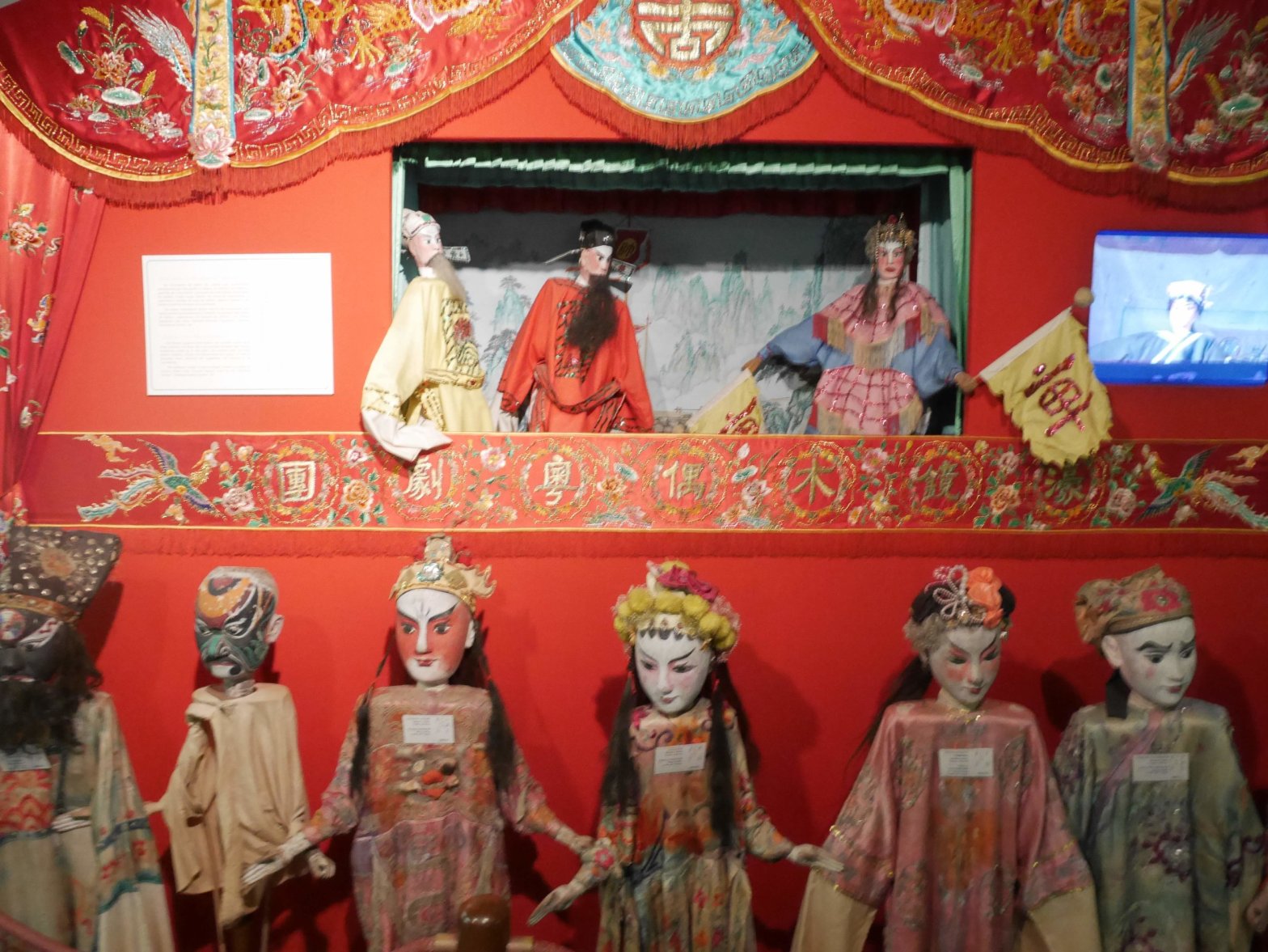
Chinese puppets on display inside the Macau Museum
Even more than learning about history, here at the Macau Museum, visitors can receive an in-depth introduction to Macau’s culture, which is a rich blend of Chinese and European customs and influences.
Exhibits are presented in Chinese, Portuguese, and English, and admission to the museum is free every Tuesday! After visiting the museum, be sure to take the escalator from the museum ticketing area to the top of the fortress hill for excellent views across the Macau Peninsula.
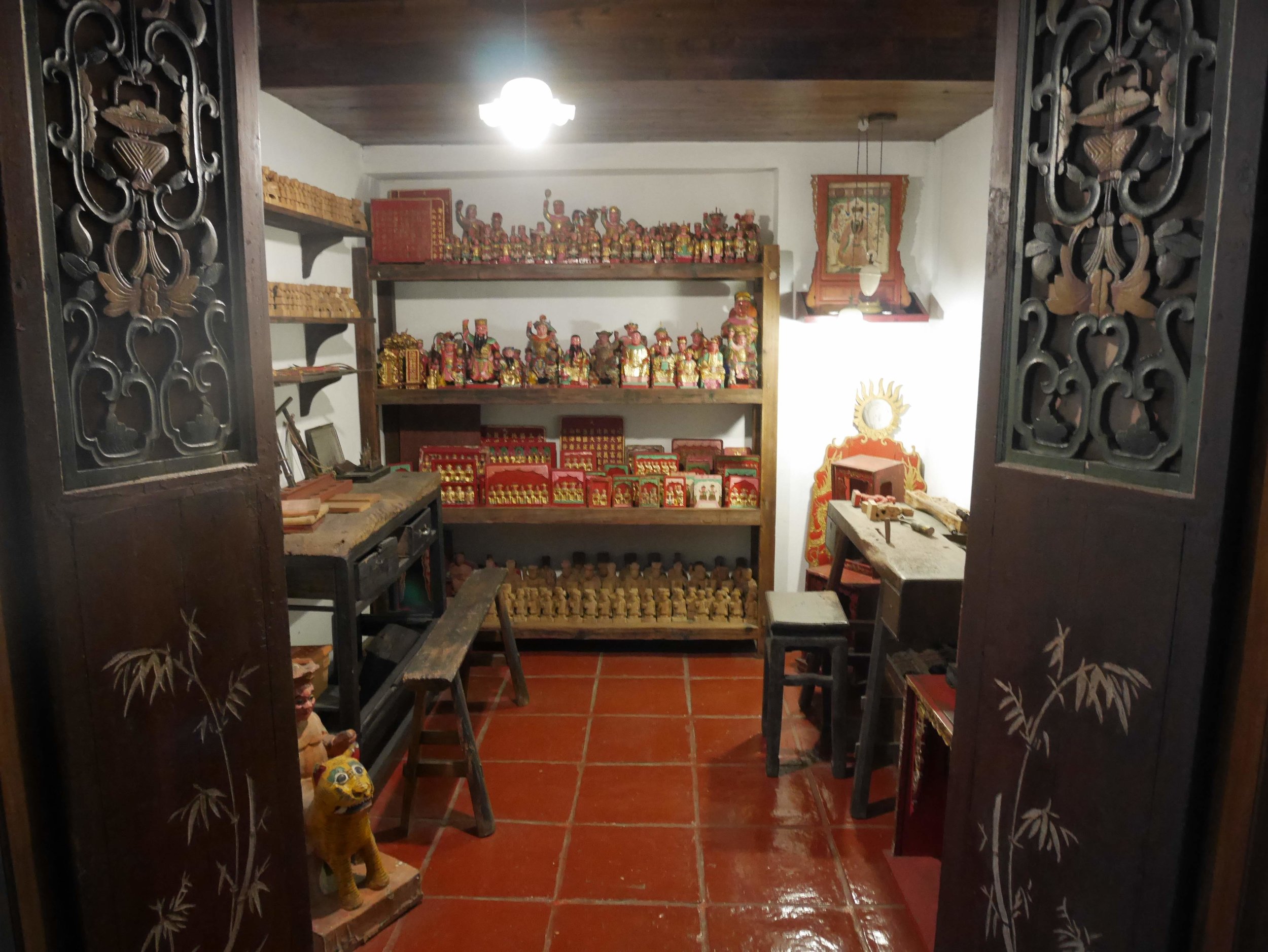
an exhibition display inside the Macau Museum about traditional shop houses
Opening Hours
The museum is open from 10:00 – 18:00. The last admission to the museum is at 17:30.
The Macau Museum is closed on Mondays.
Admission
Admission to the Macau Museum is 15 MOP/HKD.
The Macau Museum offers FREE admission every Tuesday, the 15th of every month, and on certain national holidays.
Location
The Macau Museum is located on Monte Forte Hill near the Ruins of St. Paul’s and right in the center of the old town.
The museum’s address is 112 Praceta do Museu de Macau, Macau
Macau has a deep maritime history. During the colonial era, Macau was the headquarters and most important port for the cultural and economic spread of the Portuguese Empire. Even before that, Macau was an important port for trade to the rest of China, and many the local people who lived in Macau before the Portuguese arrived were seafarers, fishermen, and traders.
The Macau Maritime Museum is one of the most interesting museums in the city
The Macau Maritime Museum highlights all of this and more, from trade and navigation to different types of ships and the importance of the sea in the development of Macau.
I like this museum because I’ve always been interested in sailing and the sea. Even if you aren’t you still will enjoy the great collection of historical artifacts, tools, model ships, and maps on display inside the museum.
colonial-era naval uniforms on display in Macau’s Maritime Museum
Opening Hours
The Macau Maritime Museum is open from 10:00 – 18:00.
The museum is closed on Tuesday.
Admission
Admission to the Macau Maritime Museum is 10 MOP/HKD.
Location
The Macau Maritime Museum is located near A-Ma Temple at the southwestern end of the Macau Peninsula.
Like most of China, Macau has a very deep love of tea. It’s a huge part of the city’s culture. As a matter of fact, Macau was one of the most important trading ports for exporting tea from China to Europe.
The Macau Tea Culture House is a free museum located at Lou Lim Leoc Garden, and is dedicated to tea, tea culture, and tea ware.
the tea room at the Macau Tea Culture House Museum
The two-story building has a small but excellent collection. I only wish that they had offered tea tasting when I was visiting! The museum does have a great gift shop as well where you can buy all sorts of great teas and tea souvenirs.
a traditional Chinese tea set inside the Tea Culture House Museum
Opening Hours
The Tea Culture House is open from 9:00 – 19:00.
This museum is closed on Mondays.
Admission
Admission to the Macau Tea Culture House is FREE
Location
The Macau Tea Culture House is located within Lou Lim Leoc Garden
Lou Lim Ieoc Garden, Avenida do Conselheiro Ferreira de Almeida, Macao
Taipa, which is in the southern (island) part of Macau, is home to the majority of the city’s casinos. As such, this small free museum is sometimes overlooked. The Taipa Houses Museum is a collection of several traditional houses dating back to the 1920s. The houses showcase the lives of some of the wealthy Portuguese families living in the colony in the early 20th century.
Taipa Houses Museum, Macau
In the Taipa Square just next to where the houses are located is the Church of Our Lady of Carmel. The church was built for the colonial families living in Taipa. Now, it’s managed as one of the city’s protected historical properties. It is free to visit the historical church as well, and it’s well worth paying a visit to after walking through the five Taipa Houses.
Our Lady of Carmel Church, located near Taipa Houses Museum, Macau
Opening Hours
The Taipa Houses Museum is open from 10:00 – 18:00
Admission
Admission to the Taipa Houses Museum is FREE
Location
This museum is located at the northern part of Taipa, Macau
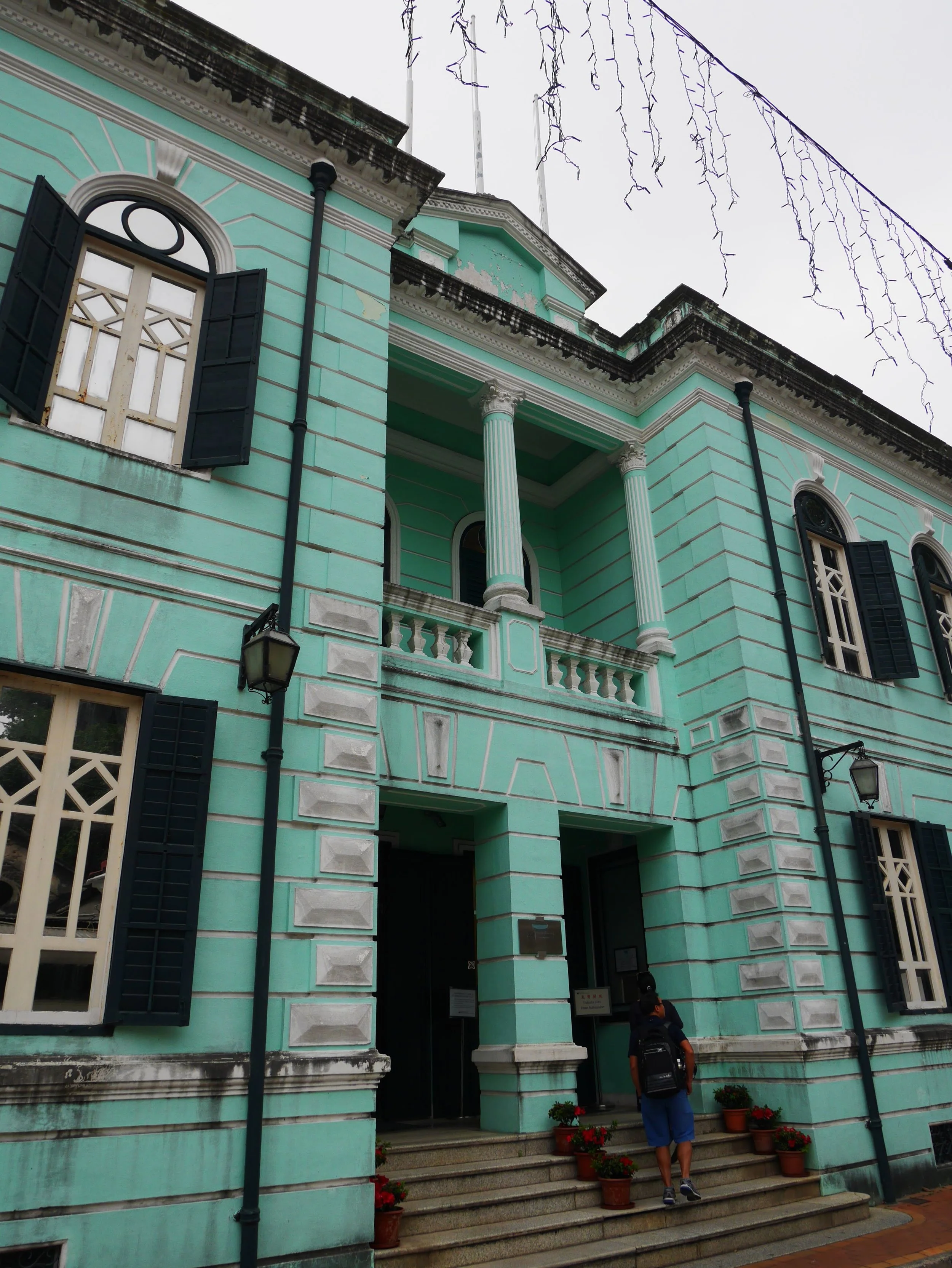
Down the road and within walking distance from the Taipa Houses Museum is the Museum of Taipa and Coloane History. The museum is located inside an early 20th century building that once housed some of the colonial government offices.
The museum has several galleries displaying historical artifacts dating back to the region’s prehistoric era, as well as displays about Macau’s colonial past. While not as large or expansive as the Macau Museum, I especially enjoyed visiting the Museum of Taipa and Coloane History because of its emphasis on archaeology.
The Museum of Taipa and Coloane History shares the culture of southern Macau
Opening Hours
The Museum of Taipa and Coloane History is open from 10:00 – 18:00.
The museum is closed on Mondays.
Admission
Admission is FREE
Location
The Museum of Taipa and Coloane History is located within walking distance of the Taipa Houses Museum
It’s free to visit the Ruins of St. Paul’s, Macau’s most iconic landmark. This historic Jesuit church was destroyed in the 19th century, and today only the facade is still standing. The towering church ruins have become one of the symbols of Macau, appearing on postage stamps, banknotes, and coins.
inside Macau’s Ruins of St. Paul’s
Beneath the ruins of the church lies The Museum of Sacred Art and Crypt. This crypt was re-discovered during preservation efforts in the 1990s. Since renovated, the crypt today holds the relics of numerous 16th century Japanese Catholic martyrs and important Jesuit missionaries who were based out of Macau. As you climb down the steps into the cool dark crypt, the complete silence is broken only by the soft sounds of recorded Gregorian chant.
Most tourist stay out front in order to get photos with the famous landmark, so the museum and crypt are often peaceful and quiet.
The Crypt at the Ruins of St. Paul’s
Opening Hours
The Ruins of St. Paul and crypt are open to visitors from 9:00 – 18:00.
On Tuesday the ruins close at 14:00.
Admission
Admission is FREE
Location
The Museum of Sacred Art and Crypt are located beneath the Ruins of St. Paul’s Church in central Macau.
St. Dominic’s Church Treasures of Sacred Art Museum
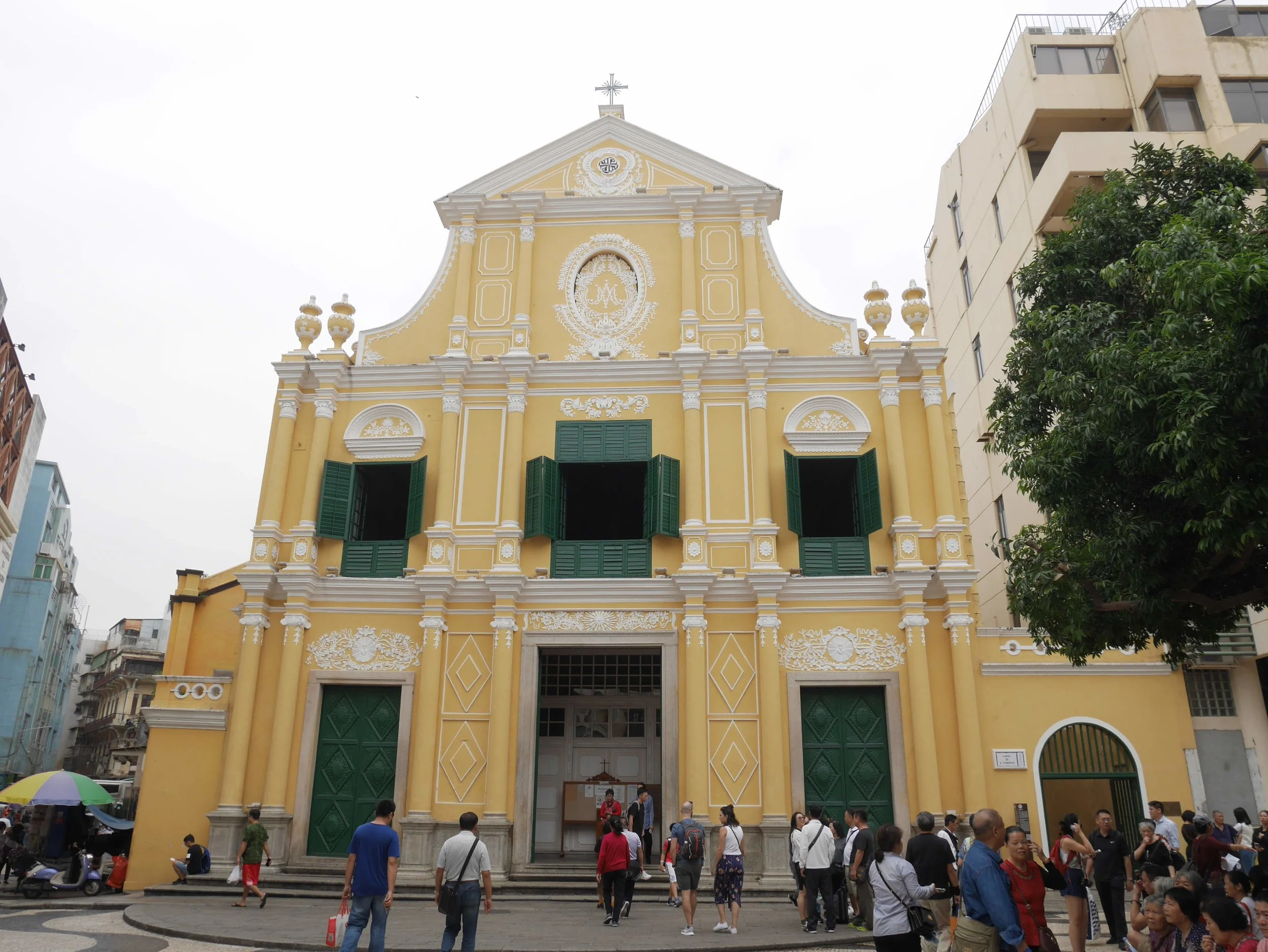
St. Dominic’s Church is one of Macau’s oldest churches. The yellow building is a beautiful Roman Catholic church, and is also home to the Treasures of Sacred Art Museum, a collection of Jesuit art and artifacts.
St. Dominic Church, Macau
After walking through the sanctuary, visitors can climb a set of stairs to the upper levels of the church where the museum collection is housed. Macau was the headquarters of the Society of Jesus (Jesuits) in Asia, and the church holds an amazing collection of historic religious art and artifacts.
I especially liked being able to climb to the upper levels to see the mechanism of the bell tower.
Treasures of Sacred Art Museum located within St. Dominic Church, Macau
Opening Hours
The Treasures of Sacred Art and St. Dominic’s Church is open to visitors daily from 10:00 – 18:00.
Admission
Admission is free, although donations are welcome.
Location
The Treasures of Sacred Art is located within St. Dominic’s Church in Macau, just down the street from the Ruins of St. Paul’s.
Looking for fun things to do in Luang Prabang at night? Try shopping, eating, and exploring at the Luang Prabang Night Market!
vendors with souvenirs at the Luang Prabang Night Market in Laos
Being a night owl may not match with the lifestyle in Luang Prabang. The city wakes up early, and things tend to close down when the sky grows dark. While there is some night life in the more touristy bars and clubs, in general, Luang Prabang is a quiet and sleepy city, especially once the sun goes down. Luang Prabang is considered to be one of the most charming and peaceful cities in Southeast Asia.
However, if you love shopping, and especially if you love night markets, you must visit head out to Sisavangvong Road after dark. There, you’ll discover the Luang Prabang Night Market, and with it plenty of amazing food and great souvenir shopping.
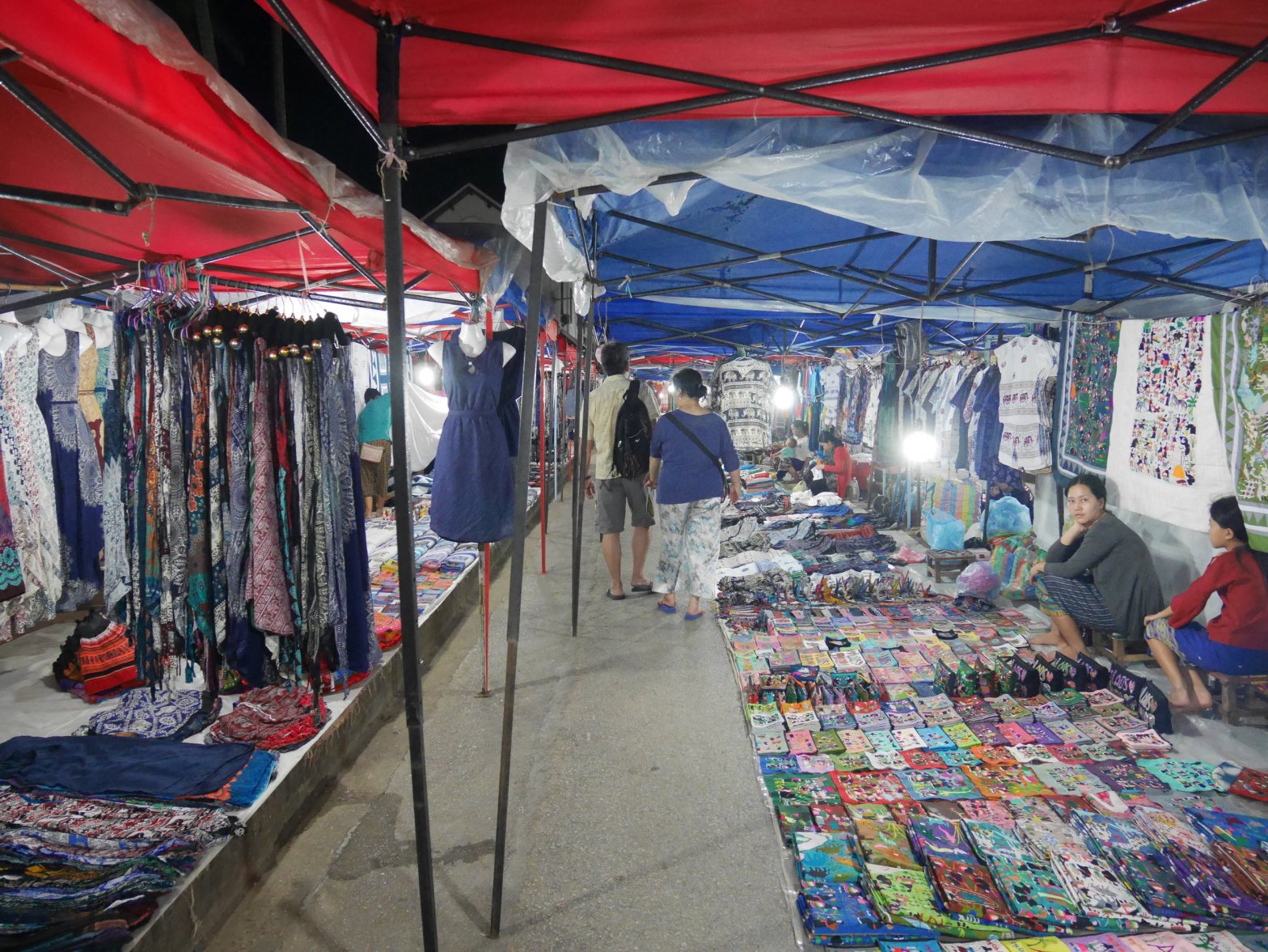
shopping at the Night Market in Luang Prabang, Laos
Sisavangvong Road is closed for pedestrians only at night due to the market. It’s like the whole town comes out to this road once it’s dark. The road in front of Wat Mai fills with vendors, and the street becomes crowded with souvenirs, clothes, scarves, Lao handicrafts, and much more.
I especially enjoyed looking at all of the cool handcrafts along the street. They are beautiful and cheap, and make excellent souvenirs for family and friends back home! The nicest thing is that none of the vendors are pushy or aggressive at all, and though the Night Market is very popular, it never feels crowded. I don’t think I have ever been to any other night market in the world that is as calm as this market in Laos.
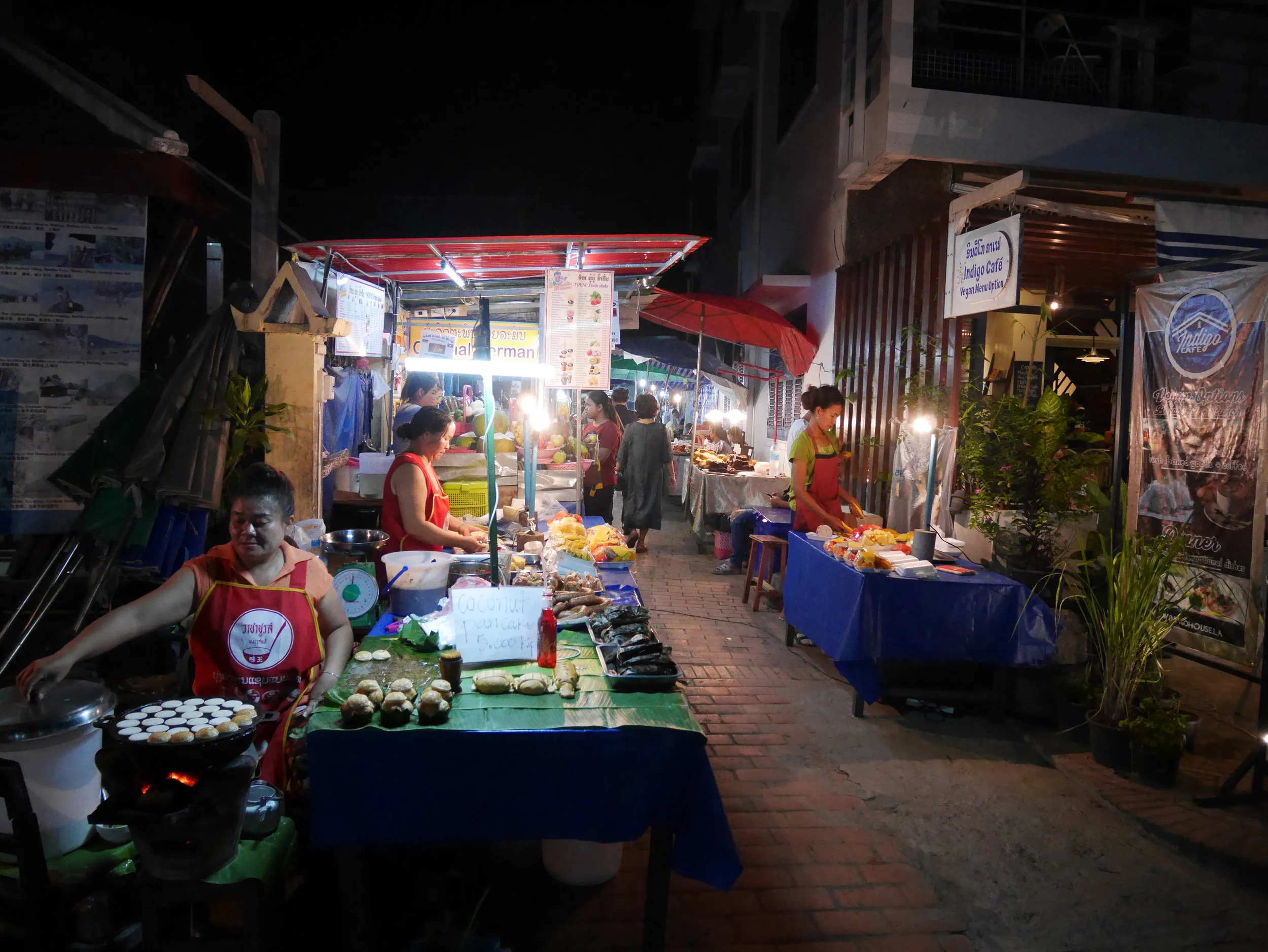
street vendors preparing food and snacks at the Night Market in Luang Prabang, Laos
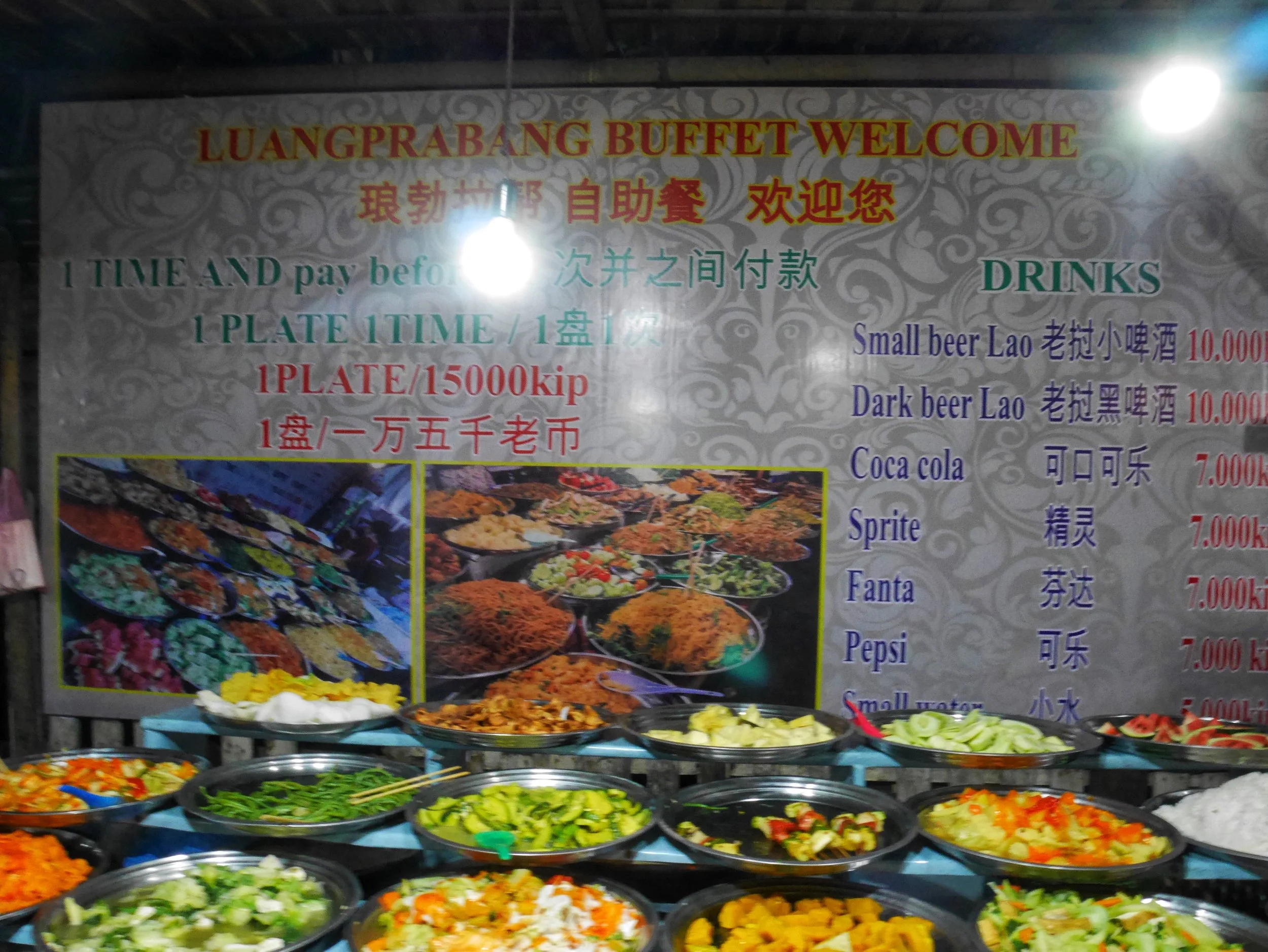
After shopping for a little while, I was very hungry, so I decided to find some food to stuff my tummy. I walked through the market to a tiny alley where all of the food stalls and shops are found. There is plenty to eat there, but the most popular is the Luang Prabang Vegetarian Buffet. I ended up stuffing myself with delicious organic and vegetarian dishes, which cost only 15.000 kip (all you can eat!).
I also highly recommend grabbing a delicious fresh baguette near the entrance to the food street!
Night Market Vegetarian Buffet in Luang Prabang, Laos
The Luang Prabang Morning Market comes alive before the sun rises. After spending a cool, fresh morning experiencing a Lao alms-giving ceremony, head to the morning market to buy some of the freshest, healthiest, and most delicious produce in the city. You have to wake up early to experience the Morning Market, but it’s one of the coolest local experiences that you really shouldn’t miss when traveling to the city.
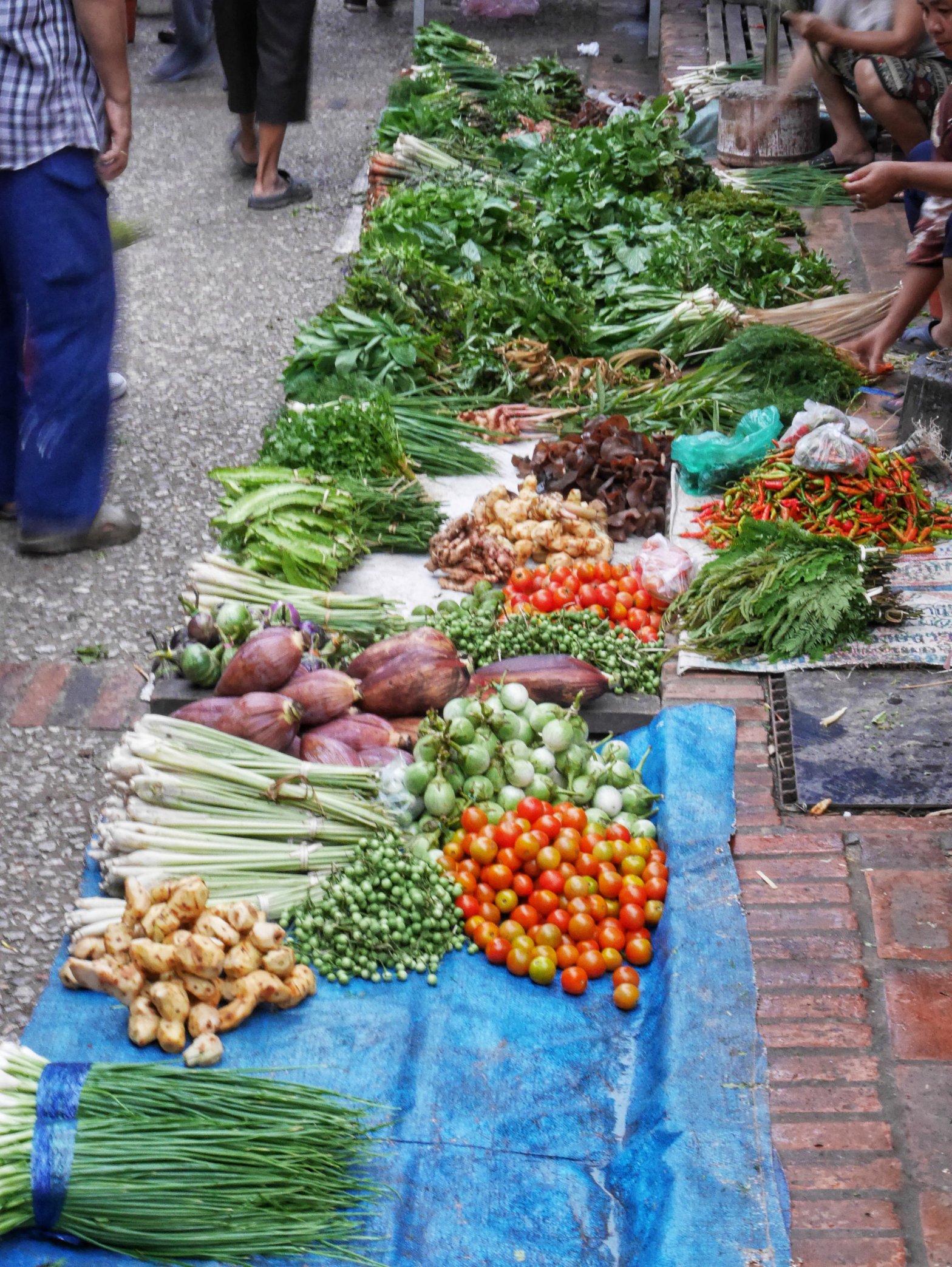
fresh produce for sale at the Morning Market in Luang Prabang, Laos
Unlike the Night Market in Luang Prabang, which sells souvenirs and snacks and generally caters to tourists, the Morning Market is very much a local market. Here, local farmers and vendors sell delicious produce fresh from the farm.
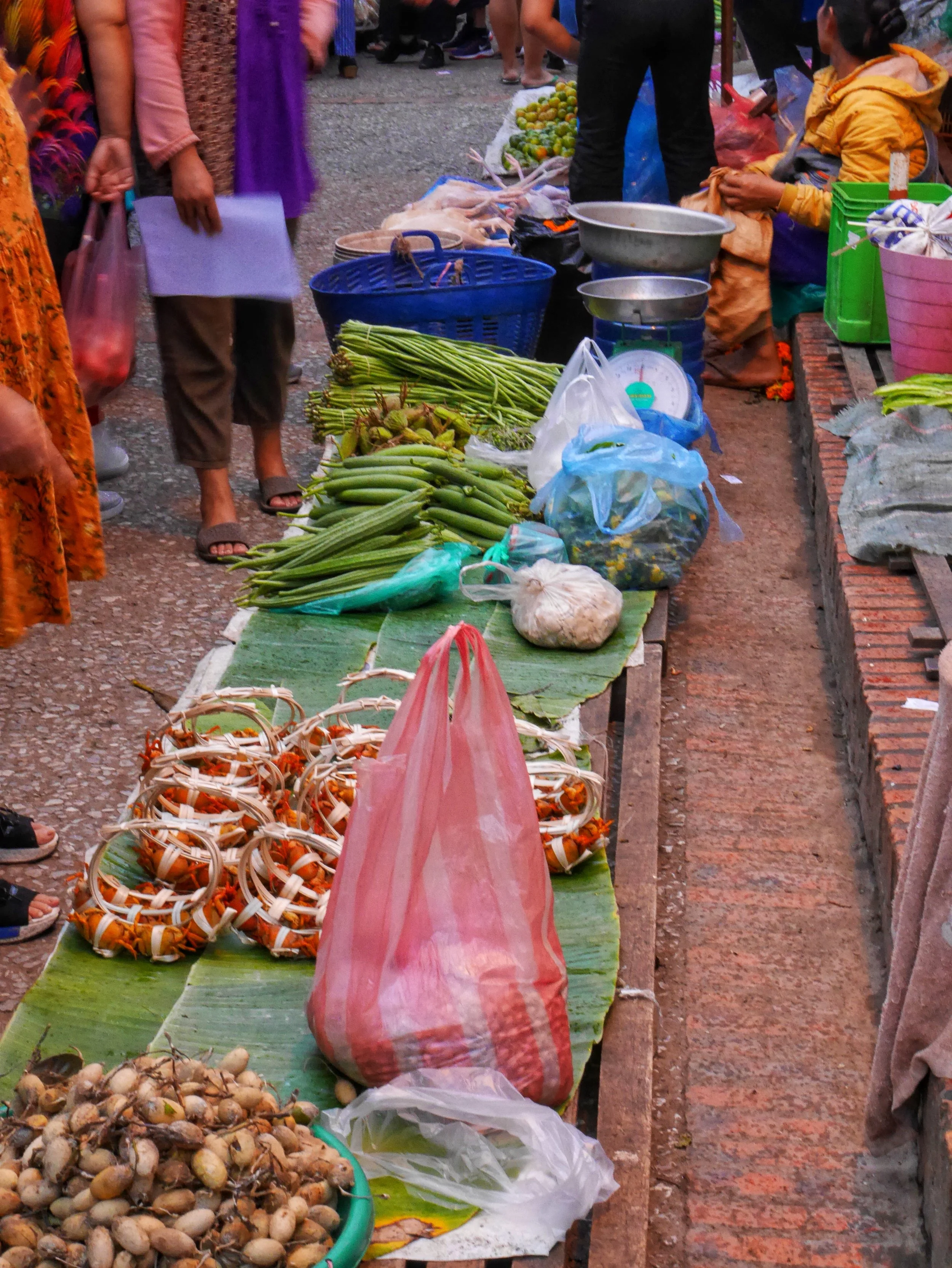
All of the produce on sale is very reasonably priced. You can also find some street food, noodles, and snacks for sale, as well as traditional iced Lao coffee, while you wander through the market streets.
live crabs for sale along with various produce at Luang Prabang’s Morning Market
A perfect Luang Prabang morning starts with a Buddhist alms ceremony, followed by a walk through the morning market, and ends up at Prachaniyom Coffee Shop on the banks of the Mekong River with a bowl of rice porridge and one of the best cups of coffee in town.
Although Hanoi is Vietnam’s capital city, the larger Ho Chi Minh City (formerly Saigon) is home to some of the country’s best museums. Though most of the museums in the city are dedicated to Vietnam’s independence struggles and the Vietnam War, there are a number of fine art and culture museums as well. In my opinion, Ho Chi Minh City is home to some of the best museums in Southeast Asia.
Independence Palace Museum
Independence Palace Museum, Ho Chi Minh City, Vietnam
Independence Palace, also called Reunification Palace, was the residence and headquarters of the president of the Republic of Vietnam (South Vietnam) during the 1960s and 70s. Visiting the massive compound is like stepping back in time to war-era Vietnam, when the palace was the center of high society in Vietnam, and indeed in Southeast Asia.
Visiting the museum gives visitors to Ho Chi Minh City a look at the history of the government and ruling class of South Vietnam during the war. It’s one of the most interesting spots in the city for those who are interested in Vietnam’s war-era history.
Visitors can see the rooftop ballroom, originally built as a meditation room but instead used to host South Vietnam’s wildest parties; the president’s secret underground bunker and command center; government meeting rooms; and private residences.
The interior of the Independence Palace Museum, the home and headquarters of the former President of South Vietnam.
Location
Independence Palace, also known as Reunification Palace, is located near the center of downtown Saigon at 135 Nam Kỳ Khởi Nghĩa, Phường Bến Thành, Quận 1, Hồ Chí Minh 700000, Vietnam.
Exhibits inside the Southern Vietnam Women’s Museum in Ho Chi Minh City
The Southern Vietnam Women’s Museum is dedicated to the women of Vietnam, with a special emphasis on female revolutionary leaders as well as the traditional culture of minority women in the country.
The main focus of the museum is on famous women from Vietnam’s history, especially those who were leaders during the war.
Exhibits and demonstrations about Vietnam’s traditional textile industry
Location
The Southern Vietnam Women’s Museum is located in Ho Chi Minh City (Saigon) at 202 Võ Thị Sáu, Phường 7, Quận 3, Hồ Chí Minh, Vietnam.
Admission to the Southern Vietnam Women’s Museum is 30,000 VND.
Hours
The Southern Vietnam Women’s Museum is open every day except Friday.
The museum’s hours are 7:30 – 11:30 and 13:30 – 17:00.
War Remnants Museum
War Remnants Museum in Ho Chi Minh City, Vietnam
The War Remnants Museum is one of the best museums in Vietnam for learning about the history of the “American War” from the other side. It’s a very important museum to visit, as all too often we only hear one perspective of the war.
The museum holds a large collection of war-era artifacts, documents, and photographs. The most heartbreaking room is dedicated to informing visitors of the lasting effects of the “Agent Orange” defoliant, which is still causing terrible birth defects and massive health problems throughout the country to this day.
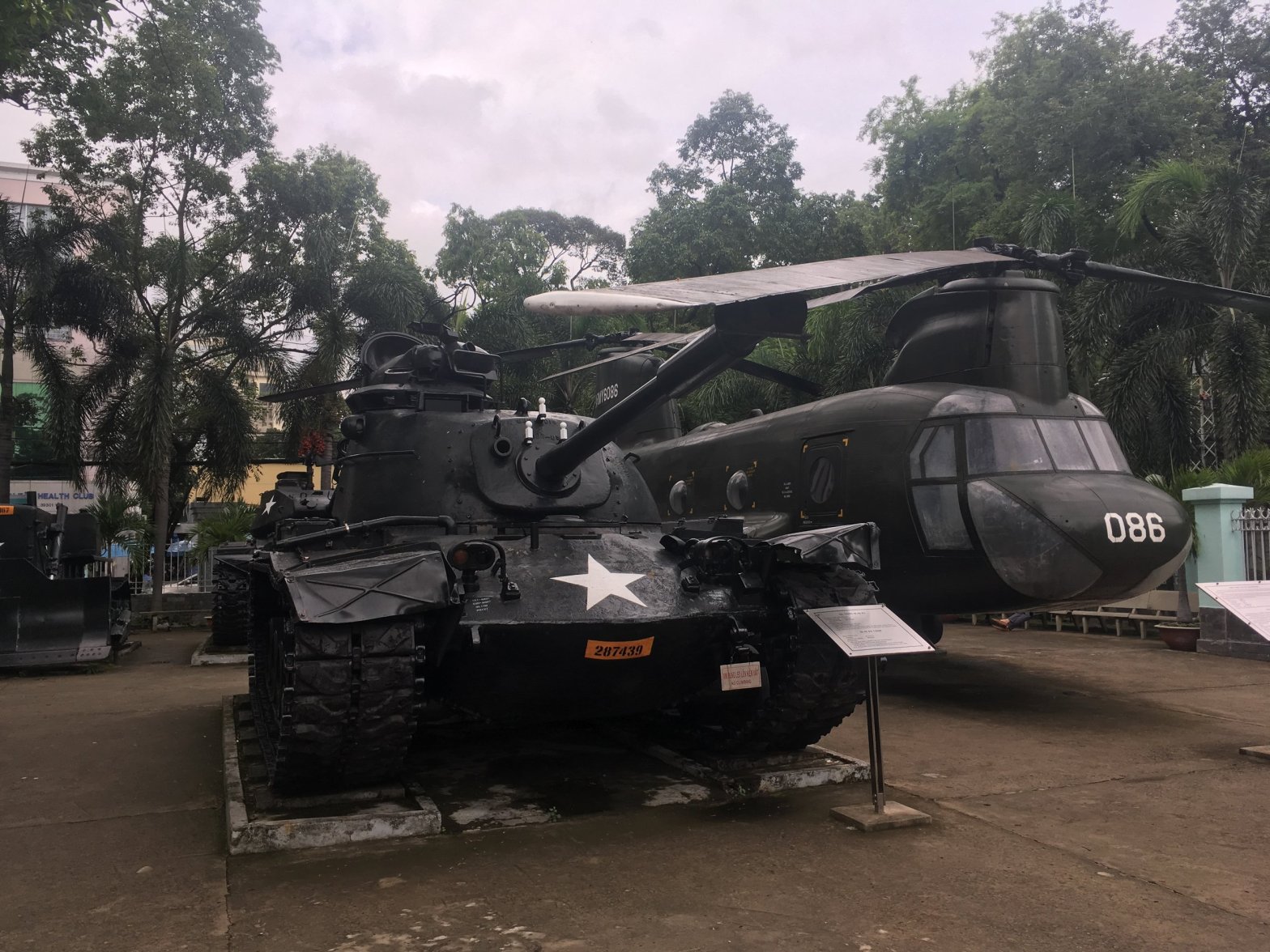
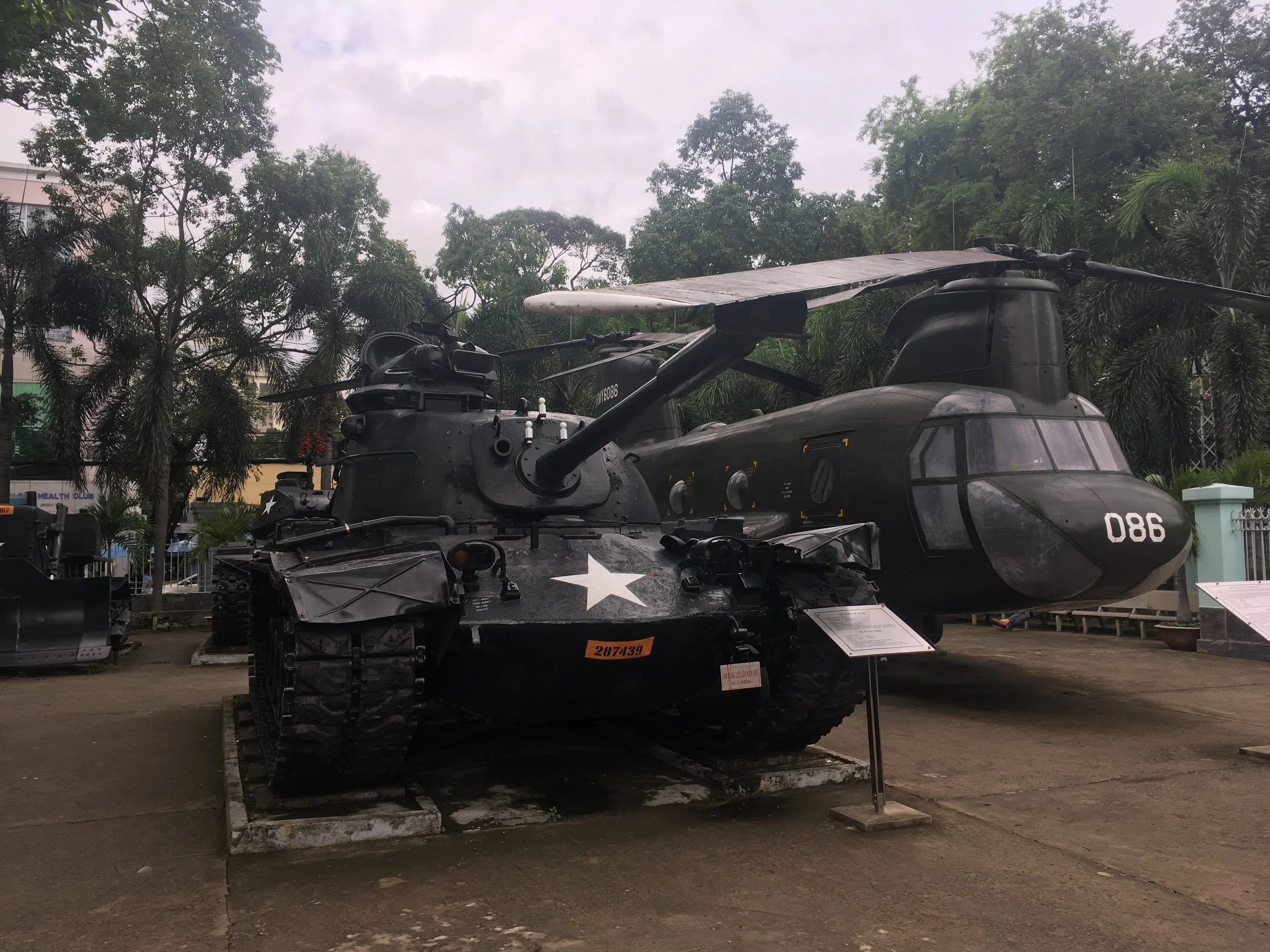
tanks and aircraft on display at Vietnam’s War Remnants Museum
Location
The Ho Chi Minh War Remnants Museum is located in downtown Saigon within walking distance of the Independence Palace Museum and the Ho Chi Minh City Museum.
The War Remnants Museum is located at 28 Võ Văn Tần, Phường 6, Quận 3, Hồ Chí Minh 700000, Vietnam
Admission to the Vietnam War Remnants Museum is 40,000 VND.
Hours
The War Remnants Museum is open daily from 7:30 – 18:00.
Ho Chi Minh City Museum of Fine Arts
interior of the Ho Chi Minh City Museum of Fine Arts
The Museum of Fine Arts is one of the coolest museums in the city, not only for its great collection of art spanning centuries, but for the beautiful old mansion that is the museum’s home. The Ho Chi Minh City Museum of Fine Arts is housed inside an old colonial-era villa, complete with a historic elevator, spiral staircase, and stained glass, and the building itself is as much a work of art as the fantastic collection that it holds.
a spiral staircase and stained glass window inside the Museum of Fine Arts
Location
The Museum of Fine Arts is located in downtown Ho Chi Minh City within walking distance to Saigon Square.
The museum is located at 97A Phó Đức Chính, Phường Nguyễn Thái Bìn, Quận 1, Hồ Chí Minh, Vietnam
Museum of Vietnamese History (Vietnam History Museum)
The Museum of Vietnamese History in Ho Chi Minh City is located next to the city zoo and botanical garden
Located just next door to the Saigon Zoo and Botanical Gardens, the Museum of Vietnamese History is another of my favorite museums in the city. The collection, which tells the story of Vietnam from its ancient history to today, spans centuries, and gives visitors a great overview of Vietnamese history and culture.
Collections include prehistoric relics, imperial artifacts, religious art, and much more.
a historic Buddha statue inside the Ho Chi Minh Museum of Vietnamese History
An entrance ticket to the Museum of Vietnamese History costs 40,000 VND. If you want to carry your camera and take pictures, there is an extra 20,000 VND fee.
Hours
The Museum of Vietnamese History is open daily from 8:00 – 11:30 and 13:30 – 17:00.
the wreckage of American aircraft at the Ho Chi Minh City Museum
The Ho Chi Minh City Museum is built inside the old Gia Long Palace. The palace was constructed in 1890 as the residence of the colonial governor, and later became the residence of the president of the State of Vietnam. Today, it’s been converted into the Ho Chi Minh City Museum.
This museum tells the story of Ho Chi Minh City (Saigon). It was originally the Ho Chi Minh Revolutionary Museum, a museum dedicated to showcasing the political art and propaganda of the Socialist Republic of Vietnam. The museum has since been renamed to the Ho Chi Minh City Museum.
The museum is also home to several interesting pieces of war-era American wreckage.
Location
The Ho Chi Minh City Museum is located inside the old Gia Long Palace, near central Saigon.
The museum is located just down the road from Independence Palace at 65 Lý Tự Trọng, Bến Nghé, Quận 1, Hồ Chí Minh, Vietnam.
Admission to the Ho Chi Minh City Museum is 30,000 VND.
Hours
The Ho Chi Minh City Museum (Gia Long Palace) is open daily from 8:00 – 18:00.
Ho Chi Minh Movement Museum
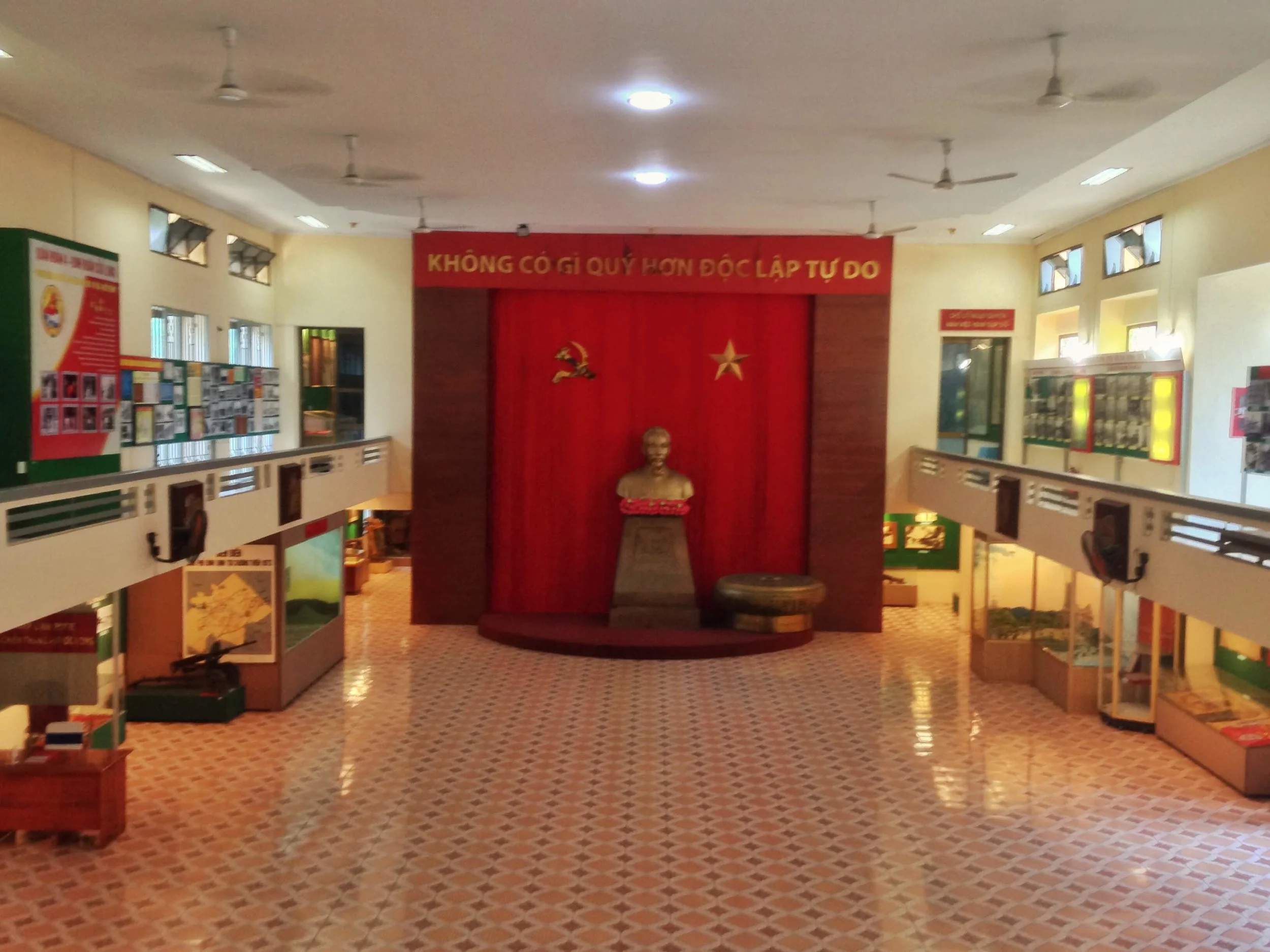
the interior hall at the Ho Chi Minh Movement Museum
The small but free Ho Chi Minh Movement Museum is a showroom and exhibition hall dedicated to the history of the war in Vietnam and how the Communist movement and forces of Ho Chi Minh spread across the country. Although the exhibits are almost entirely presented in Vietnamese, it’s an interesting museum to visit due to the numerous war-era artifacts on display.
Location
The Ho Chi Minh Movement Museum is located near the Saigon Zoo and Botanical Garden and Museum of Vietnamese History.
The museum is located at 2 Le Duan Street, District 1, Ho Chi Minh City 70000, Vietnam
While Macau may be better known for its casinos than anything else, a visitor shouldn’t overlook the excellent cuisine that the city has to offer. Macanese cuisine is deeply steeped in the city’s history, and is influenced by both its traditional Chinese and colonial Portuguese past. Some of Macau’s best dishes can be found in its street food; some of the best food can sometimes be found in the most unassuming of local food stalls!
Egg Tart
An egg tart in Macau
The Portuguese egg tart is probably the most famous of Macau’s street food offerings. The egg tart has a long and delicious history in Macau, and while the most famous place to get a delicious, warm, fresh egg tart is at the iconic Lord Stow’s Bakery, they can be found for sale all over the city, usually costing around $10 per pastry.
Macau egg tarts for sale at a bakery in the city’s old town area
Pork Chop Bun
A pork chop bun in Macau bought at a street food stall
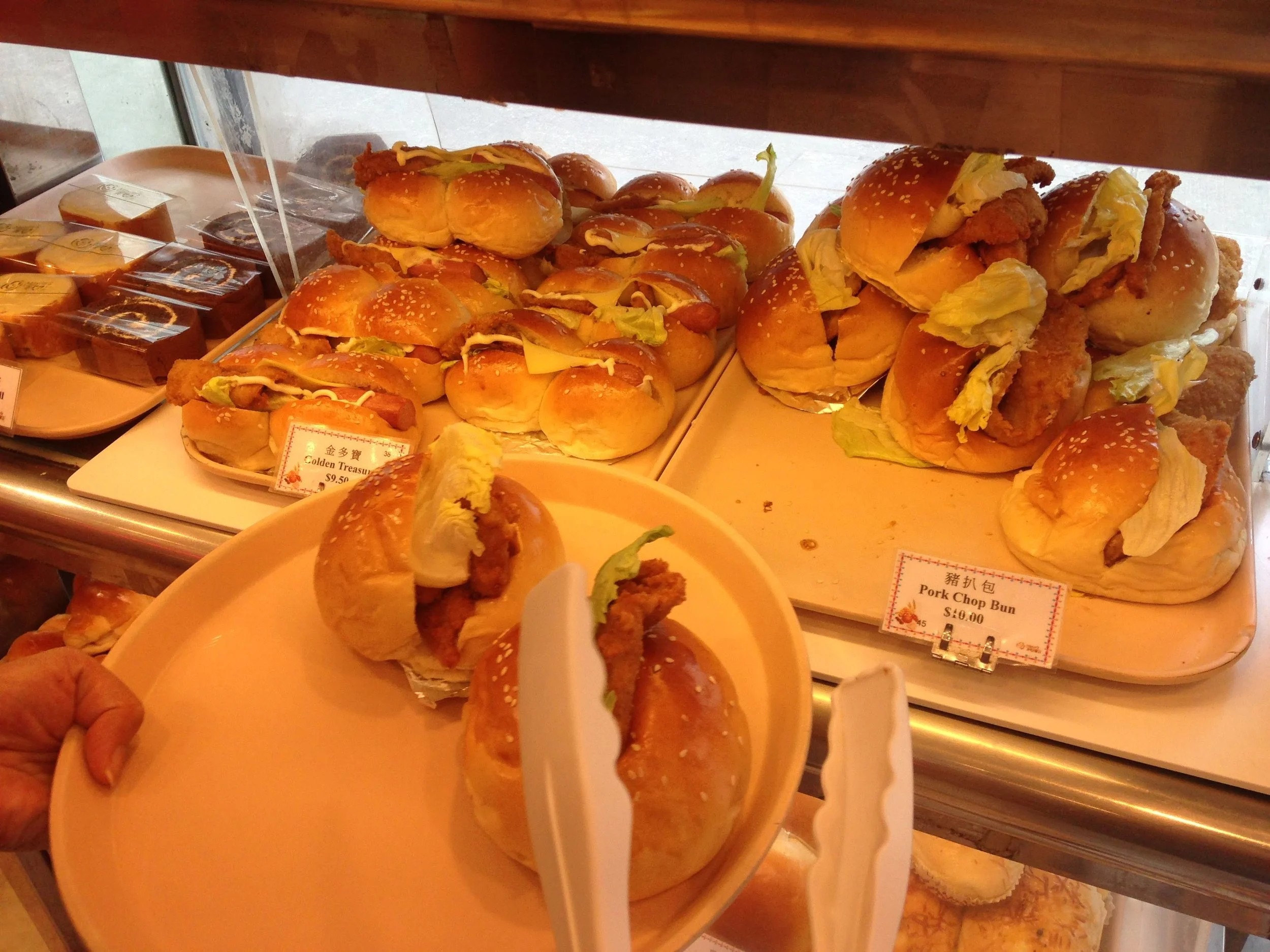
The pork chop bun is another favorite street food snack in Macau. A fried pork chop served in a sandwich with a hot, fresh baked bun is the perfect on-the-go snack in the busy city.
Sometimes referred to as a “Macanese Hamburger”, the pork chop bun is delicious and filling… but not necessarily a healthy snack! Pork chop buns can be found at street food stands and bakeries all over the city.
pork chop buns at a bakery in Macao
Xiao Long Bao Dumplings
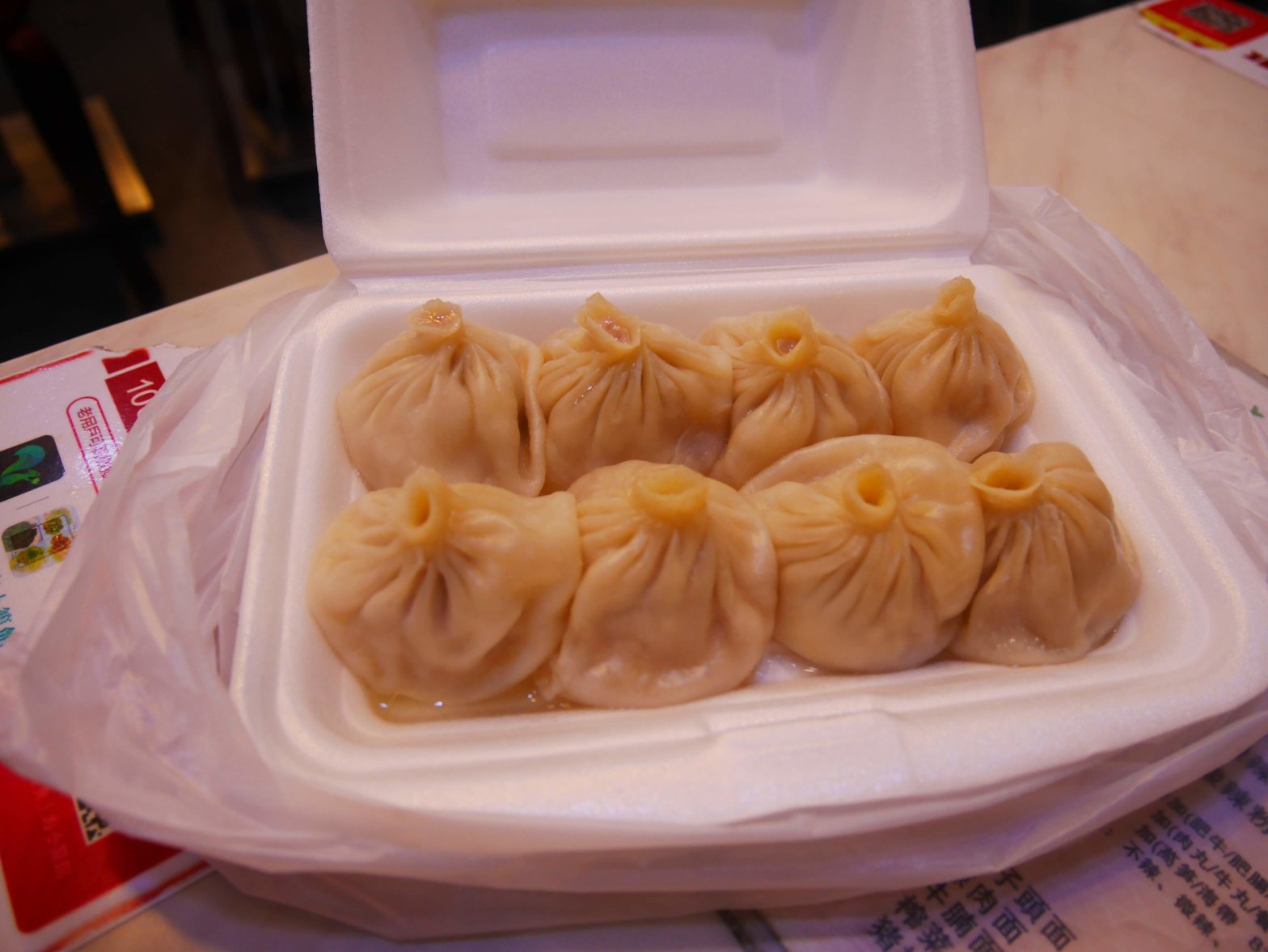
xiao long bao soup dumplings in Macau
Xiao Long Bao, or Chinese soup dumplings, are a type of steamed dumpling that is very popular for a late-night snack in Macau. The tiny hand-made dumplings are filled with delicious hot soup, so you have to eat them very carefully! To eat a xiao long bao, pick up the top of the dumpling with your chopsticks, take a small bite, and drink the soup out of the dumpling. Then, eat the rest of the delicious, delicate xiao long bao. So good!
Macau Beer
A bottle of Macau Beer Golden Ale
Finally, wash down all the delicious food that you’ve enjoyed with the most popular drink in Macau… beer! The iconic Macau Beer is a craft-style golden ale, and in my opinion, one of the best beers in Asia. Surprisingly, it can be a little bit difficult to find! Chinese beers like Tsingtao are a lot more common. But don’t pass up the chance to try a Macau Beer whenever you can. Cheers!































 LB convert