Hong Kong and Macau, though both parts of China, are what’s known as “Special Administrative Regions”. Simply put, after centuries of western colonial rule, these two cities are guaranteed a certain degree of autonomy, with their own laws, currency, immigration requirements, and more. Even though both cities are part of China, one has to go through immigration when moving between one city and the other, or between either city and mainland China.
Hong Kong and Macau are located quite close to each other – less than 40 miles by sea, and the easiest way to cross from one maritime SAR to the other is by ferry.
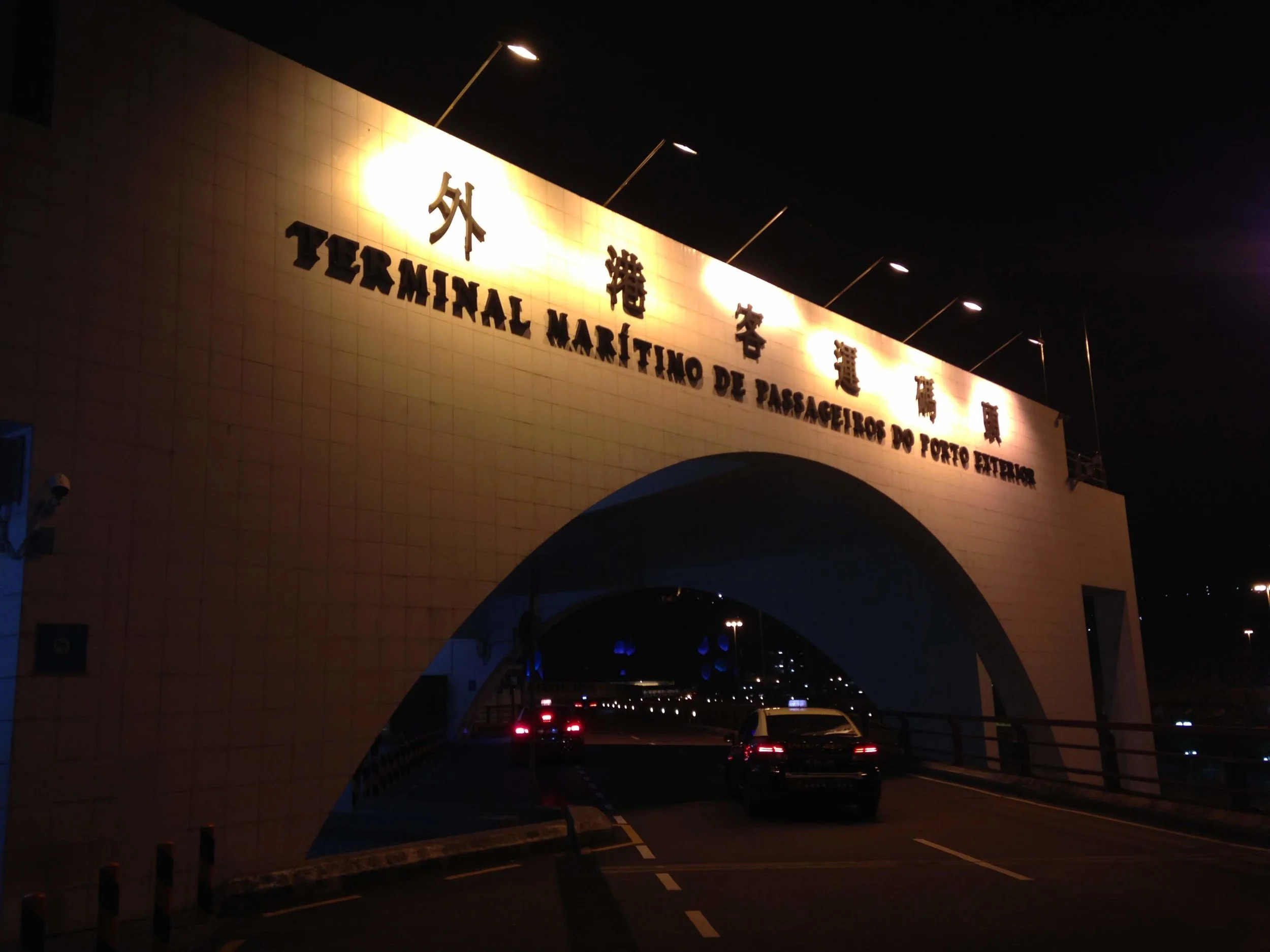
The ferry terminal in Macau
We booked tickets on the earliest morning ferry between Macau and Hong Kong, which was due to depart at 7:00am. We took a taxi from our hotel to the Macau Port. It was too early to check in, but we grabbed a can of iced coffee from a vending machine and sat down to wait.
There are several restaurants and souvenir shops at the ferry port, and even a 7-11 convenience store.
Tickets are available for purchase online or at the port, however you must have your passport with you in order to book tickets.
A one-way ticket between Macau and Hong Kong costs $160 HKD (or MOP).
The voyage takes around one hour.
A one-way ticket for the Macau-Hong Kong Ferry
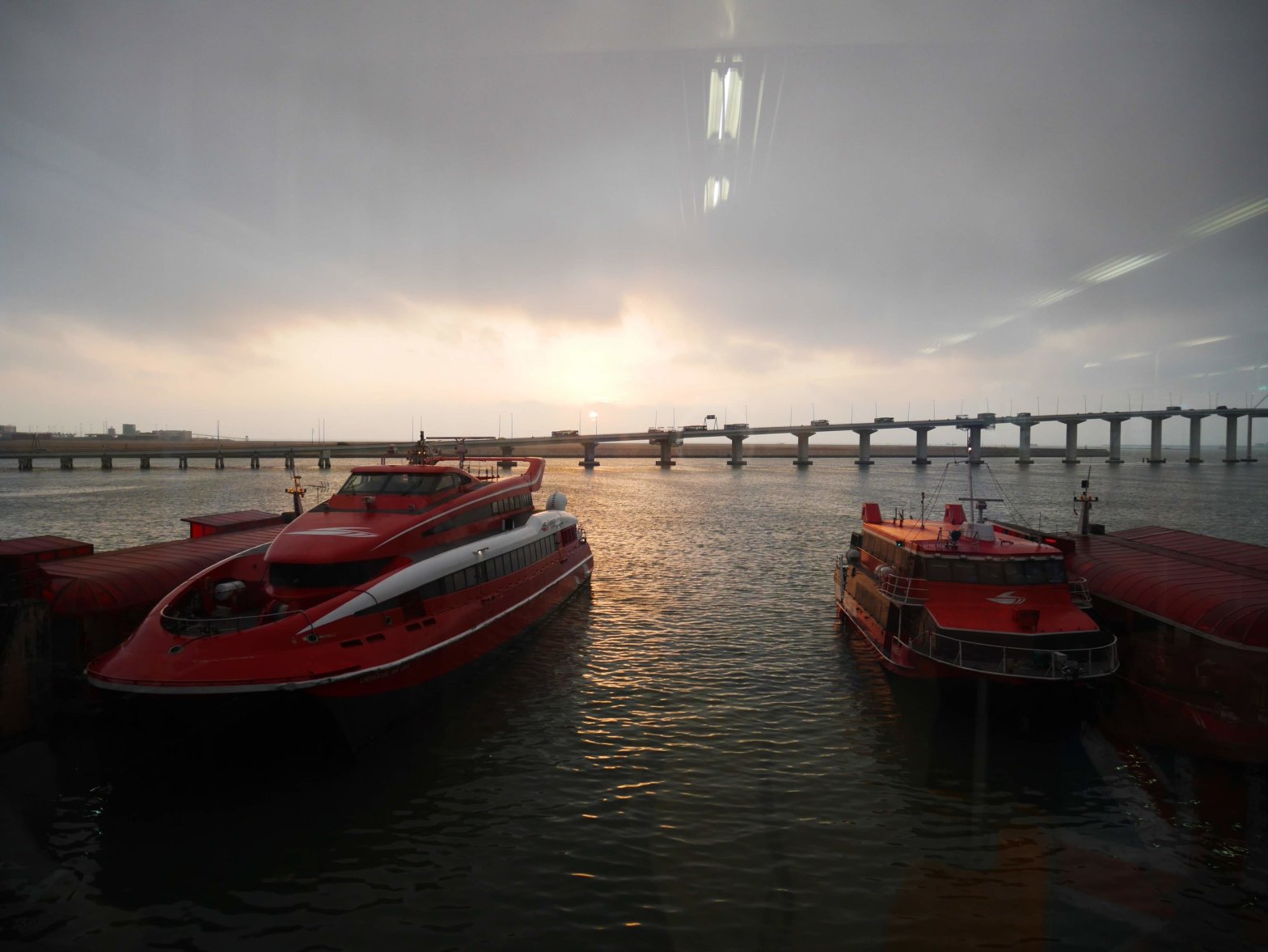
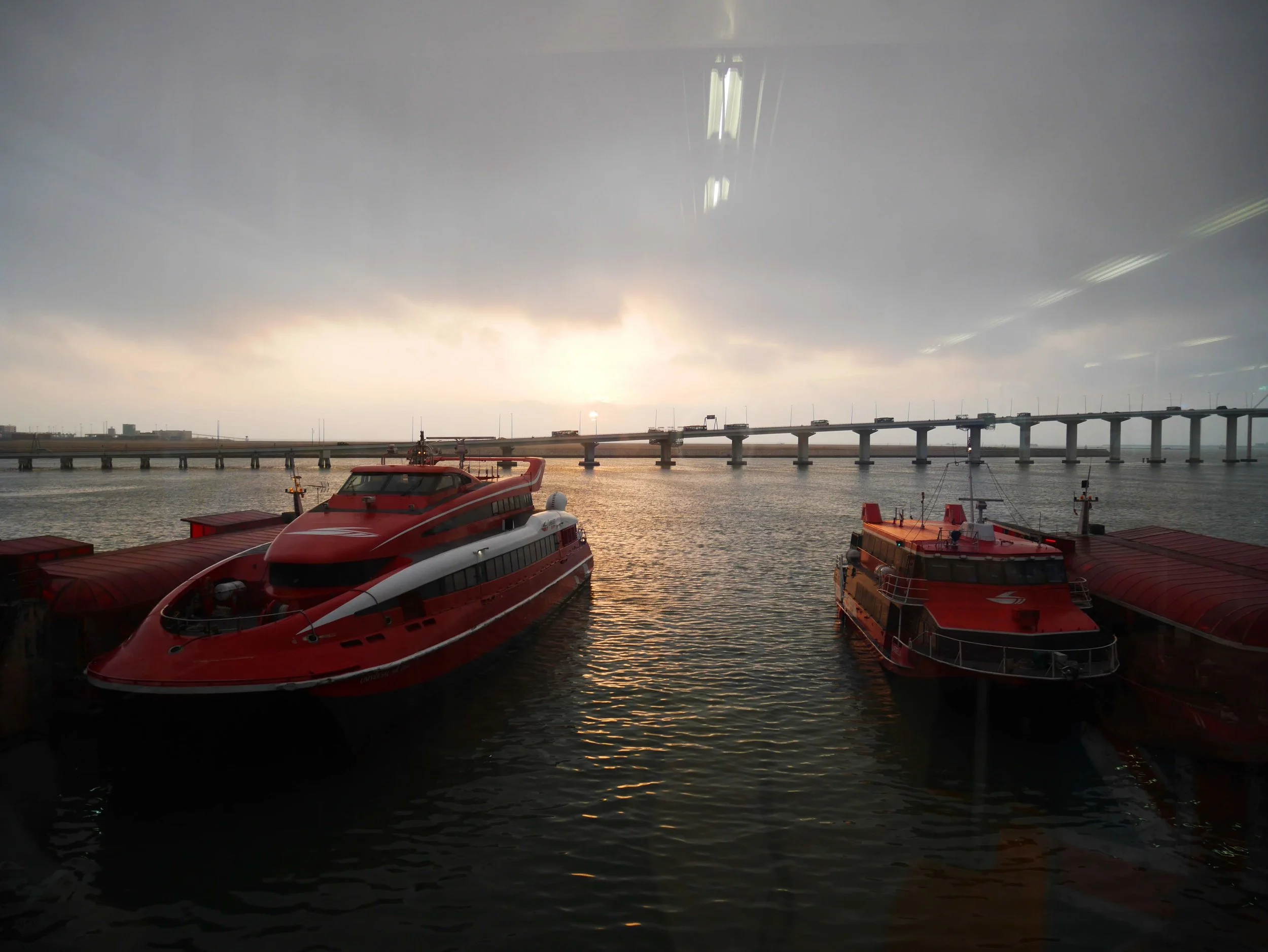
Traveling by boat was much more comfortable and easier than flying. We did have to go through immigration both upon leaving Macau and when arriving in Hong Kong, but this hardly took any time whatsoever. Soon, we were waiting at our gate, looking out at the ferry boats waiting to carry passengers to Hong Kong as the sun slowly rose over the South China Sea.
Two types of Macau-Hong Kong Ferry boats waiting to depart
We stowed our luggage at the back of the ferry. The luggage area was large, and there was plenty of space for all of the passengers to stow their suitcases.
Every ticket has an assigned seat, and we found ours easily. Since it was so early, the ferry was only about one-third full. The seats were larger than airplane seats, and very comfortable.
the Macau-Hong Hong Ferry interior
There was a coffee/drink/snack service during the trip.
The ferry had clean and comfortable toilets for passengers.
The Star Ferry Company has been taking passengers across Victoria Harbor between Hong Kong Island and Kowloon since 1888. While the MRT can get you from one side of the city to the other much faster, a trip on the iconic ferry is one of my favorite experiences in Hong Kong, and a way to connect to a piece of the city’s history. The ride from once side of the harbor to the other takes around ten minutes, and gives some of the best views of downtown Hong Kong on both sides of the harbor.
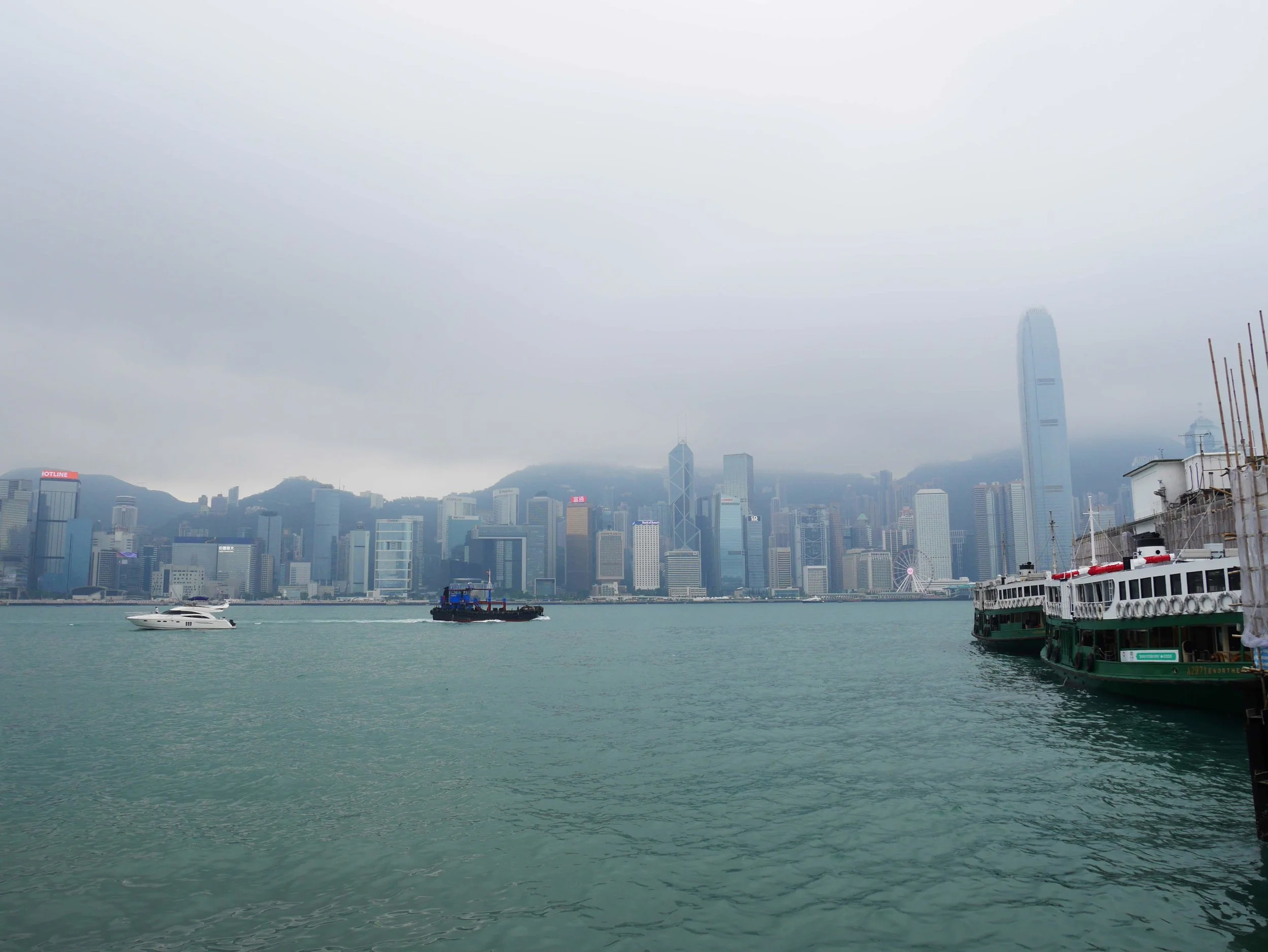
A view of downtown Hong Kong and Victoria Harbour from onboard the Star Ferry.
Sometimes, especially if the weather is nice, I like to ride the ferry back and forth across the harbor. The ride isn’t expensive; you can pay with cash (purchase a single-trip token) or with Octopus Card (Hong Kong’s city-wide pre-paid card). Tickets cost around $2-$3 HKD depending on if it’s a weekday or weekend.
The Kowloon Star Ferry Terminal with downtown Hong Kong in the background.
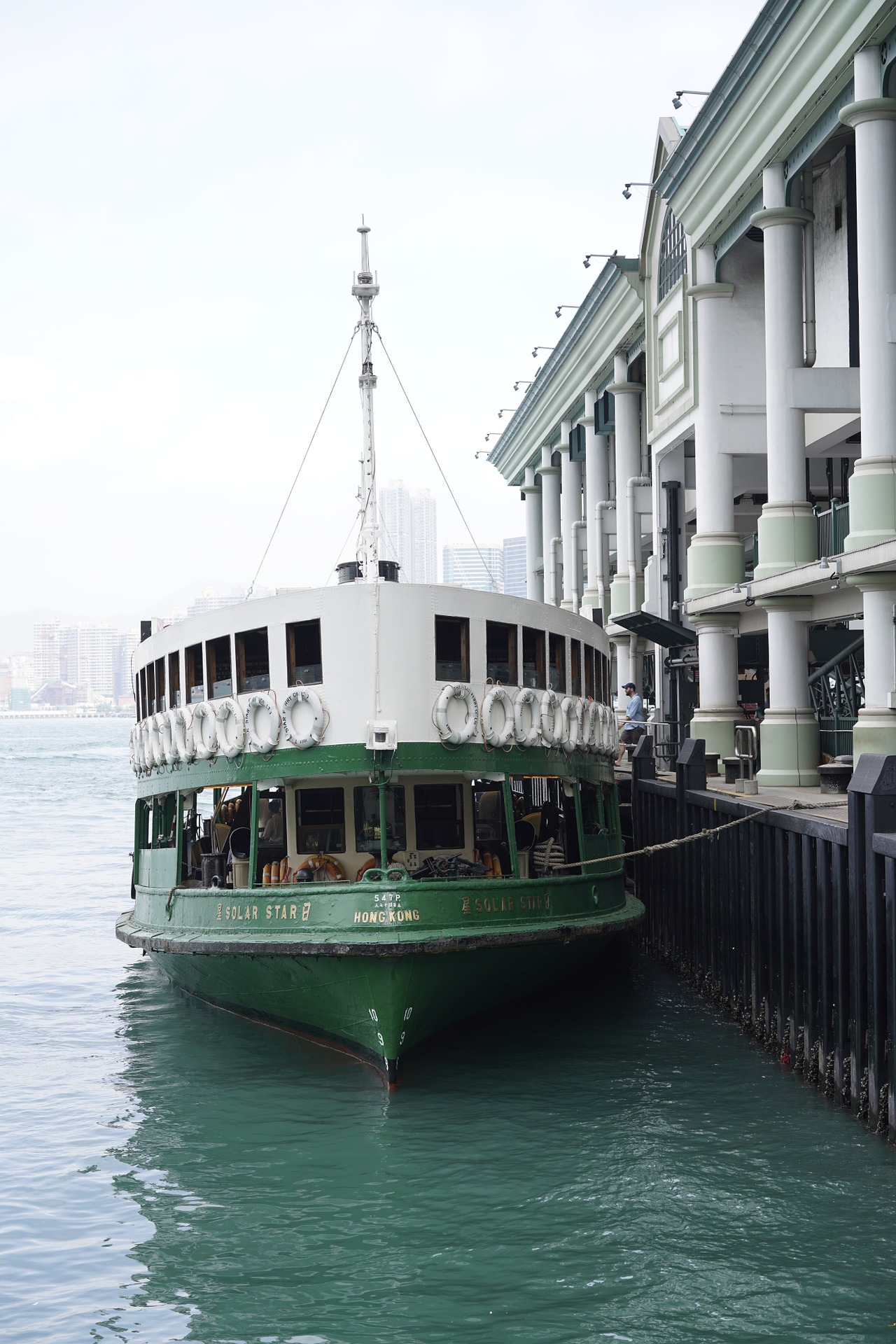
Each of the Star Ferry boats has a star-themed name like Evening Star or Glowing Star. The current fleet of ferries has been in service since the 1950s, and give riders a real glimpse into Hong Kong’s past and the way of life in the city before the MTR was constructed.
The Star Ferry Company also offers harbor tours on specially-designed Star Ferry boats.
On board the iconic Star Ferry in Hong Kong
Star Ferry Routes and Piers
The Star Ferry operates two routes from Tsim Sha Tsui Pier in Kowloon to Central Pier and Wan Chai Pier, both located on Hong Kong Island.
Central Star Ferry Pier (Hong Kong Island)
The Central Star Ferry Pier is located at Man Kwong Street, Central, Hong Kong near Hong Kong MTR Station. It is located in the city’s big boat terminal alongside the piers that carry passengers between Hong Kong’s Outer Islands.
Wan Chai Star Ferry Pier (Hong Kong Island)
Wan Chai Pier is also located on Hong Kong Island near the Hong Kong Convention Center and the Golden Bauhinia Statue. The pier is easily reached by foot from MTR Causeway Bay Station.
Tsim Sha Tsui Star Ferry Pier (Kowloon)
There is just one Star Ferry pier on the Kowloon side of Hong Kong. It can be found at Tsim Sha Tsui, near the Kowloon Clock Tower and the Hong Kong Space Museum. The closest MTR station is MTR Tsim Sha Tsui.
The Hong Kong Star Ferry docked at the ferry terminal. (via Pixabay)
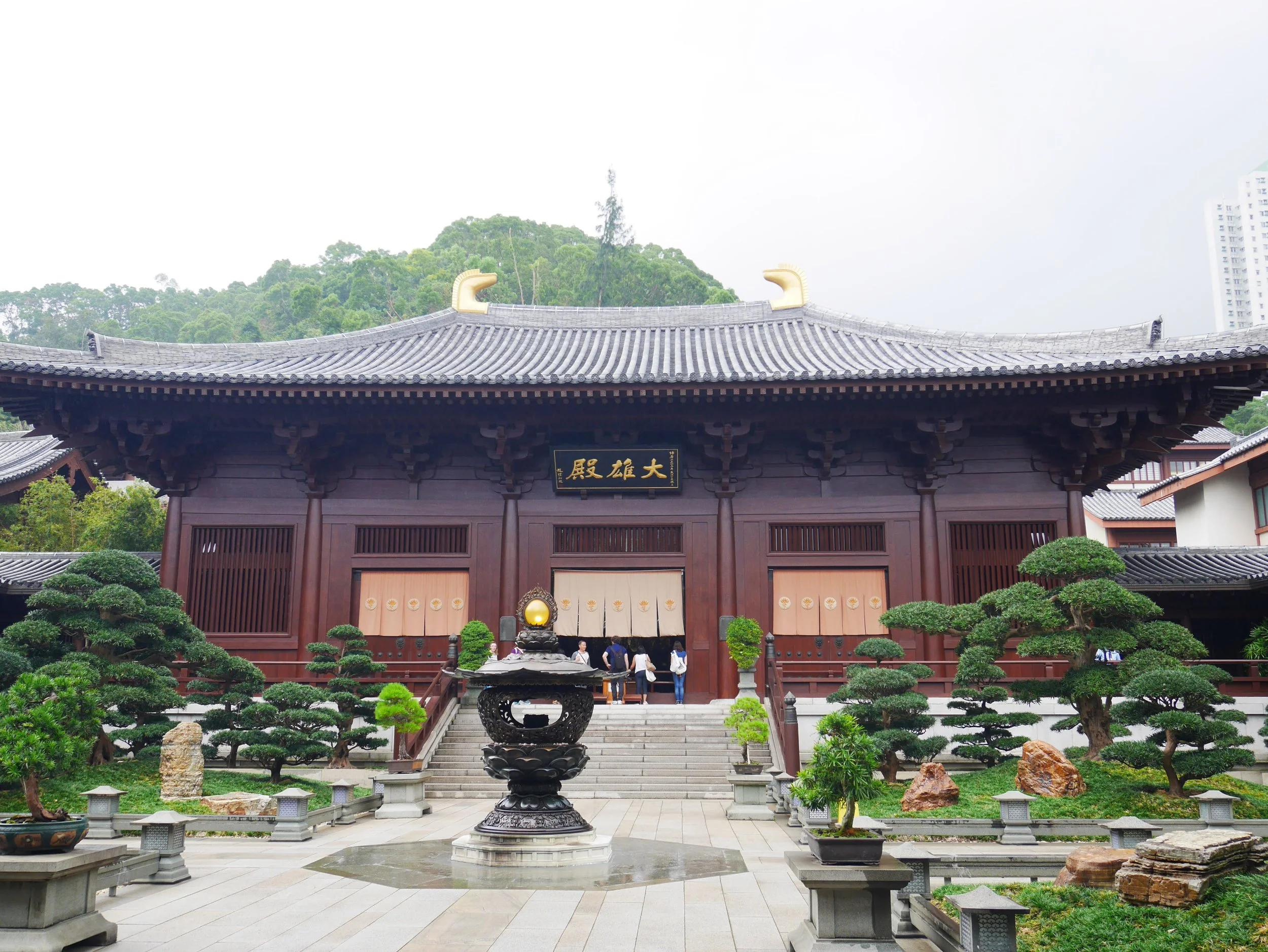
Chi Lin Nunnery, though only dating back to the 1930s, looks like it comes out of China’s imperial past. The temple was designed in the architectural style of the Tang Dynasty (618–907 ), and the impressive wooden temple hall itself is a work of perfect craftsmanship; not a single nail or piece of metal was used in the construction of the building! There are lots of Buddhist temples all throughout Hong Kong, but in my opinion, the Chi Lin Nunnery is the most beautiful one.
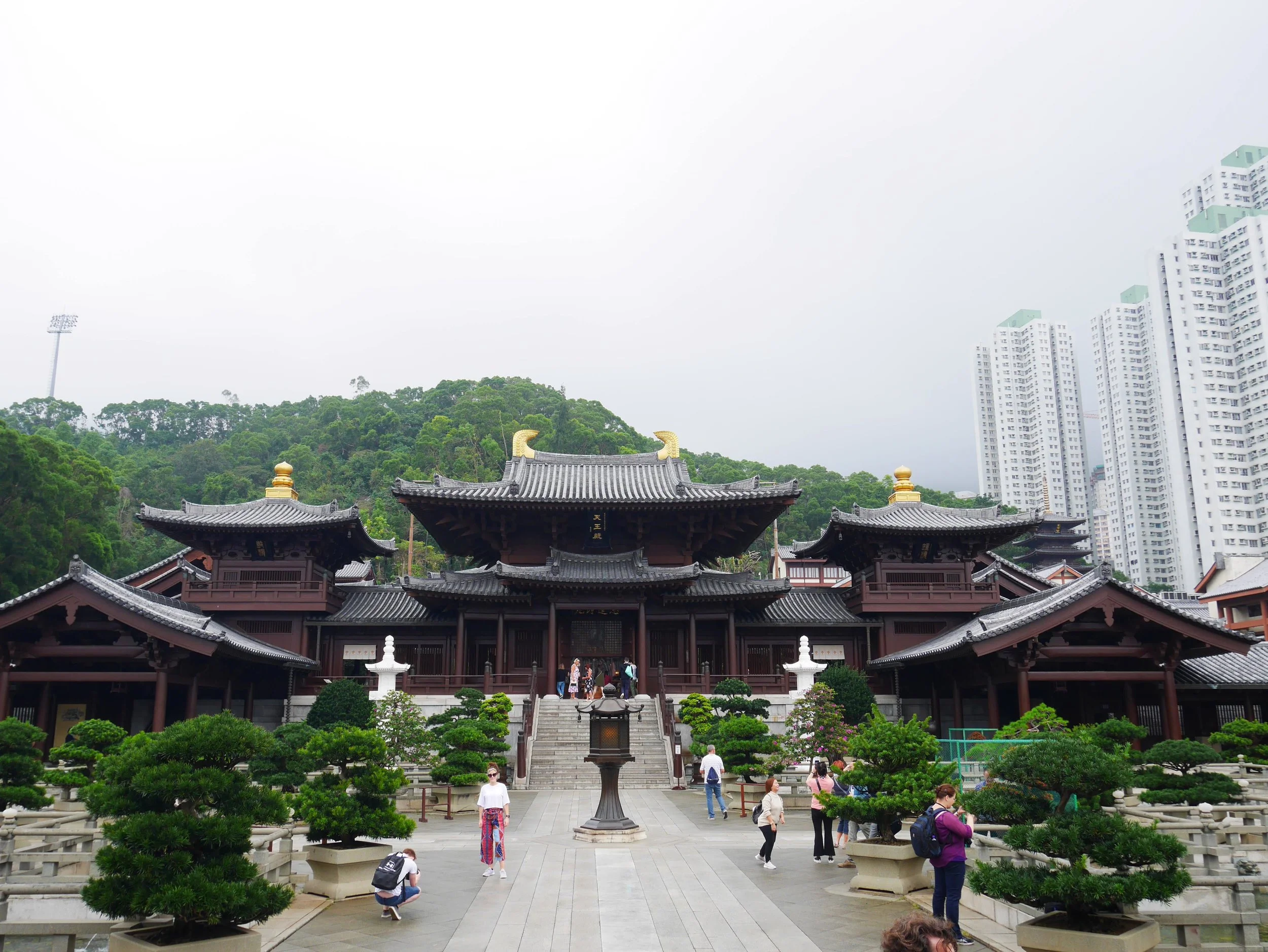
The Maitreya Hall at Chi Lin Nunnery in Hong Kong, built in the style of the Tang Dynasty.
Chi Lin Nunnery 志蓮淨苑
The temple is nestled amongst the mountains and skyscrapers of Diamond Hill in Kowloon, Hong Kong. Visitors can easily reach the temple by taking the C2 Exit at Diamond Hill MTR Station (in Kowloon) and walking just a few minutes to Chi Lin Nunnery. The temple is clearly marked with easy-to-follow signage.
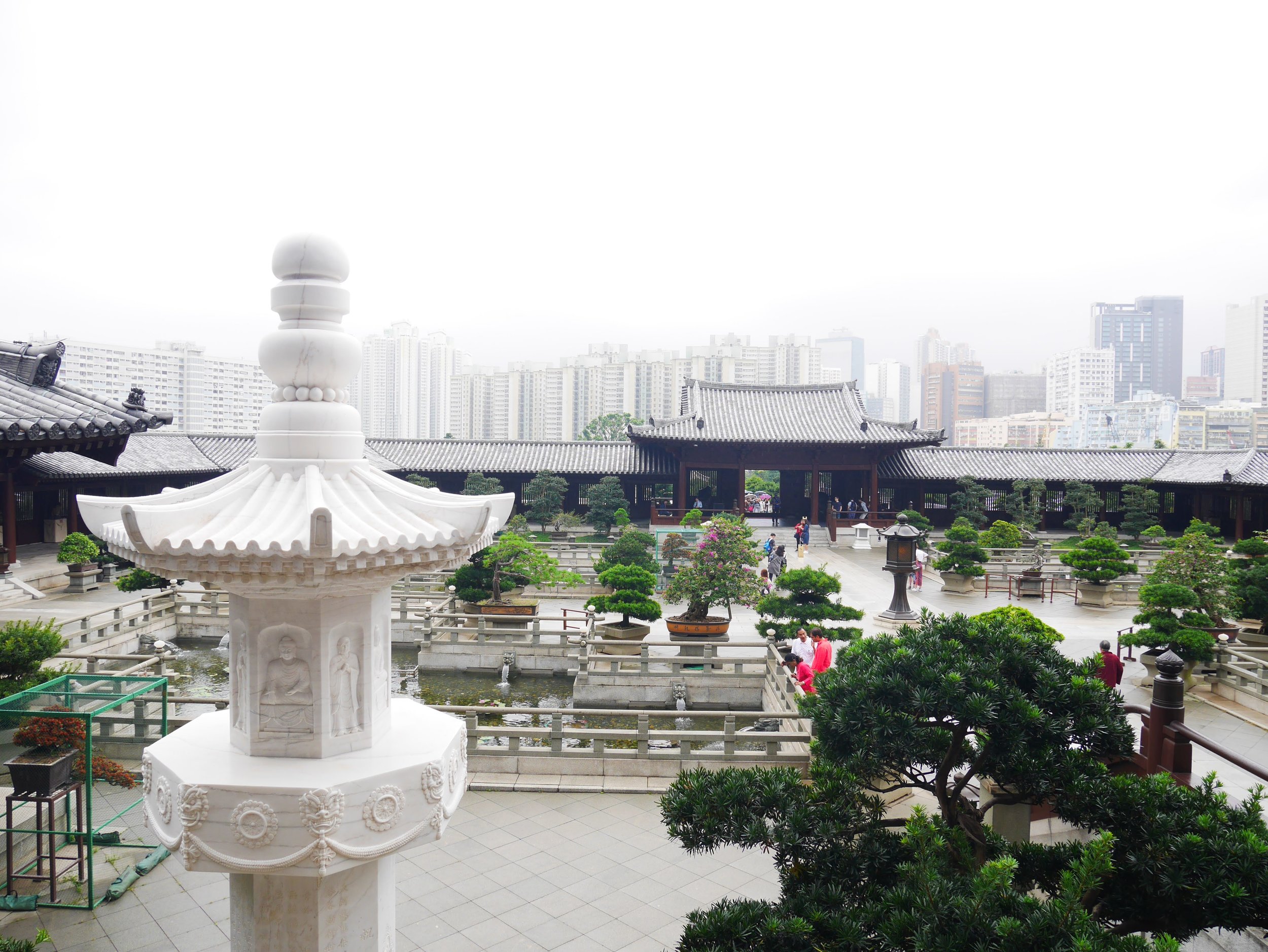
The temple compound is made up of many different buildings. Some, like the library, school, and living areas for the Buddhist nuns who reside at Chi Lin are private, but anyone can visit the beautiful temple hall and the nearby Nan Lian Garden.
Chi Lin Nunnery courtyard and fish ponds, Kowloon, Hong Kong
Chi Lin Nunnery was founded in 1934. Although the current temple hall and buildings look ancient, they were rebuilt during the 1990s. The temple buildings were designed in the style of the ancient Chinese Tang Dynasty, and are the only buildings of the type in all of Hong Kong.
Chi Lin Nunnery is built entirely of wood, without the use of a single metal nail. It is the largest hand-carved wooden building in the world.
The temple halls at the Chi Lin Nunnery are made entirely of wood without the use of a single nail.
Visitors are encouraged to enjoy the peaceful temple courtyard, and may take photographs of the outside of the temple. Photography is not permitted inside the temple hall, however. The temple interior holds several statues of Buddhas and Bodhisattvas.
To help support the nunnery, visitors may purchase Buddhist art, charms, books, beads, music, and more at the well-stocked gift shop on the temple grounds.
The great doors at the Chi Lin Nunnery in Hong Kong.
Nan Lian Garden 南蓮園池
Opposite Chi Lin Nunnery, you’ll find the fantastic Nan Lian Garden. The garden was built in 2006 as a joint effort between the Hong Kong Government and Chi Lin Nunnery. This public park is considered to be one of the finest examples of Chinese Classical Garden in all of China. Like the Chi Lin Nunnery, Nan Lian Garden is free to visit.
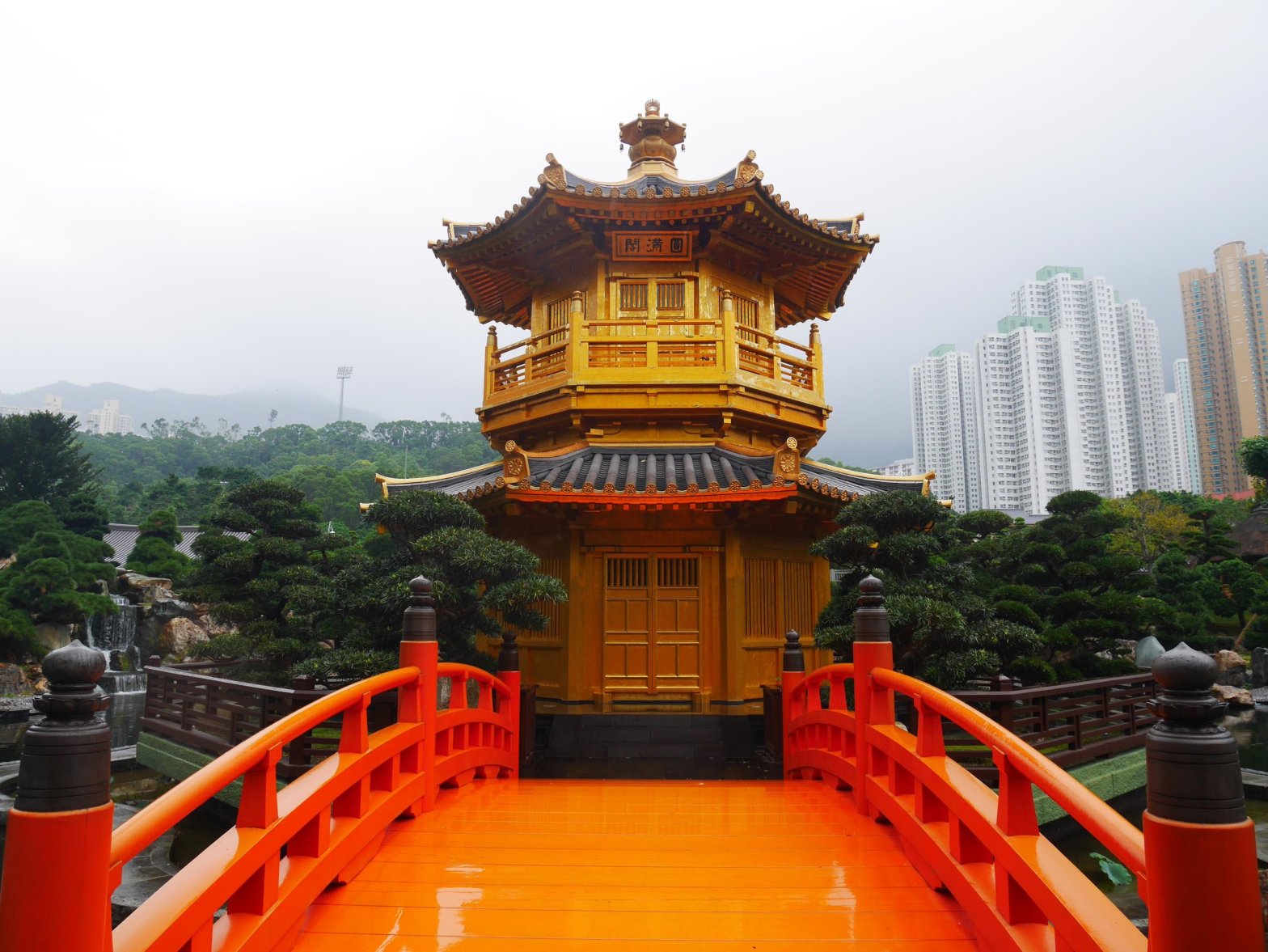
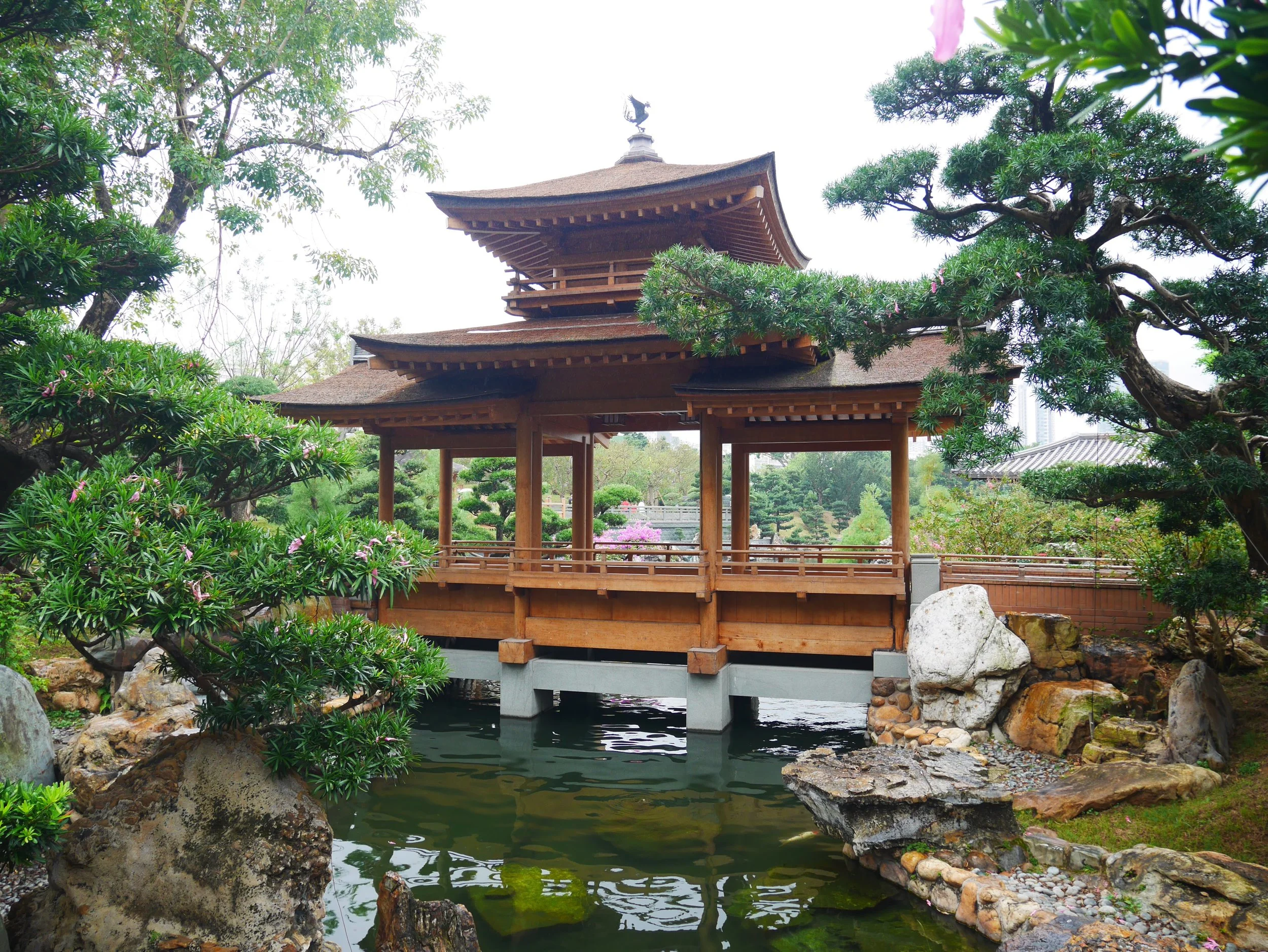
The Pavilion of Absolute Perfection at the Nan Lian Garden in Hong Kong.
The Nan Lian Garden is built around the glittering Pavilion of Absolute Perfection, a golden Chinese pagoda constructed on an island in a pond within the garden. the pavilion is the focal point of the garden, and the path and other structures are built surrounding it.
There are several other structures at the Nan Lian Garden as well. There are a few shops where visitors can buy gifts, tea, and souvenirs. There is also an interesting museum and exhibition hall detailing the construction techniques used to build the Chi Lin Nunnery, complete with scale models of the temple and other famous hand carved wooden buildings.
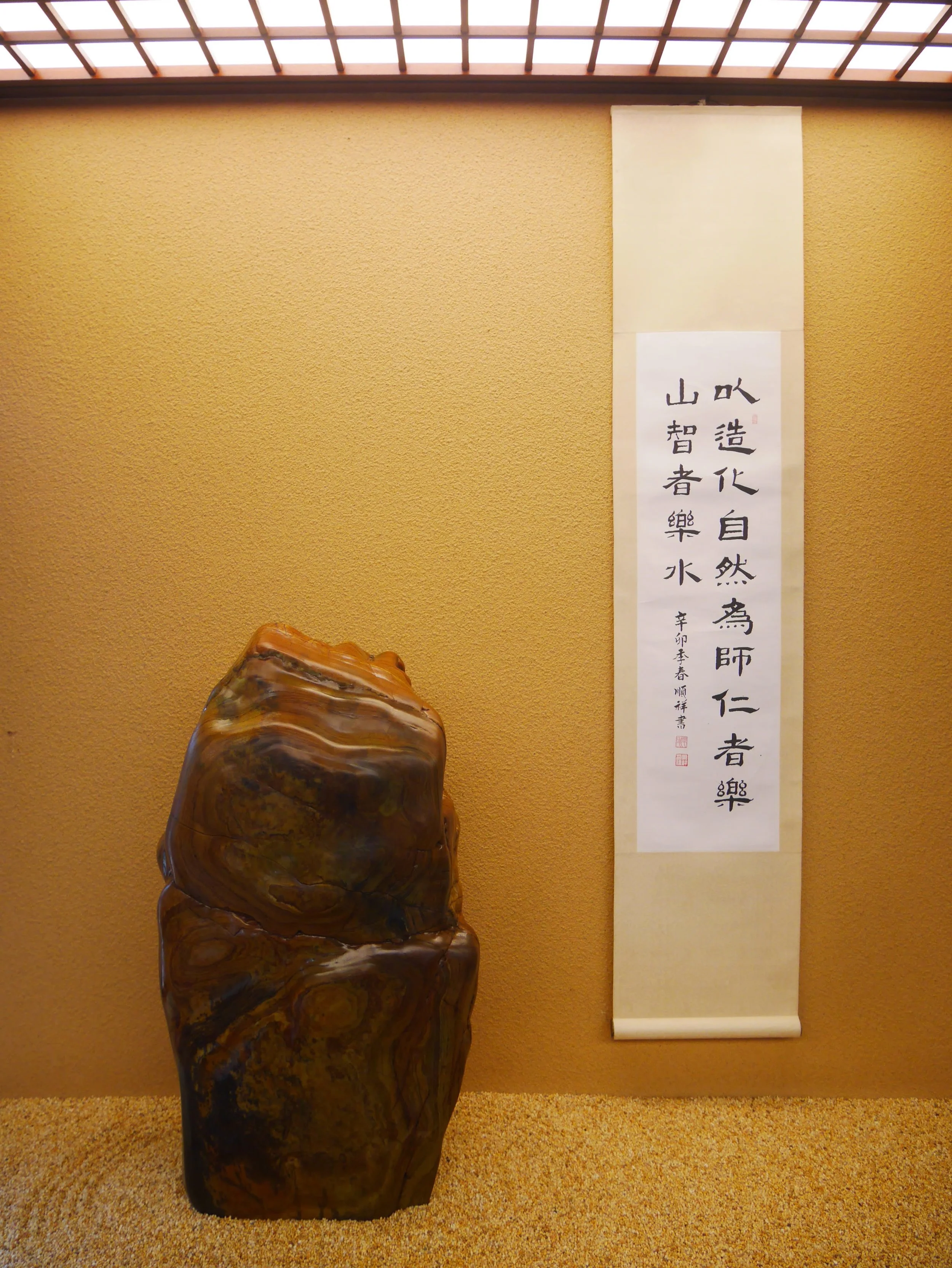
The Rockery, a Zen rock garden at the Nan Lian Garden.
One of the most peaceful parts of the garden is the “Rockery”, an indoor Zen rock garden exhibition hall. It was starting to rain on the day I first visited the Nan Lian Garden. I ran indoors to the Rockery to get out of the rain. The interior was quiet, warm, and dry. Rock gardens are often used in Zen Buddhism as a type of meditation tool and a way to emphasize the beauty of simplicity.
Inside the Zen Rockery
A Chinese Garden is a really specific type of landscaping designed to follow a winding path through a natural landscape. Chinese gardens don’t create an artificial landscape, but rather are structured around enhancing the natural beauty of the nature. The path winding through Nan Lian Garden is a perfect example of this philosophy. It is said that the path in a perfect Chinese garden should unroll “like a scroll”, revealing new features with every wind and turn.
Various structures in the Chinese Garden are designed using Tang Dynasty architectural styles.
If you are feeling hungry, there is a vegetarian restaurant located in a beautiful, tranquil setting within the Nan Lian Garden. Proceeds go to support the garden and the Chi Lin Nunnery. It is one of the most beautiful restaurant settings in all of Hong Kong.
If you are interested in Chinese art or culture, or just want to escape the crowds of busy Hong Kong, the Nan Lian Garden is a beautiful place to visit.
Temple and Garden Location, Opening Hours, and Admission
Location
Chi Lin Nunnery is located at 5 Chi Lin Drive, Diamond Hill, Kowloon .
Nan Lian Garden is located just across the road at 60 Fung Tak Road, Diamond Hill, Kowloon.
Both the temple and garden are located at Diamond Hill MTR Station in Kowloon at Exit C2.
Tuol Tompoung Market, the “Russian Market” in Phnom Penh, Cambodia
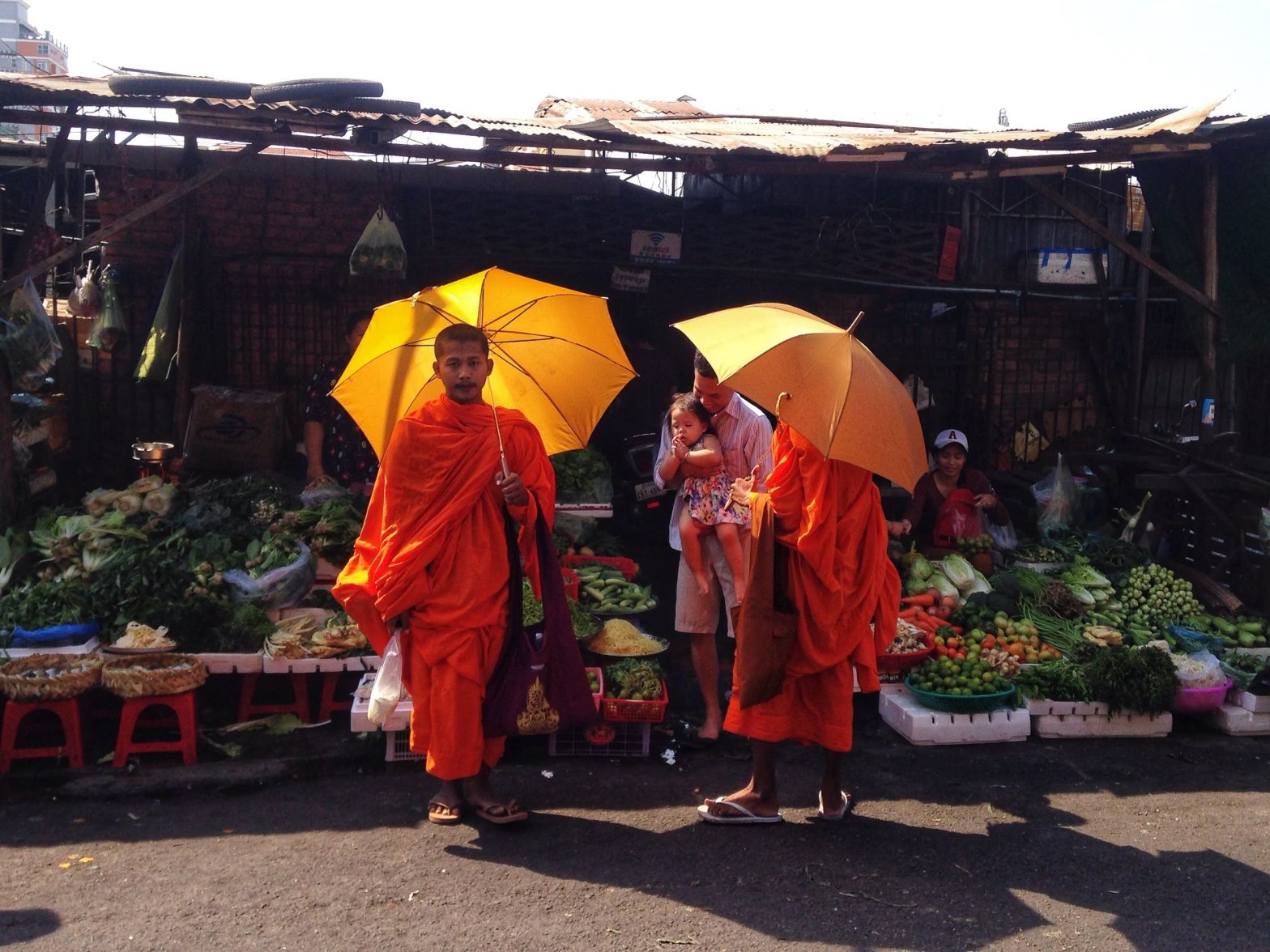
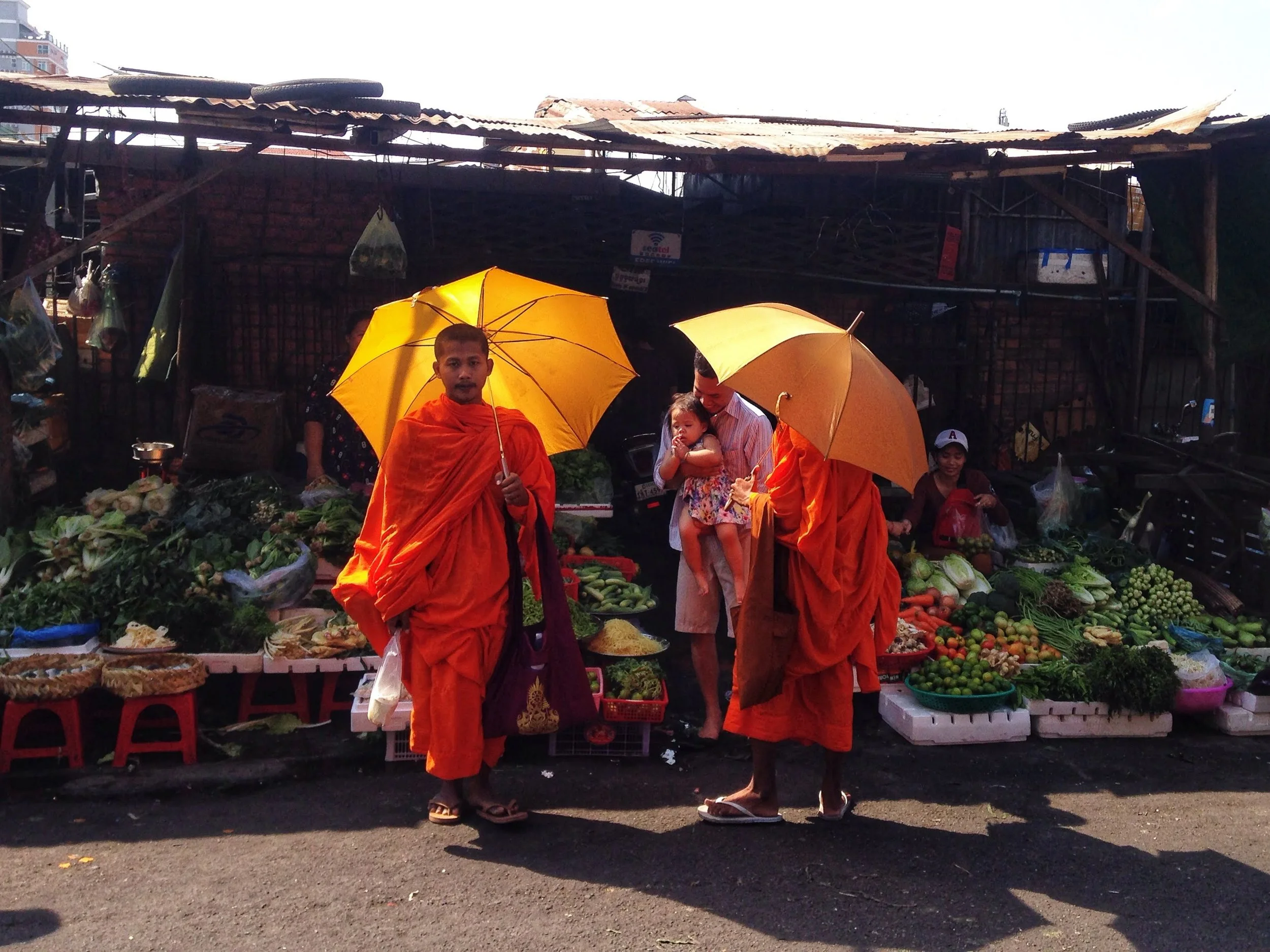
Buddhist monks collecting alms at the Russian Market in Phnom Penh
The Tuol Tompoung Market, located just south of Central Phnom Penh, Cambodia, is commonly referred to as the “Russian Market” by locals and visitors alike. The market gets its name from the past, when the market used to be full of Eastern-bloc knockoffs and fakes. Today, the market is still full of knockoffs and fakes, but most of them now are imported from China!
If you want to shop for “name brand” clothes, bags, sunglasses, or more, the Russian Market is one of the best places in the city, providing you know how to barter for a fair price.
fresh produce at the Russian Market
The Russian Market is busy, crowded, and cramped. Even if you don’t plan on buying anything, it can be a really interesting experience in and of itself to squeeze yourself through the narrow alleys inside the market, looking at the counterfeit DVDs, fake Prada bags, cheap souvenirs, and fresh produce. The market is also a great place to find some of the cheapest and tastiest Khmer street food in the city.
entering the Russian Market
Bartering
You will have to barter at this market in order to get the best price. Bartering is just a part of shopping at a market like this one in Cambodia.
Bartering is almost like a game. The goal isn’t to get the cheapest price possible, but instead to agree on a price that both the buyer and seller thinks is fair and reasonable.
Don’t think that the shopkeeper is trying to rip you off or cheat you because they quote you a higher price than you expect. The point is to barter it down to a reasonable price. Bartering is supposed to be fun!
shopping for cheap clothes and souvenirs at the Russian Market in Phnom Penh, Cambodia
Russian Market Information for Travelers
Location
The Tuol Tompoung Russian Market in Phnom Penh is located at St 163, Phnom Penh, Cambodia, within walking distance of the Tuol Sleng Genocide Museum.
Preăh Barum Réachea Veang Chaktomuk, the Royal Palace in Phnom Penh, Cambodia
The gates of the Royal Palace in Phnom Penh, Cambodia.
Just as royal and religious life in Thailand are centered around the Grand Palace and the Temple of the Emerald Buddha, the neighboring Kingdom of Cambodia has its own impressive royal palace and temple where visitors can learn more about the royal history and culture of the small Southeast Asian kingdom.
A visit to the Royal Palace and Silver Pagoda is one of the must-have experiences when visiting Phnom Penh. Although the monarchy was deposed in the 1970s by the Khmer Rouge, it was restored in 1993, returning the previous king to the throne. This makes Cambodia one of the few countries in modern history to restore its monarchy.
Today, some parts of the Royal Palace, including the Throne Hall, Silver Pagoda, and some dozen or so Buddhist shrines and stupas, are open to the public. The residences of the royal family are, of course, off limits to tourists.
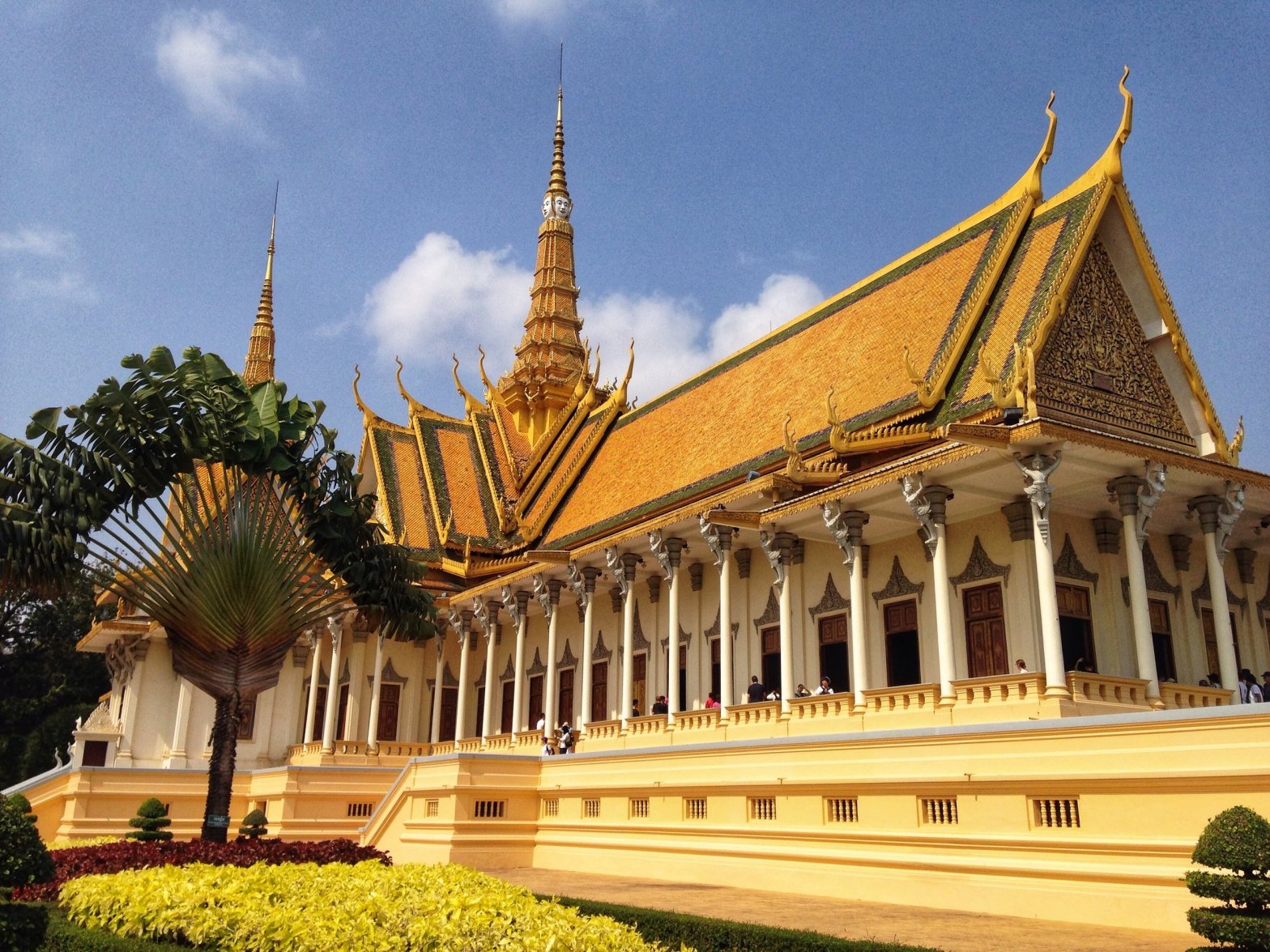
The Throne Hall at the Cambodian Royal Palace, Phnom Penh.
Wat Preah Keo Morakot, the Silver Pagoda (Temple of the Emerald Buddha)
The Silver Pagoda, rarely called by its official name, “Temple of the Emerald-Crystal Buddha”, is the most important Buddhist temple in Phnom Penh, and the royal temple of Cambodia.
Murals at the Royal Palace depicting scenes from Cambodian history and legends.
The murals at the temple depict scenes from Cambodian history and the Ramayana. Although it fell into disrepair during the Khmer Rouge era, the temple has undergone excellent restoration. Many of the murals have been returned to their original state.
The Silver Pagoda at the Royal Palace, Phnom Penh, Cambodia
The main building in the temple compound at the palace is the Silver Pagoda, named for the silver tiles that covered the temple in the pre-Khmer Rouge monarchy period.
The Silver Pagoda, also called the Temple of the Emerald-Crystal Buddha
The temple holds Cambodia’s 17th-century replica of the Emerald Buddha, the most holy religious image in Theravada Buddhism. The original Emerald Buddha is now housed at Wat Phra Keao at the Grand Palace in Bangkok, Thailand.
Buddha statues at one of the many shrines at the Royal Palace.
Photograph is not permitted inside the Throne Hall or inside the Silver Pagoda.
Visitors are asked to remove shoes when entering any temple or shrine building at the Royal Palace.
Visitors should be advised that a dress code is required to visit the Royal Palace. The dress code forbids short, short skirts, and sleeveless shirts. Arms and legs must be covered.
The Silver Pagoda is the most important royal temple in the Kingdom of Cambodia.
Royal Palace and Silver Pagoda Information
Location
The Royal Palace and Silver Pagoda are located in central Phnom Penh along the banks of the Mekong River. The palace is located next to the National Museum of Cambodia, and down the road from Wat Phnom.
The Royal Palace is open to visitors from 8:00 to 17:00 daily
A common scam involves tuk-tuk drivers or tour guides telling tourists that the palace is closed. This is in an attempt to get them to hire the driver for the day instead. Don’t fall for this! The palace is open every day.
Admission
A ticket to the Royal Palace includes visiting the Throne Hall, Silver Pagoda, and various other royal pavilions and Buddhist shrines.
Tickets to the Royal Palace cost 40,000 KHR or $10. The ticket comes with a map, which explains what each building and structure at the palace compound is.
Tour guides are available for hire for an additional $10.
An entry ticket (40,000 khr or $10) to the Royal Palace and a map of the palace grounds.
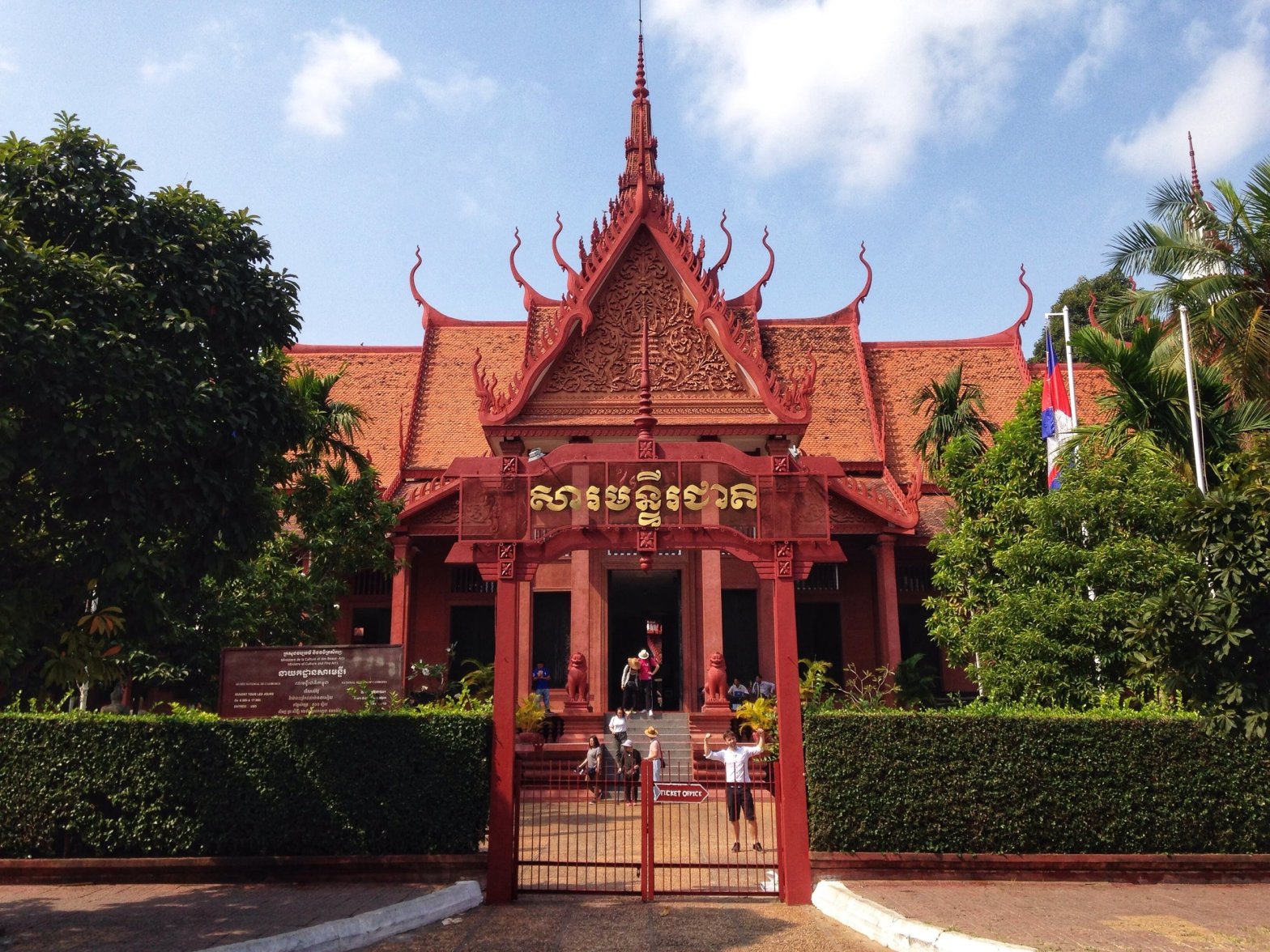
The National Museum of Cambodia in Phnom Penh is located near the Royal Palace in a gorgeous old Cambodian-Colonial style building, which dates back to the founding of the museum in 1920. The collection is interesting, but students of architecture will possibly find this incredible old building even more so.
The museum houses the kingdom’s largest collection of Cambodian art, artifacts, antiques, and treasures
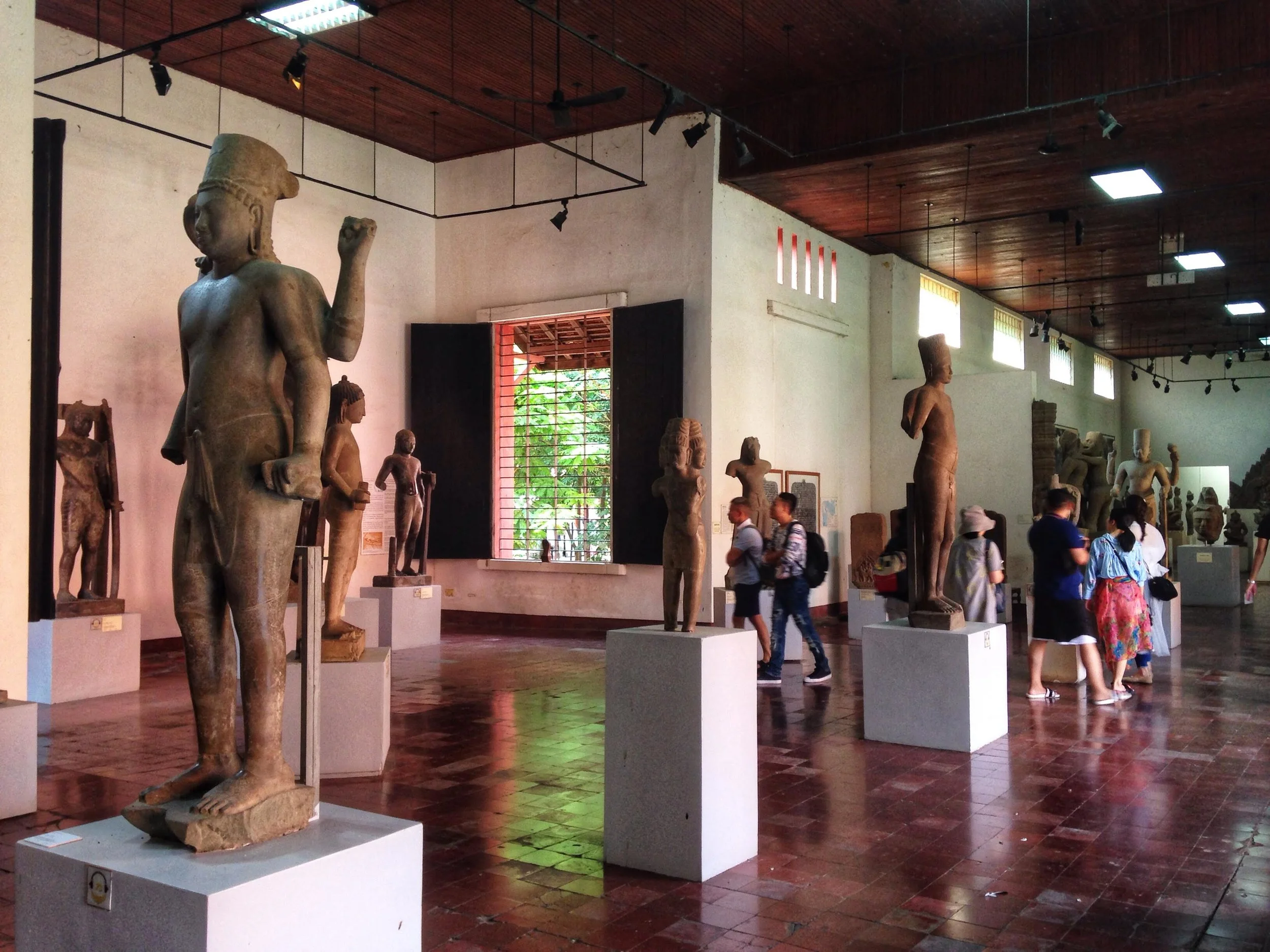
The National Museum of Cambodia in Phnom Penh holds one of the kingdom’s best collections of ancient artifacts and treasures
The museum’s collection includes artifacts from all periods of Cambodia’s ancient and medieval history – some dating back to the pre-Angkor era.
It’s a beautiful museum, but unfortunately the building is not air-conditioned. While shady, it can get a bit hot and stuffy. My only other complaint about the otherwise excellent museum is that many of the exhibits and displays lack information boards giving any real history or context to the artifacts. If you are really interested in learning about the history of the exhibits, I recommend renting one of the additional audio guides that are available when you purchase a ticket.
art and artifacts inside the National Museum of Cambodia
The history of the National Museum of Cambodia
The Cambodian National Museum was opened on Khmer New Year, 1920. The elegant and imposing red museum building was designed in the style of Khmer Buddhist temples. In the years after its inauguration, the museum accumulated the world’s largest collections of ancient Khmer artifacts, dating back to before the Angkor Empire (Angkor Wat).
Sadly, the museum was abandoned and fell into disrepair in the 1970s when the Khmer Rouge seized power in Cambodia. It has since been restored to its former state, and today is the authority on Cambodian history, art, and archaeology.
the courtyard at the National Museum
Take some time to walk around the museum’s courtyard. Here, you can buy a cool drink and sit in the shade, watching the fish and fountains in the ponds.
People love taking photographs in the courtyard. You might even see a young Cambodian couple taking their pre-wedding photos here!
National Museum of Cambodia (Phnom Penh) or the Angkor National Museum (Siem Reap)?
Cambodia actually has two different national museums: the National Museum of Cambodia in Phnom Penh and the Angkor National Museum in Siem Reap.
What’s the difference between these two museums? Is one better than the other?
Honestly, if you have the time and are interested in Cambodian art and history, you really ought to visit both museums.
The National Museum of Cambodia in Phnom Penh is older (1920s). It has a larger, more extensive collection. This museum is located in the capital, and receives more government funding and attention. However, the building itself (though beautiful) is much older, and is not air-conditioned. The collection is large, but is not laid out in the most caring way. Some of the artifacts seem a bit dusty or neglected. There is also not so much posted information. If you don’t rent an audio guide, you may have a hard time telling one artifact from the next.
The Angkor National Museum in Siem Reap is newer and flashier. While the collection is smaller, this museum receives far more private funding. It is fully air-conditioned, the displays are well-laid out and fully informative. The Angkor National Museum is dedicated entirely to Angkor-Era (Khmer Empire) artifacts and history.
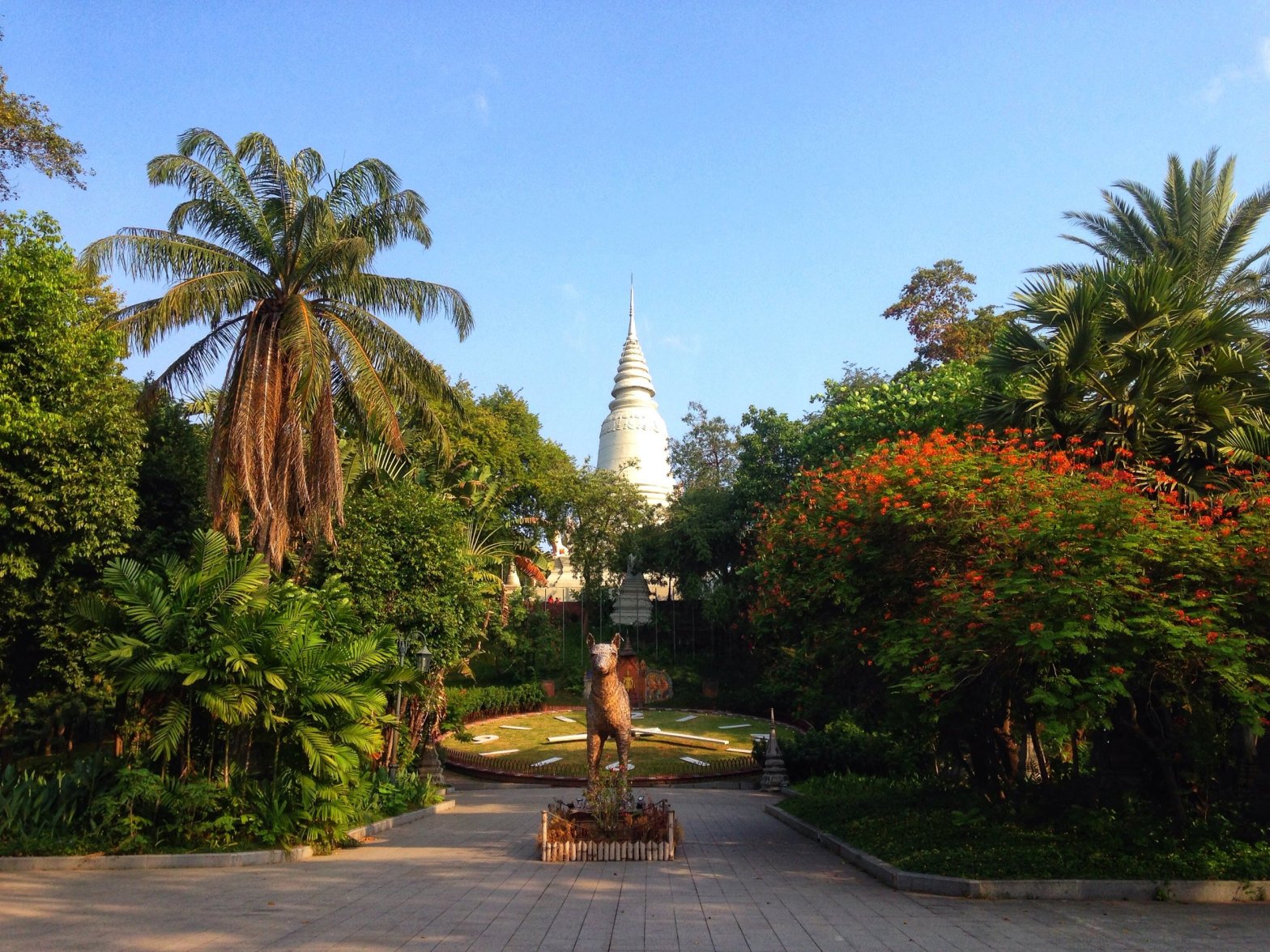
Wat Phnom, Phnom Penh, Cambodia – this temple is one of the oldest and most important in the city
Wat Phnom, a temple that stands on a hill overlooking the city, is one of the oldest and most important Buddhist temples in Phnom Penh, Cambodia. In fact, the tallest temple in the city is the Phnom Penh’s namesake, its history dating back to the early 14th century.
If you want to get a close look at spiritual life in Phnom Penh, there really is no better place than Wat Phnom.
the entrance to Wat Phnom
The history of Wat Phnom dates back hundreds of years, and is steeped in myth and legend. According to the stories, an old woman named Penh discovered a bronze Buddha sculpture inside a tree atop the hill. The people recognized it as a sacred site, and built a stone shrine to honor it.
The name of the city comes from the Khmer word for “hill”, Phnom, and the woman’s name, Penh.
The temple has been added to and re-built many times since its founding. Today, it is the tallest religious structure in the entire city, and the tall white chedi towers over the surrounding area from atop its hill.
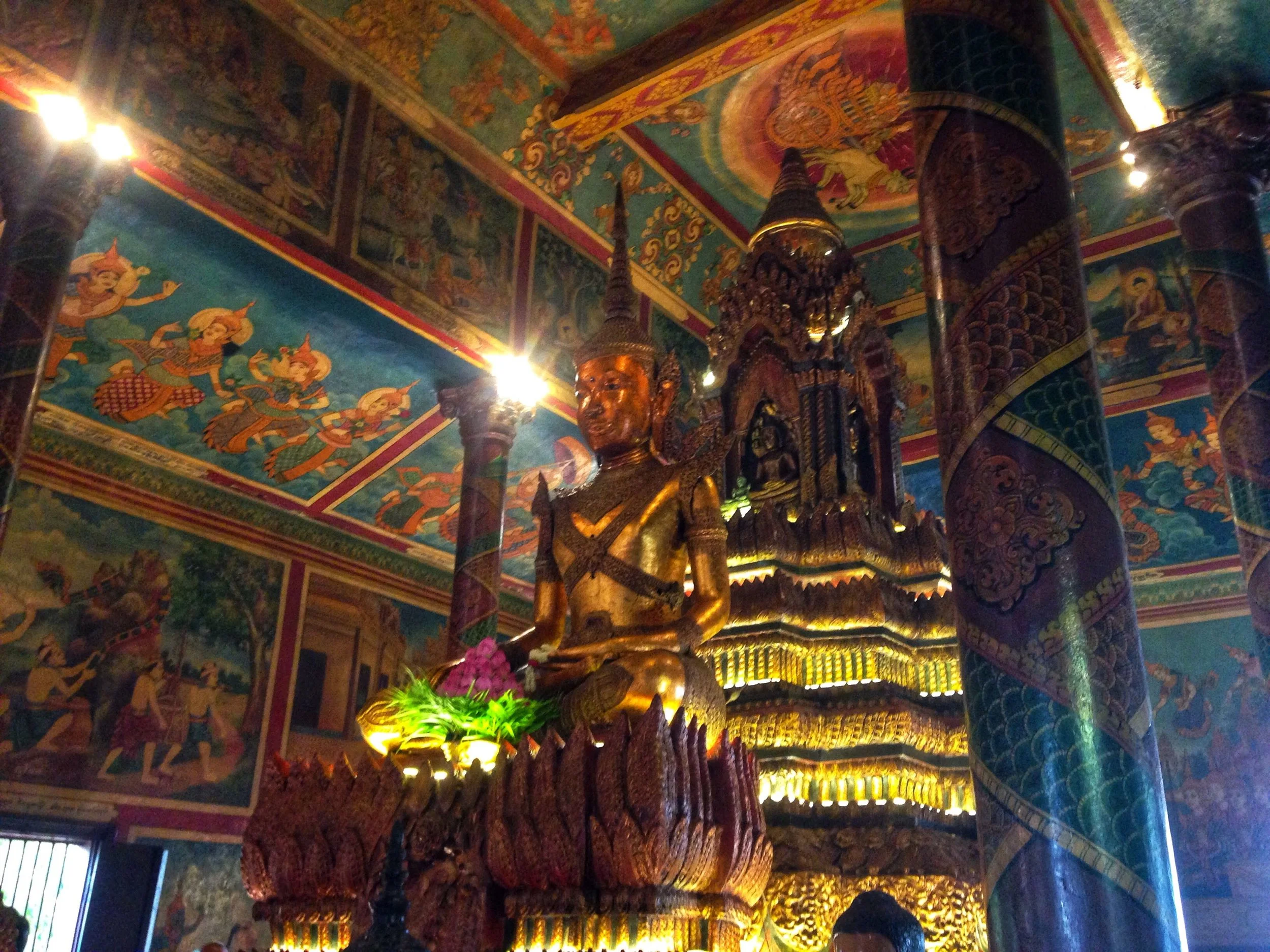
The interior of Wat Phnom Temple in Phnom Penh, Cambodia.
Visitors have to climb a set of stairs up the hill to reach the main temple building. Once inside, take some time to admire the incredible works of art painted on every wall and the ceiling. Wat Phnom was once one of the most important royal temples in Cambodia, and it is painted to be fittingly celestial.
The remains of several members of the royal family are interred in stupas on the grounds of Wat Phnom.
You can purchase sticks of incense or candles to light as an offering at the temple. There are also old women with cages of birds that you can pay to release for good karma. I advise against this practice, however. The birds are trained to return, making your good intentions just a waste of money.
If you visit during a holiday, you will be able to get a very intimate look at local Cambodian Buddhism, but be advised that it can get very crowded during religious holidays.
candles, incense, and prayers inside Wat Phnom
Wat Phnom Location, Opening Hours, and Ticket Price
Wat Phnom is located in the center of Phnom Penh just across from the US Embassy. The temple is located close to the National Museum and the Royal Palace. While it’s possible to walk, the traffic makes it much easier to hire a tuk-tuk for the short distance. >Open Google Maps Link. You shouldn’t have any trouble finding the temple, as it’s one of the major sites in the city, and is located in a very prominent location in the center of town.
Wat Phnom is open daily from 8:00 – 17:00. It can get crowded on holidays, especially on Buddhist holidays, New Year, Chinese New Year, and Khmer New Year.
After witnessing the crazy traffic and crowds around Hoan Kiem Lake all week, our first weekend in Hanoi , Vietnam surprised us by how peaceful and lovely this area could be without the hustling and bustling of the weekday traffic.
The streets around Hoan Kiem Lake are closed on the weekend, and the area is open for pedestrians to enjoy the area around the lake.
We stepped outside on a Saturday morning and were shocked to see that there were no cars and no motorbikes, and that the streets surrounding the lake had been closed off for pedestrians. A local friend told us that they close down the road around the lake every Saturday and Sunday so that families can enjoy the area. It’s so nice to get to enjoy the view of the famous Turtle Tower, the lake and the city in a more relaxed atmosphere than is usual in Hanoi.
kids catching bubbles – there are lots of games and activities for families around the lake on the weekend
Every weekend the local Hanoians come out to walk or jog and spend time with their families around the lake. Vendors sell games for kids, like toy airplanes that they can fly, and kids can rent electric cars to drive around the empty streets (or have the parent control them by remote). It’s also normal to see a group of Vietnamese teenagers doing a hip-hop dance show, street musicians, magicians, caricature sketch artists, and vendors selling all sorts of toys and candy.
Street vendors around Hoan Kiem Lake during the weekends
Visiting Hoan Kiem Lake on the weekend is totally different from visiting during the week. It doesn’t feel as much like Vietnam as it does remind me of my time in Europe. It’s fun to join the crowd and enjoy the calm and fun weekend atmosphere.
There artists make great sketches of people in just a few minutes.
We stayed in Hanoi for one month. Although we really did enjoy our time in the city, sometimes the traffic and stress of trying to avid getting hit by a motorbike really wore us down. It was nice to have a chance to breathe and relax while walking around the neighborhood.
The weekend is the only time when you’ll ever see a clear and empty street in Hanoi’s Old Quarter!
When you’re visiting somewhere, especially if you are staying for a long time, it’s great to try to see what local life is actually like, beyond the top destinations from the guidebooks. Here in Hanoi, local life on the weekends revolves around Hoan Kiem Lake.
Musicians provide live music all throughout the day
Other posts about Hanoi and Hoan Kiem Lake that you might enjoy:
The Khmer Rouge, under dictator Pol Pot, ruled Cambodia under one of the most oppressive and genocidal regimes in history. It’s unclear exactly how many people were killed by the Khmer Rouge, but high-end estimates put the death toll around 30% of Cambodia’s population.
In the past several decades, Cambodia has come a long way in recovering from its heartbreaking past, and today, with its reestablished monarchy, is developing and moving forward into a brighter future.
Part of ensuring that nothing like the Khmer Rouge ever happens again is spreading awareness and educating the world about what happened in Cambodia during the 1970s. Although it can be hard to hear, it’s important to learn about it when visiting Cambodia.
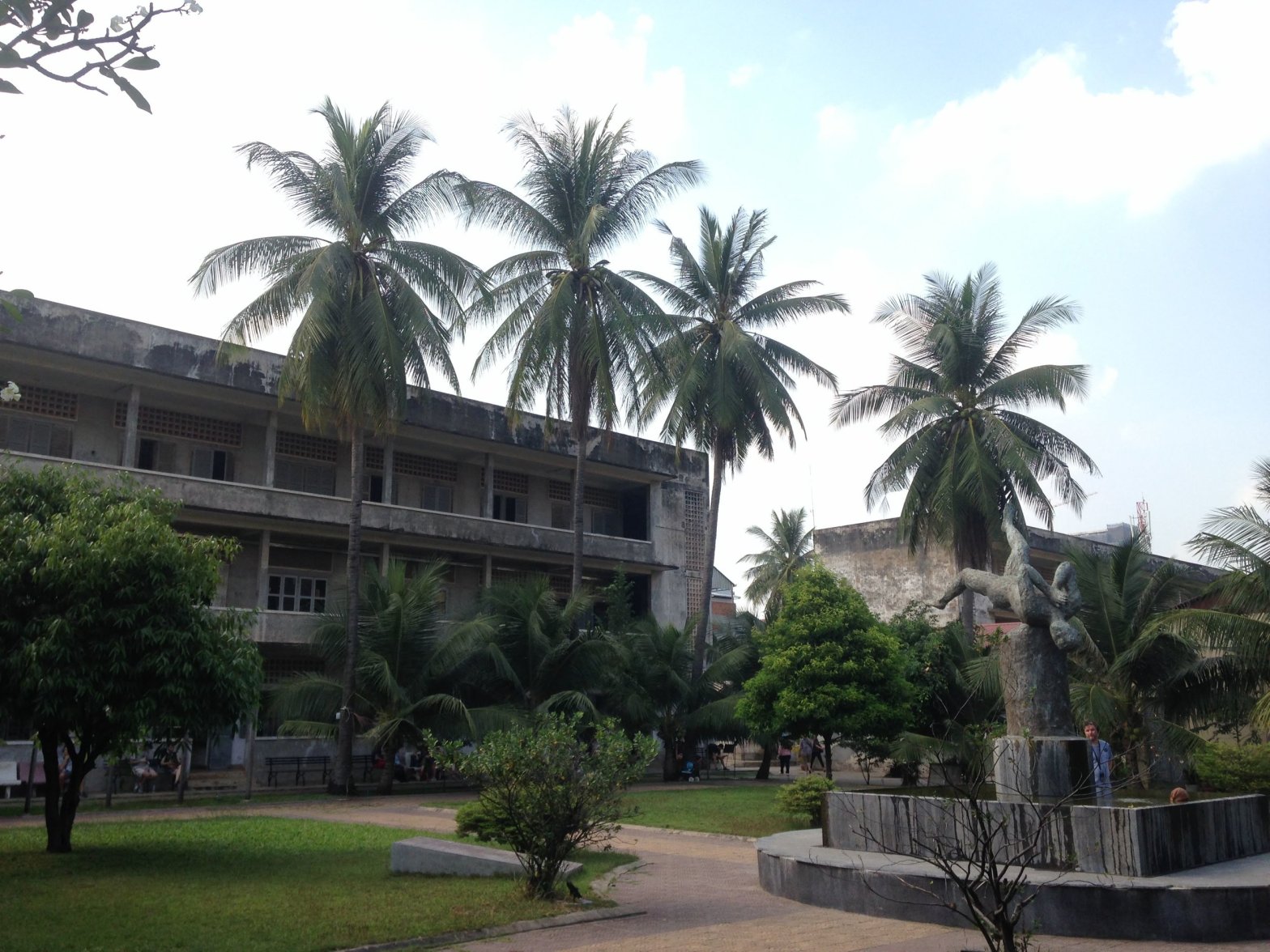
Tuol Sleng Prison, code-named S-21, was a brutal prison for Pol Pot’s Khmer Rouge regime. Today, the former prison has been turned into the Tuol Sleng Genocide Museum.
One of the most tragic and important places to learn about the Cambodian genocide is at the Tuol Sleng Genocide Museum in the country’s capital, Phnom Penh. This school turned prison (code-named S-21) was one of the regime’s most brutal prisons. An estimated 20,000 prisoners were executed there. Seven former prisoners survived.
I really do recommend paying the extra $3 to rent an audio guide, or better yet, hiring a guide to take you around the museum. Hearing the personal stories of the brutalities that took place at Tuol Sleng makes the experience much more powerful than just wandering around on your own.
If the photographs of the victims on display or the stories about what happened to them gets to be overwhelming, there’s a very nice rest area in one of the buildings called the White Lotus Room. It’s a sort of meditation room with comfortable cushions, quiet music, air-con, and cold water where visitors can sit to meditate or pray.
The prison was built inside of an old school. Classrooms were turned into cramped prison blocks and torture rooms.
As a teacher, it breaks my heart to see a school, which should be a safe place where students can learn and grow, turned into a prison camp. Walking around the old buildings, I was struck with a really eerie and uncomfortable feeling. Many of the buildings were laid out exactly like the school where I teach in Thailand.
a memorial to the martyrs of the Khmer Rouge regime at Tuol Sleng Genocide Museum in Phnom Penh
It’s not a fun place to visit, and it’s not a happy place to visit. But it is an important place to visit. I think that it’s important to take a step back to remember the horrible tragedies that took place here just decades ago.
prisoners were held in terrible conditions in the S-21 prison
Tuol Sleng Genocide Museum Location
The Tuol Sleng Genocide Museum in Phnom Penh, Cambodia is located at St 113, Phnom Penh. It’s not far from the Russian Market, and technically within walking distance. I walked from my hotel, which was located near the Russian Market, but with the traffic in Phnom Penh, I recommend hiring a tuk-tuk. If you are not used to walking in Phnom Penh, or are staying far from the museum in another part of the city, definitely hire a driver. It’s too far to walk to Tuol Sleng Museum from the Royal Palace or riverfront area.
It’s not hard to find the museum. It’s very clearly marked, and as the prison was built in an old school, the area is quite large – making up the entire block.
The Tuol Sleng Genocide Museum is open daily from 8:00 – 17:00.
Tuol Sleng Genocide Museum Admission Price
Admission to the Tuol Sleng Genocide Museum is $5 for adults. The audio guide costs $3 extra. I highly recommend paying the full $8 for the entry ticket and audio guide. The first time I visited the museum, I opted out of the extra audio guide, and definitely didn’t get nearly as much out of my visit as I did the second time, when I did take the audio guide.
$5 – entry ticket only
$8 – entry ticket and audio guide (definitely take this option!)
Top 10 Experiences to have on a trip to Luang Prabang, Laos
For such a small town, Luang Prabang has a lot to offer. From temple-hopping and silent cinema to sipping snake whisky and shopping at the night market, it’s hard to be bored, even if the town looks a little sleepy from the outside. Here, we share some of the coolest experiences that we recommend you to try when visiting Luang Prabang, Laos.
1. Visit the Royal Palace and the Phra Bang Buddha
If you only do one thing in Luang Prabang, you must visit the Royal Palace and the Haw Phra Bang Temple. This is the most important royal site in the city, and the home of the holiest Buddha in Laos.
Today, the old Royal Palace s now the Luang Prabang National Museum, and holds a fascinating collection of pre-revolution Lao royal artifacts, which are kept on display, preserving the lives of the late royal family.
The Haw Phra Bang Temple houses the Phra Bang Buddha, which is the city’s namesake. This holy artifact is considered the most sacred Buddhist relic in all of Laos, and is kept on the grounds of the Royal Palace in one of the city’s most beautiful temples.
The Royal Palace in Luang Prabang, Laos is now home to the National Museum, which houses numerous royal artifacts
2. Try Snake Whisky and pray at the Pak Ou Caves
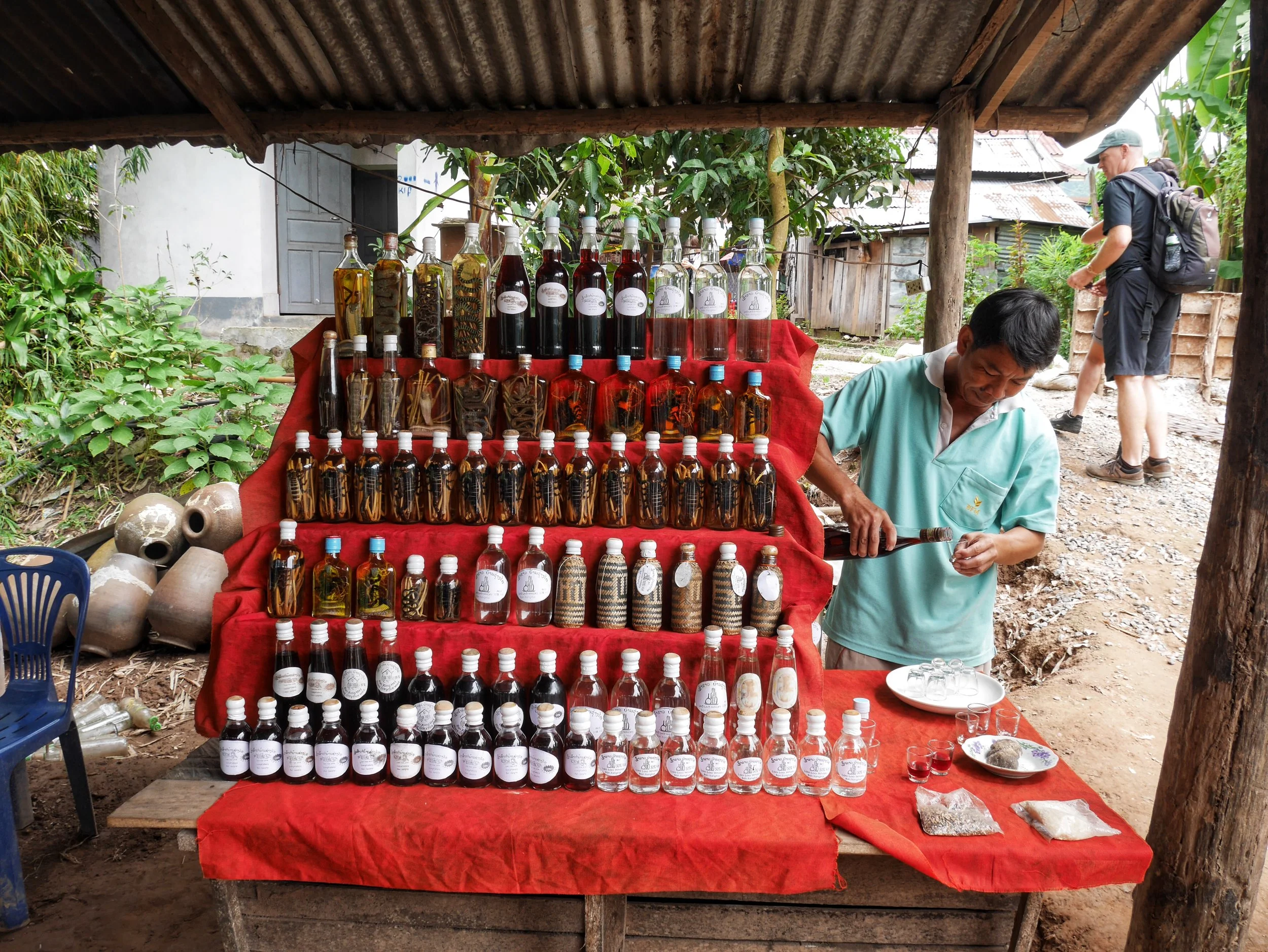
Are you brave enough to sip on 100-proof Lao moonshine fermented with a preserved cobra??
If so, take a stop at the famous Whisky Village. A visit to the village is included as part of a package tour to the sacred Pak Ou Caves where old and damaged Buddha images are retired at a former royal meditation retreat.
Although the Whisky Village may not be exciting enough to visit on its own, when paired with a stop at the caves, it’s definitely worth the visit, if only for the odd experience that it is. The village has been making homemade lao-lao, or rice whisky, in the traditional style for hundreds of years… but try it at your own risk!
snake whisky at the Whisky Village near the Pak Ou Caves, Luang Prabang, Laos
3. Learn about Endangered Bears and explore the Kuang Si Waterfall
The most popular half-day trip from Luang Prabang is a visit to the Kuang Si Falls, a sacred waterfall that is located just 30km outside of the city. The waterfall itself is immense and impressive, and is deeply steeped in local myth and legend.
Maybe even more interesting than the waterfall itself is the Tat Kuang Si Bear Rescue Center, which has a headquarters at the Kuang Si Forest Park. The Bear Rescue Center works to combat the illegal Asiatic black bear trade in Laos. These endangered bears are rescued and rehabilitated at Kuang Si. A visit to the Bear Rescue Center is free, and you can learn a lot about the brutal bear trade and the efforts of the Laotian government, as well as volunteers and NGOs, in fighting the industry and rescuing the bears.
The world-famous Kuang Si Falls are located just 30km outside of Luang Prabang, and make for a great half-day trip from the city
4. Take a slow boat ride down the Mekong River
There are few experiences in Luang Prabang more relaxing than a slow cruise down the muddy waters of the Mekong River. You can hire a boat and driver from the Luang Prabang boat dock.
A river boat ride is part of the package when visiting the Whisky Village and the Pak Ou Caves, but you can also hire a driver to cruise you up and down the river at your own leisure. It’s even nicer with a cold can of Beer Lao in hand!
Luang Prabang Boat Ride
5. Join in the morning alms-giving ceremony
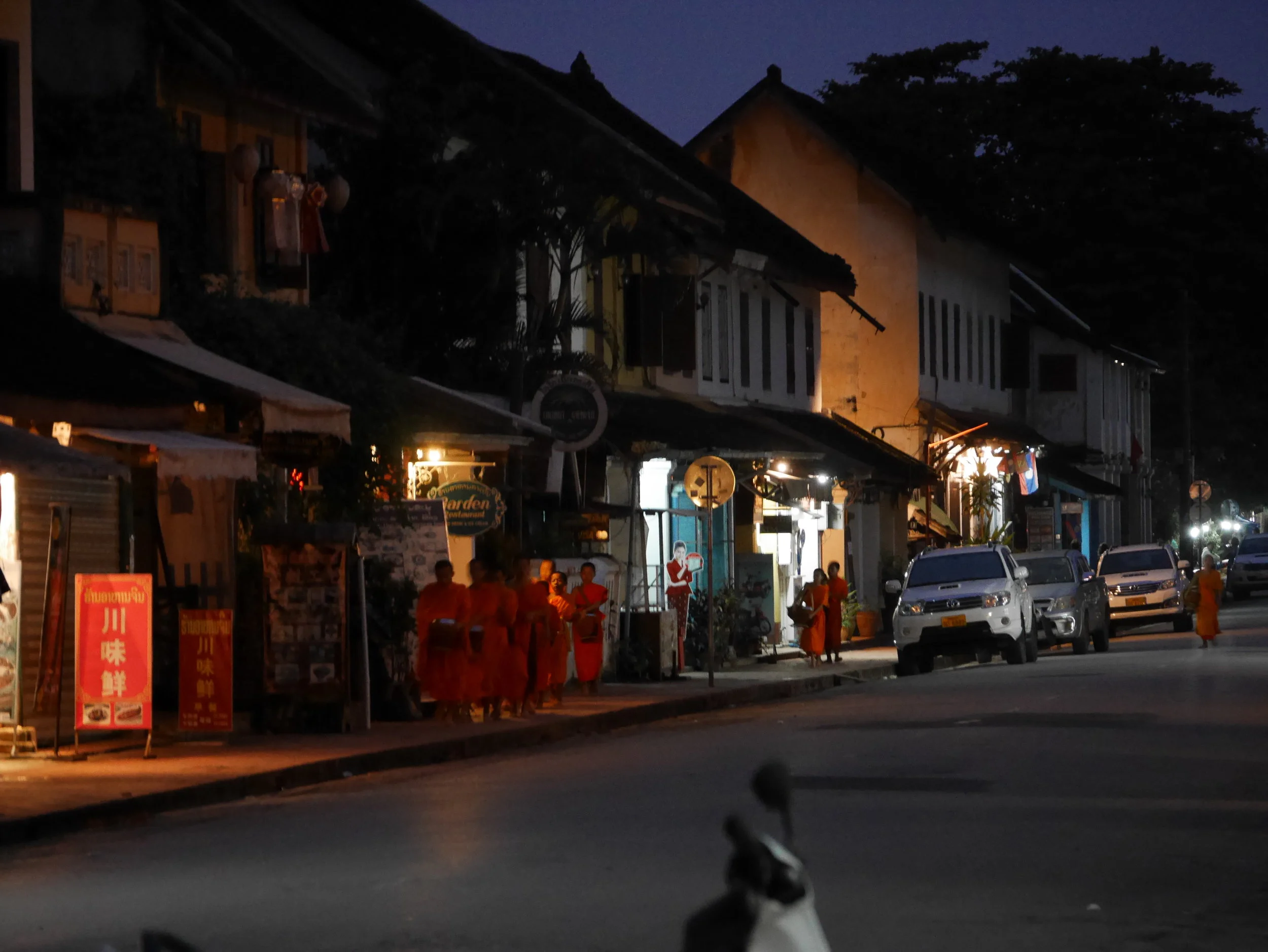
Every morning, before the sun rises in Luang Prabang, dozens of Buddhist monks, clad in their saffron robes and carrying nothing but their monk’s bowls, slowly walk the silent streets. These monks are partaking in the daily “sai-bat” or alms-giving ceremony. Devout Buddhist kneel on the side of the road, placing offerings of food into the bowls of the passing monks in exchange for a blessing.
Even if you are not Buddhist, you are welcome to witness, or even take part in this sacred ceremony. Just be sure to be respectful and follow the proper cultural behaviors.
6. Learn about Laos’ tragic past at the UXO Museum
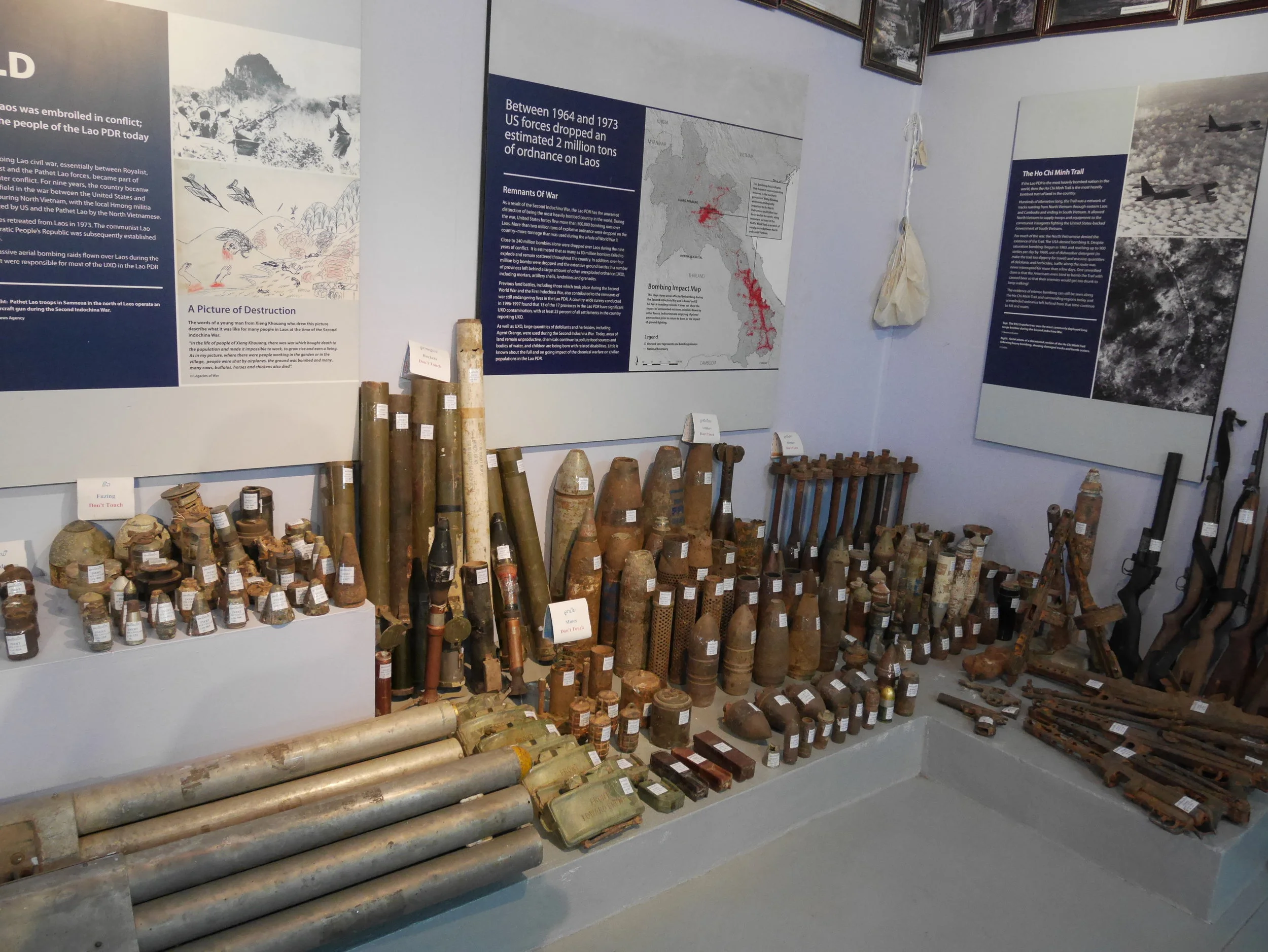
Though today a seemingly happy and peaceful country, Laos has a difficult and tragic past. During the second half of the 20th century, Laos became the battleground of the “Secret War” between Eastern and Western powers. It was rarely reported. During this time, Laos became the most heavily bombed country in the history of the Earth. Today, there are still many times more bombs left unexploded in Laos than there are people. Every year, many people are killed and injured by these explosives.
Learn more about the tragic situation and what various NGOs are doing to try to help matters at the Luang Prabang UXO Museum. I highly recommend visiting this heartbreaking but important museum, or the COPE Center in Vientiane. Both museums will give you an in-depth look at the current situation surrounding UXOs in Laos and what is being done about it.
casings from various explosives dug up all throughout the country on display at the UXO Museum in Luang Prabang, Laos
7. Take a walk at Night Market and grab a cheap buffet dinner
Want to pick up some souvenirs? There’s no better place than the Luang Prabang Night Market! Every night, the main road in town comes alive with the bustle of a busy market. You can buy everything from Beer Lao t-shirts and Buddhist amulets to silk scarves and eco-friendly bamboo straws. You can even purchase traditional hill tribe handicrafts and amazing one-of-a-kind artwork.
The Night Market is also one of the cheapest and most fun places to eat dinner in Luang Prabang. The famous Night Market Buffet has a huge selection of organic vegetarian dishes to choose from. Just pay a few thousand kip, and fill up your bowl with as much food as you like. Best served with an ice-cold glass of Beer Lao!
If you are craving a little protein, grilled meat is also cooked to order, costing extra.
delicious and colorful dishes available at the Luang Prabang Night Market’s famous vegetarian buffet
8. Have an unforgettable movie night
There is no cinema in Luang Prabang, but that doesn’t mean that you can’t have a movie night out!
Stop by the Sanctuary Hotel every evening for a free screening (they ask that you do purchase a small snack or drink) of the 1927 movie Chang.
This is an incredible experience. If you think such an old movie will be boring, I can guarantee you that it’s not at all. Chang, which follows a family living in a small village on the border between Thailand and Laos, is one of the world’s first documentaries. This silent movie has a loose plot based around the village dealing with threats of rampaging elephants, leopards, and tigers, but really it’s an awesome look at traditional family life.
The movie is about an hour long, and it’s super fun, especially if watched with friends. I can’t recommend it enough! In fact, it kind of kicked off an interest in me for looking up a bunch of old silent films to watch.
Chang is screened nightly in Luang Prabang.
9. Go Temple-Hopping in the old town
If there’s one thing that Luang Prabang is known for, it’s the city’s amazing UNESCO World Heritage temples. Luang Prabang has dozens of temples, each one unique.
Luang Prabang is considered to be the holy city of Laotian Buddhism, and you can’t turn your head in Luang Prabang without seeing at least another temple or two.
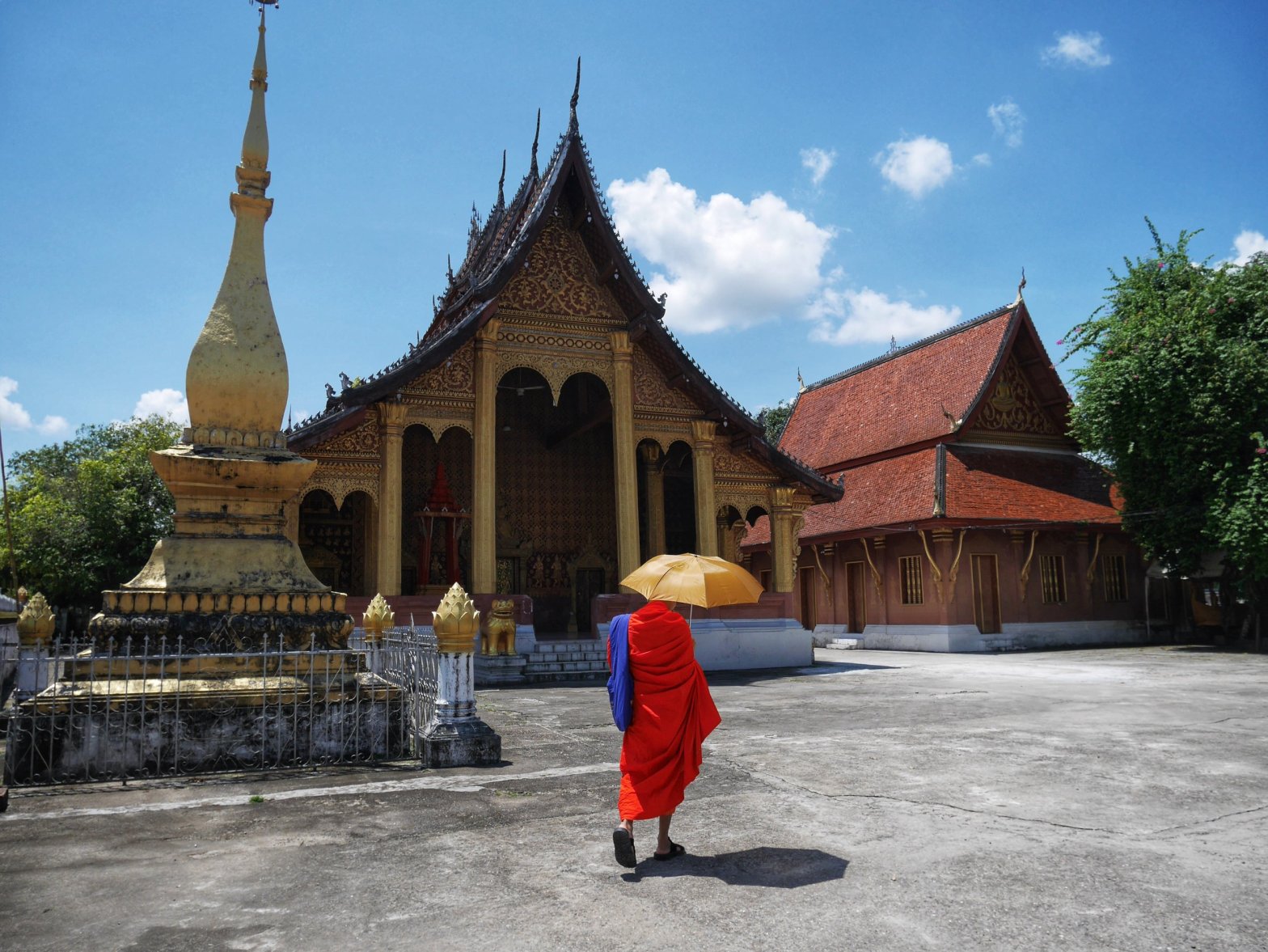
A Buddhist monk walking at a temple in Luang Prabang, Laos
10. Chill out by the river with a few glasses of Beer Lao
All of that temple-hopping is sure to make a traveler thirsty! Cool off at Utopia, a river-front restaurant, lounge, bar, and the coolest place in the city.
Everyone who visits Luang Prabang eventually ends up at Utopia. It’s a cool and breezy place to pass a few hours over a cold beer (or iced coffee) and a snack.
Utopia is one of the best places in Luang Prabang to kick back and relax after a busy day of sightseeing




























 LB convert