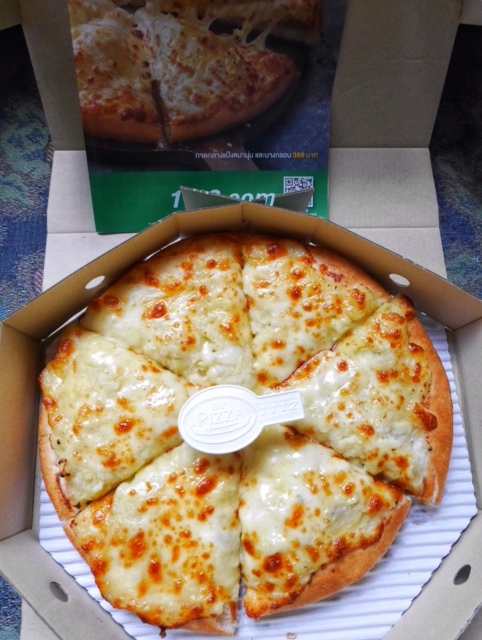
For a limited time only, The Pizza Company, a popular pizza restaurant and delivery, is offering a very strange and very Thai dish: durian and cheese pizza. Is it any good? Let’s check it out.
Durian and Cheese Pizza from The Pizza Company, Thailand
What is durian?
Durian is a very stinky fruit that is popular in southeast Asia. It’s called the “King of Fruit” in Thailand. Despite its bad smell, it’s pretty popular with local people, and after a few years, even some expats begin to like it… in small doses.
Durian really does stink. It smells so bad, in fact, that it’s banned from many public places alongside smoking.
“It tastes like heaven and smells like hell”, is the most popular description of durian. It’s mushy and dense, and has a sort of rich, creamy, and mildly sweet flavor. It smells something like gasoline, stinky feet, and rotten fruit.
Pizza Company Durian Cheese Pizza REVIEW
After seeing the advertisement for the new durian and cheese pizza from The Pizza Company, I decided that I had to give it a try. I ordered the pizza online for 359 baht (about $11).
I could smell the pizza from inside its box and the delivery bag as soon as I opened the door to the pizza delivery guy. Durian has a strong odor! I’ve come to like durian over the past few years, but the smell is a bit shocking!
I took a bite: the first taste was overwhelmingly that of durian. If you hate durian, you will definitely hate this pizza. It’s not mild, and there is no way around it. The second taste was that of lots of melted cheese. The sweet durian and the salty cheese go together well, but I still can’t help feeling like this pizza is a little too sweet to make a meal. It’s more of a dessert, in my opinion.
I like it, but it’s not something that I want to eat over and over again. I did put a few pieces in the fridge, and I actually think it tastes even better cold.
In my opinion, it’s worth trying if you like durian, but if you aren’t a fan, you will probably want to give it a pass. If you really like durian, why not give it a try? I kind of like it, but I have to admit that it is a strange concept.
Durian pizza is available from The Pizza Company through 21 November 2018, or while supplies last.
Thailand is one of the most popular destinations in the world for foreign tourists to visit. When you are visiting Thailand, you will probably want to use your mobile phone. Should you pay for an international plan before you leave home, purchase a pre-paid tourist SIM card upon arrival in Thailand, or buy a local Thailand SIM card?
What are the different mobile networks in Thailand? Which mobile network should I use? What phone plan should I buy in Thailand? Can I use my phone in Thailand? Where can I buy a SIM card in Thailand? How do I get the best deal on text, talk, and mobile data in Thailand?
Here is everything you need to know about traveling with your mobile phone in Thailand.
How to unlock your phone to use in Thailand
Before leaving your home country, simply call your mobile provider (such as Sprint or Verizon) and ask them to unlock your phone, as you will be traveling abroad.
If you can’t unlock your phone before leaving for Thailand, you can bring it to any mobile phone shop.
Unlocking your phone is completely legal. It simply means that your mobile carrier allows you to use a tourist SIM card, or other SIM card, while traveling abroad.
Where to get your phone unlocked in Thailand
The best place to get your phone unlocked for just a few hundred baht is at the 4th floor market at MBK Center in Bangkok, a huge shopping mall dedicated to mobile phones and electronics.
MBK Center – BTS Skytrain station National Stadium
A tourist SIM card is much cheaper than using an international roaming plan from your provider back home. For example, AT&T offers an international roaming plan for $10 per day.
Instead, you can purchase a tourist SIM card from Bangkok International Airport for the same price that will give you unlimited internet data, as well as a number of international calling minutes, for eight days.
Where to buy a SIM card in Thailand
Purchase a tourist SIM card upon arrival at Survarnabhumi International Airport (BKK) in Bangkok, Thailand
You can purchase a tourist SIM card from any of the major phone service providers (see below) immediately after exiting the customs area at the international airport in Bangkok
Tourist SIM cards can also be purchased from Family Mart or 7-11 convenience stores
How to buy a SIM card in Thailand
You must show your passport in order to buy a SIM card in Thailand
Which SIM card should I use in Thailand?
There are several options for tourist SIM cards that you can use in Thailand, all of which can be purchased at Bangkok’s International Airport. Each provider offers more or less identical services for identical prices.
Comparison of mobile carriers and prices in Thailand
True Move, AIS, and dtac are the three major mobile phone carriers in Thailand. All three services offer tourist SIM cards for travelers to Thailand. The cost of the tourist SIM cards in Thailand are all the same from provider to provider.
True Move H Tourist Sim options and price
The True Move H Tourist SIM has three options. 49 baht (about $1.50), 200 baht (about $10), and 500 baht (about $20). The first SIM card has the cheapest price, and is good for one day, but can be topped up at a 7-11 convenience store to renew the plan for further days.
Tourist SIM card options and prices, Thailand
The best deal is the 299 baht plan, which offers unlimited True Move wifi in public areas, unlimited mobile internet data, 100 baht of calling credits. This plan is good for eight days.
dtac Happy Tourist SIM options and price
The dtac Happy Tourist SIM is the second option for tourists and travelers in Thailand. Although the Happy Tourist Sim has more package options than the other carriers, the mobile service and price is identical.
tourist mobile phone SIM card plans, options, and prices; Thailand
AIS Traveller SIM options and price
The AIS Travller SIM is a third option for tourists. The offering is essentially identical to the other carriers, both in service and in price.
Again, while they offer a limited amount of mobile internet data at full 4G speeds, internet data is actually unlimited. The mobile internet data is throttled down to 3G speeds once your mobile data has run out.
SIM card options and prices for mobile phone usage in Thailand via AIS
SUMMARY: Which SIM card to use in Thailand?
The three tourist SIM card options (True Move H, dtac, and AIS) are more or less identical. All three tourist SIM card options in Thailand offer free calling to other tourist SIM card users on the same network (an excellent deal if you are traveling with friends) and free usage of messaging and social apps such as Facebook, Instagram, LINE or What’sApp.
It’s easy to top up the SIM card after its period has run out. Simply visit a 7-11 convenience store, or a True, AIS, or dtac phone store, and ask to “top up”. They will add money (usually 100 baht) to your SIM card, allowing you to renew your plan for another day, week, or month.
So which SIM card is best? They are all almost identical. I have used all three networks, and 4G coverage for all three networks in Thailand is widespread. There are very few “dead zones” in Thailand, mostly out in the far rural areas where tourists are unlikely to visit. Bangkok has excellent 4G coverage, and many public places offer True Move, AIS, or dtac wifi, which you can access when using each carrier’s SIM card.
The 4G internet service in Thailand is fast and comprehensive. The mobile data on SIM cards in Thailand are essentially unlimited. After reaching your limit on the 4G SIM card, the data will be throttled to what is basically 3G speeds.
Zabb on Ice: the weirdest, strangest, most bizzarre ice cream flavor that I’ve ever tasted. This limited-time-only ice cream flavor is available for only a few days at KFC Thailand restaurants. Let’s try it out and give it our honest review! This is going to be weird…
Zabb on Ice KFC ice cream REVIEW
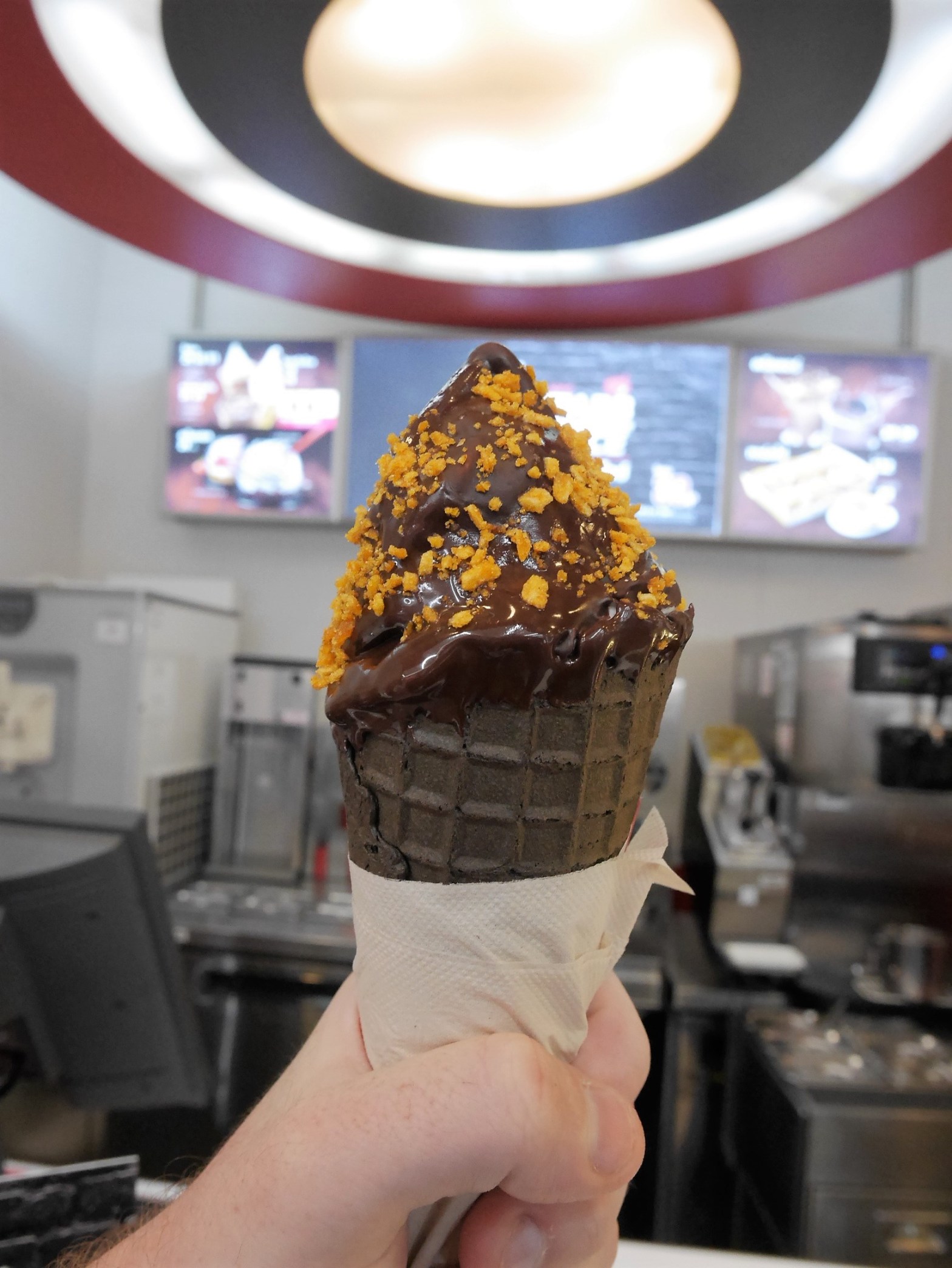
Zabb on Ice is a new limited flavor of ice cream from KFC Thailand. Vanilla soft-serve ice cream is dipped in dark chocolate that hardens into a hard shell over the cone. The dark chocolate is sprinkled with zabb powder, the crunchy spicy flavoring used at KFC Thailand on their spicy fried chicken. Yes, it’s a weird idea… but is it any good?
Zabb on Ice – KFC’s new dark chocolate and spicy chicken powder ice cream
Zabb on ice uses KFC’s regular vanilla ice cream served in a fairly large chocolate-flavored cone. So far, so good! The vanilla ice cream is dipped into melted dark chocolate, which cools and hardens into a hard chocolate shell around the ice cream.
Then comes the weird part: the ice cream is sprinkled with the zabb flavoring, which gives the zabb on ice ice cream its name. This is the same seasoning used on the spicy fried chicken sold at KFC Thailand.
The first flavor that I got when I tasted the ice cream was the dark chocolate. And it’s good! That was quickly followed by the zabb, which was salty, crunchy, and a tiny bit spicy. It sounds weird, but you know what? It’s not bad at all! It’s strange, but for some reason, I want to have more.
chocolate and spicy chicken crunchy powder ice cream from KFC Thailand
It’s not actually that spicy, just a hint of spicy. What makes it go so well with the dark chocolate, I think, is the crunchyness and the saltiness. It’s like having dark chocolate and sea salt: the sea salt brings out the sweetness and complex flavors of the chocolate. The same thing is happening here. And the slight spicy kick is a nice after taste.
So is it any good? I would say YES! It’s kind of surprising, because I thought it would be too weird to really enjoy. I actually really like it. Yeah, it’s a weird combination, but somehow, it works for me.
Hurry! The Zabb and Ice ice cream from KFC Thailand won’t be around forever!
Zabb on Ice is available at KFC Thailand for a limited time, and costs 39 baht per cone
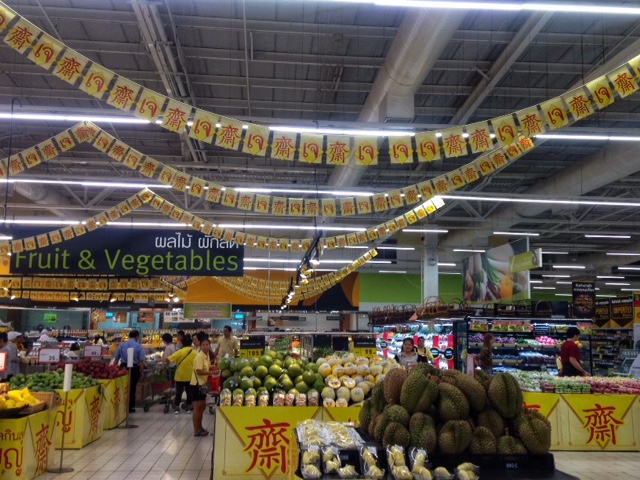
Every year in October, supermarkets, minimarts, and restaurants begin displaying yellow and red flags, meaning that the food they sell is “je” (เจ) , or proper to eat during the 9-day Vegetarian Festival.
The “Nine Emperor Gods Festival” is actually a Chinese festival, but was brought to Thailand by the large and prominent Chinese-Thai population. The festival is mostly celebrated in Bangkok and in Phuket, where the Chinese-Thai populations are the largest, though is celebrated throughout the country.
Je flags and signs at the produce section of a Thai supermarket
What foods are forbidden during the Je Festival?
The festival is usually translated to “Vegetarian Festival”, but is actually a lot more complicated than that. Technically, it’s more of a vegan festival, but there are other foods that are forbidden as well. It’s not just meat that is forbidden! During the festival, participants may not eat:
No meat, poultry, seafood
No animal products (milk, eggs, etc)
No strong vegetables (onion, garlic, chives, etc)
Technically, Je dishes must be ritually prepared in the kitchen of a Chinese temple, although this aspect is usually overlooked
vegetarian snacks and vegetarian “meat” products at a Thai convenience store
Vegetarian Festival in Phuket
While the festival is celebrated in Bangkok and elsewhere in Thailand by refraining from eating certain foods, the celebration in Phuket, the kingdom’s largest island, is quite different. During the nine-day festival in the south, very devout practitioners will mutilate themselves, slashing their tongues and impaling their cheeks with bamboo skewers. This is done in veneration to the Chinese gods.
You shouldn’t visit Laos without paying a visit to Luang Prabang, the UNESCO World Heritage City, and “holy city” of Lao Buddhism. Every corner of the small city exudes culture, boasting another temple, cafe, or hill tribe textile shop. It’s the perfect place to unwind on a long journey, or to learn more about and experience Lao Buddhism.
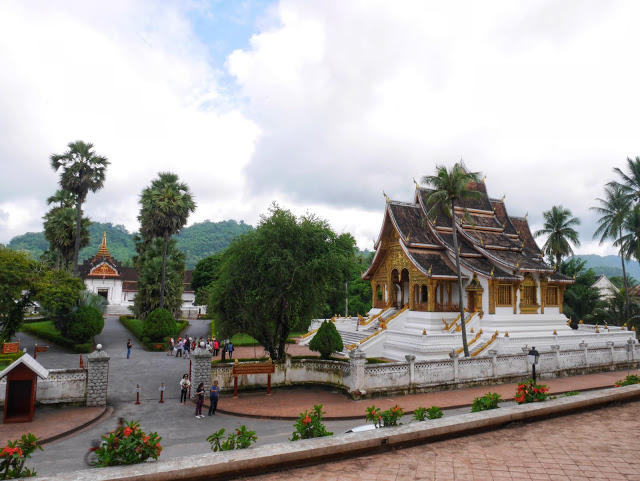
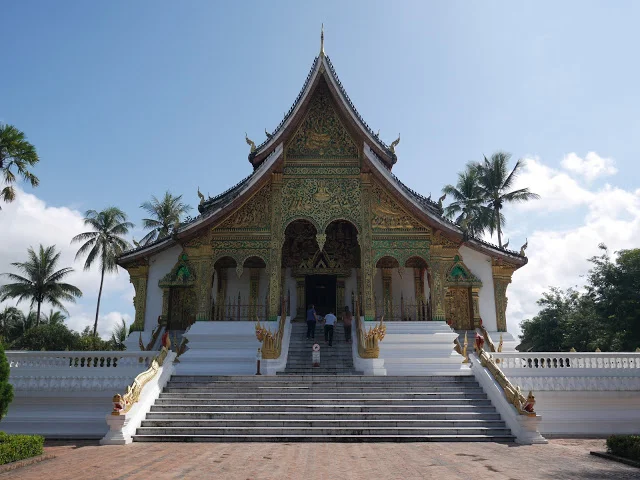
Haw Phra Bang, one of the top temples to visit in Luang Prabang, Laos
How many temples are there in Luang Prabang?
For such a small town (population around 50,000), Luang Prabang has more than its fair share of temples! The city has over 30 UNESCO-recognized historical temples!
What are the top temples to visit in Luang Prabang?
You may not have the time (or energy, or interest) to visit every temple in Luang Prabang. Instead, stick to the most unique or interesting ones! Can’t make up your mind? Here are our suggestions for the ten most interesting, historically significant, or beautiful temples in all of Luang Prabang.
Want to learn more? Just click on the link beneath the description about each temple to learn more history, as well as to see the admission fee and location of each temple.
1. Haw Phra Bang
The Haw Phra Bang Temple is the home of the Phra Bang Buddha image, the holiest Buddha statue in Laos and the royal palladium of Laos. It’s on the grounds of the Royal Palace (now the National Museum) and, despite its ancient appearance, was only completed a few years ago.
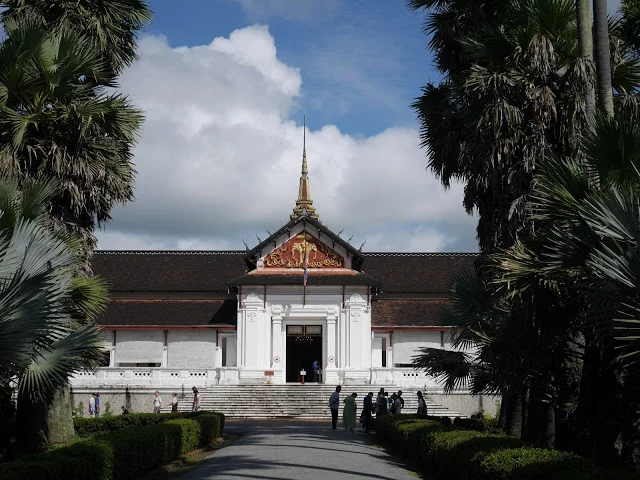
While not technically a temple, the Royal Palace, which has been converted into the Luang Prabang National Museum, holds an incredible collection of Buddha icons and Buddhist religious artifacts.
Luang Prabang Royal Palace National Museum
3. Wat Xieng Thong
Wat Xieng Thong, the Golden City Monastery, is one of the oldest temples in the city. While most of Luang Prabang’s oldest temples were destroyed in the 18th century by a band of marauders known as the Black Flag Army, Wat Xieng Thong was spared, as the leader of the army had studied there as a young man.
The temple was once used for the coronation of the Lao monarchs, and today holds the royal funerary barges.
Wat Chom Si sits atop Mount Phou Si, the Sacred Mountain in the center of Luang Prabang. For a few thousand kip, you can hike to the top of the mountain, where a glittering golden stupa crowns the peak. From there, you will be treated to some of the most incredible views of Luang Prabang and the surrounding countryside. It’s especially beautiful at sunrise and sunset.
Wat Visoun may be the oldest temple in the city. It may be home to an incredible museum dedicated to Buddhist statues and art. But what the temple is most known for is the affectionately-nicknamed “That Mak Mo”, the “Watermelon Stupa”.
Named so for its unique shape, the Watermelon Stupa houses a Buddhist relic, and was spared from the Black Flag Army, making it one of the oldest structures in the entire city of Luang Prabang.
The “Watermelon Stupa” at Wat Visoun, Luang Prabang, Laos
8. Wat Pa Huak
Wat Pa Huak, standing alone on the slopes of Mount Phou Si, is often overlooked due to its diminutive size and rundown appearance. But don’t be fooled! This tiny monastery hides a great secret inside. The interior walls of the temple are covered in gorgeous murals depicting scenes from Lao Buddhism and the history of Luang Prabang. The murals have recently undergone restoration thanks to donations from the Thai royal family.
Wat Pa Huak, a temple with amazing Buddhist murals in Luang Prabang, Laos
9. Wat Phra Mahathat
Wat Phra Mahathat, the Temple of the Great Chedi, is a beautiful and atmospheric temple on the southwestern edge of Luang Prabang’s center. Not so many tourists venture out to Wat Phra Mahathat (which is only about five minutes on foot away from the rest of the town), but they should! It’s a very active local temple, and the eponymous Great Stupa houses an ancient and supposedly very powerful Buddhist relic.
The Pak Ou Caves, while not technically a temple, are worth visiting if you are really interested in Buddhist art. This is where old, broken, or unused Buddha statues go to be retired. Inside the cavern, thousands of Buddha statues cover every surface. It’s really a site to see!
Visiting the cave requires at least a half-day trip. While it is definitely an interesting and historically significant site, it’s really only worth visiting if you have plenty of time to spend.
Smile Beach Bar: one of the coolest spots in Vang Vieng
Vang Vieng was once the party capital of Laos, indeed, of Southeast Asia. Those days are behind it, however, after a series of tourist deaths and government crackdowns forced most of the bars in the tiny little Laotian town to shut their doors.
Today, the town is recovering from its reputation as an alcohol and drug-laden hippie paradise. It’s rebranding itself as an eco-tourism and adventure travel destination.
There are still a few places where you can have a drink, of course, but they are much quieter and more subdued than the way things were five or ten years ago. Smile Beach Bar is probably the best and most popular spot in Vang Vieng.
the path to Smile Beach Bar
How to get to Smile Beach Bar, Vang Vieng
Just head through town (there are only three roads) to the rickety-looking (but actually quite sturdy) bridge leading across the river. You’ll soon find yourself in something of a tropical paradise along the banks of the beautiful slow-moving river.
Vang Vieng, the bridge to Smile Beach Bar
Smile Beach Bar has over twenty little bungalows, complete with hammocks, set up alongside the river. Pick a hammock and make yourself at home. All they ask is that you buy one drink per hour, or three drinks to stay all day. Drinks start at 10.000 kip for a Beer Lao.
After 5 pm, order one of the bar’s very special “buckets”. Their happy hour comes with a buy-1-get-1 deal. The buckets start at 30.000 kip, and are made with literally half a bottle of Tiger whisky! Be careful!
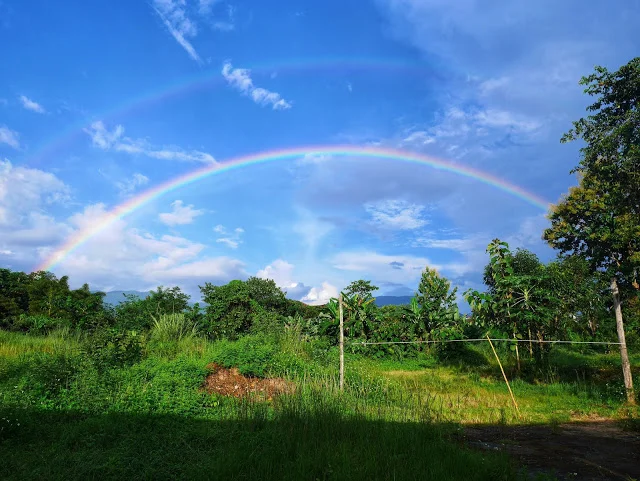
Even if you don’t want to drink, you can order an iced coffee or mango smoothie, and watch the tubers floating down the river. If you’re lucky, you might even catch a rainbow in the beautiful pollution-free sky.
a rainbow at Smile Beach Bar
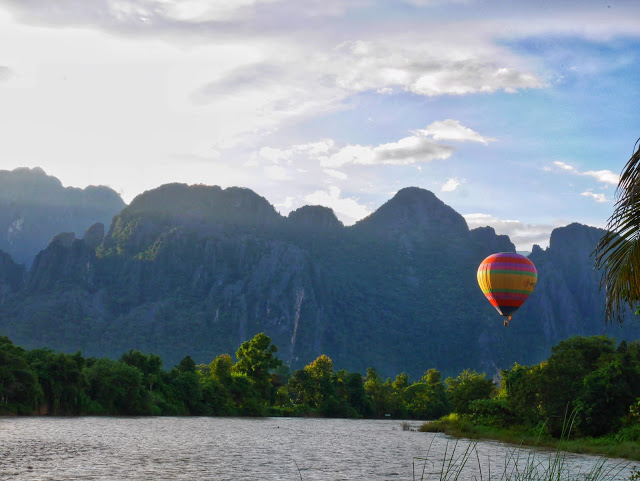
In the evenings, keep your eyes open for hot air balloons returning to Vang Vieng to land.
At 6 pm, as the sky is beginning to grow dark, Smile Beach Bar will light their daily bonfire!
Vang Vieng is a beautiful town, plagued by an unfortunate reputation that it’s working hard to change. Help be a part of this change! Enjoy the beauty of the nature, and help the town recover from its bad past. It has a lot more to offer than cheap (and very illegal) drugs.
When you are traveling in Laos, you don’t have many options for getting between cities. There is no rail service in Laos, and flight tickets can be expensive. That leaves ground transportation, which is notoriously unreliable, uncomfortable, and overpriced.
Ticket booking office and travel agents will always push a traveler to travel by minibus (minivan) or night sleeper bus, but there is a third option as well: the VIP Day Bus.
The minivans drive too fast and recklessly on the mountain roads, and the news is often full of reports of fatal minibus accidents. On top of that, the minibus rides are cramped and terribly uncomfortable.
The night bus is a bit better, but as the roads in Laos tend to be a bit unsafe, driving late at night in the dark with a sleepy driver might not be the best advice either.
That really just leaves the often overlooked VIP Day Bus. But what is it really like? Here is our honest review; both the good and the bad:
The VIP Bus in Laos
How much does it cost to get between Luang Prabang and Vientiane?
The ticket between Luang Prabang and Vientiane, Laos on the VIP Day Bus cost 130,000 Lao Kip ($15). Transportation in Laos tends to be expensive; up to double, or even triple the cost of traveling the same distance in neighboring Vietnam or Thailand.
We booked our tickets through a local ticket booking agent in Luang Prabang, but you can buy them through any hotel, guest house, and travel agency, or go directly to the bus station to buy them without paying the small commission.
The ticket comes with a coupon for a meal.
The ride is supposed to take 7 hours.
a VIP Bus ticket from Luang Prabang to Vientiane, Laos
7:30 – a tuk-tuk picks us up at our hotel and brings us to the bus station.
8:00 – we board the bus and find our seats. Every seat is numbered, and are surprisingly comfortable. Much more comfortable than the minibus that we took to Luang Prabang! There is decent legroom, and the seats are moderately soft.
A bus employee passes out bottles of water to each passenger.
8:30 – we are off, right on time! So far so good…
interior of a VIP day bus in Laos
10:00 – the bus comes to a stop, and the driver shuts off the engine. There is a long line of cars and trucks stopped on the muddy, winding, mountainous road ahead of us. There was a mudslide, and workers are using an industrial digger to clear it. It’s too hot to stay on the bus without the AC, so all of the passengers disembark and stand around outside in the hot sun.
12:00 – finally, the road is clear, and we begin driving again.
the roads in Laos can be unsafe and slow
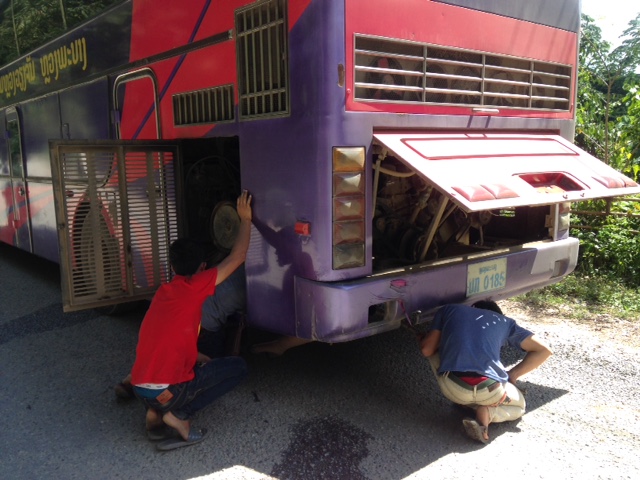
12:30 – we stop again. Part of the engine has fallen out of the bottom of the bus. We stop for half an hour while the drivers stick it back on with a piece of bamboo that they found.
breakdowns are not uncommon on the VIP Bus in Laos
13:00 – the roads are terrible: bumpy and winding. Several passengers have gotten sick, but it’s still much smoother than the minibus. Unfortunately, the roads over the mountains are so steep, narrow, and winding that the bus can barely move 40 km/hr.
16:00 – it’s already been 7 hours, and we aren’t even halfway there yet.
17:30 – we stop for “lunch”, or at least, we stop where we should have stopped five hours ago for lunch. We exchange our meal ticket for a cheap-tasting and very salty bowl of noodle soup. It’s filling anyway, and as it starts to get dark, we head back out on the road.
noodle lunch provided
18:00 – we arrive in Vang Vieng to drop off passengers before continuing on.
23:00 – we finally arrive in Vientiane. Instead of the projected seven hours, the trip took a full 15 hours. Don’t be fooled by the times quoted to you by a travel agent; this is a very average travel time in Laos.
the mountains in Laos between Luang Prabang and Vientiane
Pros and Cons of the VIP Day Bus in Laos
The Good
The VIP day bus is relatively comfortable – much more so than the minibus.
One meal is provided.
There are two drivers who take turns, making sure one driver never gets too tired.
The big bus drivers slower and much more safely on the road.
You travel during the day, so accidents are much less likely.
The Bad
The trip takes a long time, although no longer than it would on the night bus or minibus.
The VIP bus tends to break down on the rough and winding mountain roads.
There is NO TOILET on board, but you can expect to stop twice or so on the journey.
You will lose an entire day traveling just 300 or so km.
The VIP bus is more expensive than the minibus.
So, overall, while it’s a grueling and uncomfortable journey, that’s due more to the roads in Laos than to the VIP bus. Overall, we recommend the VIP bus for comfort and safety.
However, as the bus tickets tend to be more expensive than the uncomfortable and terribly long ride is really worth, if you can afford it, you might want to just buy a cheap Air Asia flight between Luang Prabang and Vientiane (20 minutes) instead.
Sai Bat – the daily alms giving ceremony to Buddhist monks in Luang Prabang
It’s five in the morning, and the sky is still dark, but the city of Luang Prabang in central Laos is wide awake. It’s time for morning alms rounds, a serious and somber Buddhist ceremony that takes place in the early hours of the morning every day. Local people, dressed in traditional Lao outfits, kneel on mats along the main road in front of the city’s temples, awaiting a procession of dozens of Buddhist monks, clad in saffron robes and carrying their traditional “beggar’s bowls”.
Buddhist monks are forbidden from purchasing their own food, instead relying on donations from the community for their daily meal.
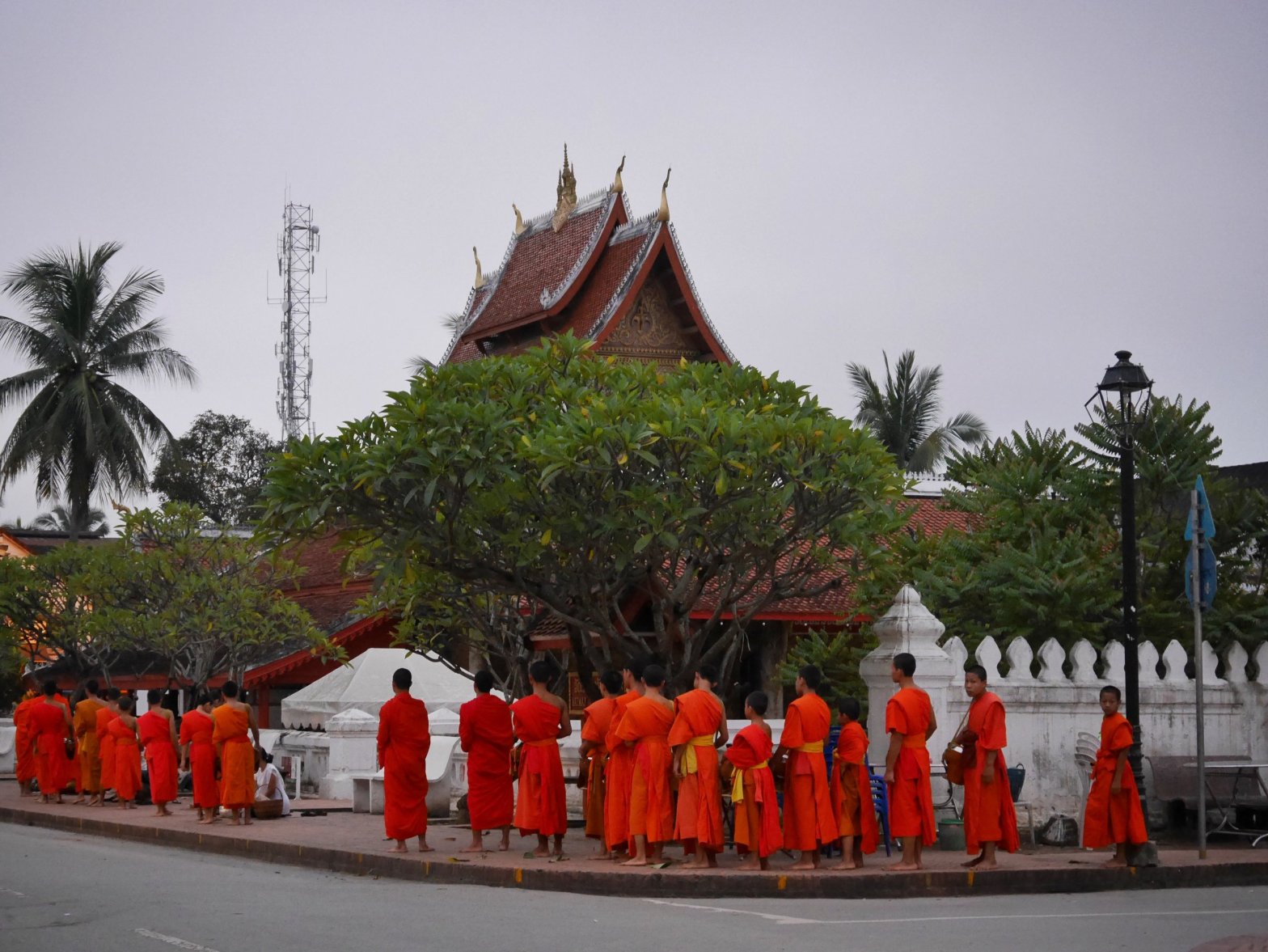
As the monks walk slowly down the street in their silent procession, people will respectfully place sticky rice and other food into their bowl, or “bat”. The food will later be shared communally by the monks at the temple. This ceremony takes place in complete silence. It’s a very important and reverential ceremony,
monks in front of Wat Mai on their morning alms rounds in Luang Prabang, Laos
Morning alms giving for monks in Luang Prabang
The morning alms giving ceremony takes place daily in Luang Prabang, and is a very important aspect of traditional religious life. Local people donate food to the monks as a way of “making merit”, or accumulating good karma.
Who can give alms to monks in Luang Prabang?
You don’t have to be Buddhist in order to participate in Luang Prabang’s daily alms giving ceremony, but the monks request that you only participate if doing so would be meaningful to you. It’s not a performance or experience put on for tourists, but rather a somber and reverential centuries-old religious practice.
If you do choose to participate in the ceremony, you must be dressed appropriately. No pajamas, no sleveless shirts, and no shorts or short skirts should be worn. It is also inappropriate to take photos while participating in the ceremony. The morning alms giving ceremony is supposed to take place in complete silence. Do not speak to, make eye contact with, or touch the monks. Remove your shoes before participating in the ceremony.
If you want to photograph the morning alms giving ceremony in Luang Prabang, you should stand on the opposite side of the road from the procession so as not to disturb the monks or the people who are participating in the ceremony. Signs posted throughout the city ask that you stand at least 3 meters (10 feet) away from the monks.
What time is the morning alms giving ceremony in Luang Prabang?
You’ll have to get up early to see the alms in Luang Prabang! The monks begin their alms rounds before dawn, and are finished around 6:00 am. The best time to catch the monks on their rounds is at 5:30, when the sky is just barely beginning to get light. If you want to participate in the alms-giving, be sure to get ready by 5:00 am or so.
the morning alms giving ceremony begins before first light in Luang Prabang
Where to see the morning alms rounds
The most popular places to watch and participate in the morning alms giving ceremony in Luang Prabang is along Sisavangvong Road. The monks pass by the primary school and in front of the city’s old temples, before walking to the National Museum and Wat Mai, ending up along the Night Market area.
Look for locals sitting or kneeling on woven mats alongside the road. The most popular areas for joining in the alms giving ceremony in Luang Prabang are near Wat Mai and the Night Market area, but bear in mind that these areas can get a bit crowded with tourists. For a more authentic experience, especially if you want to participate in the alms giving ceremony yourself, you might want to find a quieter and less popular area in town where you can really appreciate this reverential and important spiritual practice.
regulations for respectful participation in the morning alms giving ceremony – Luang Prabang
What you should know about the morning alms in Luang Prabang
The alms rounds take place very early every morning, from around 5-6 am. The alms rounds will be almost finished by the time the sky is starting to get light.
You don’t have to be Buddhist to join the morning alms giving ceremony, but the monks request that you only participate if it is meaningful for you to do so.
If you want to participate in giving alms to monks, there will be plenty of vendors selling the traditional rice that you can give to the monks, but we suggest purchasing rice from the nearby morning market near Wat Mai instead of from the vendors. The rice from the market tends to be of a higher quality, and purchasing from the market is better for the local economy.
If you want to give alms, you must be dressed appropriately – NO PAJAMAS, NO SLEVELESS SHIRTS, NO SHORTS OR SHORT SKIRTS. The alms round is not a performance for tourists, but a very important and reverent religious ceremony.
If you want to photograph the procession, the monks request that you please stand on the opposite side of the street, at least 3 meters (10 feet) away.
Do not take selfies or photographs of the monks when you are participating in the ceremony. If you want to take pictures, refrain from participating in the alms giving ceremony.
Do not speak to, make eye contact with, or touch the monks.
Remove your shoes while participating in the ceremony.
The Sai Bat, or Tak Bat Ceremony is an amazing way to participate in an ancient local custom, and to get in touch with the spirituality, history, and cultural heritage of Luang Prabang. Unfortunately, bad and disrespectful behavior by tourists has soured the experience somewhat. Help change things by being a responsible tourist. Respect the local customs and dress and behave appropriately, and you will be more than welcome to participate in this beautiful and meaningful Buddhist ceremony.
One of the most popular day trips from Luang Prabang, Laos is to visit the legendary Pak Ou Caves. While walking through town, every tuk-tuk is emblazoned with the words “Pak Ou Cave”, and every travel agency and booking office will be advertising their tours to the caves.
What are the Pak Ou Caves? How much does it cost to visit them? How do you get there? Is it worth it to spend half a day visiting the caves? Read on!
the entrance to the Pak Ou Cave, Luang Prabang, Laos
What are the Pak Ou Caves?
The Pak Ou Caves, located about 30km north of Luang Prabang Laos along the Mekong River, are made up of two limestone caverns that are considered a sacred site in Lao Buddhism. A visit to the Pak Ou Caves is one of the most popular tours and day trips from Luang Prabang.
There are two caves at Pak Ou, an upper cave and a lower cave. The lower cave is full of thousands of old, damaged, and retired Buddha statues, and the upper cave once served as an ancient meditation spot for the old Laotian kings.
Getting to the Pak Ou Caves
You can reach the Pak Ou Caves by road or by boat. While nearly every tuk-tuk advertises a tour to the caves, by far the most popular (and cheapest) way to reach the caves is by boat.
The trip to the caves by boat takes about two hours from Luang Prabang (and about one hour to get back, as you will return with the current). Along the way, you’ll pass scenes of local life along the river, and take a short 20-minute break at the Whisky Village to explore and taste some free lao-lao moonshine.
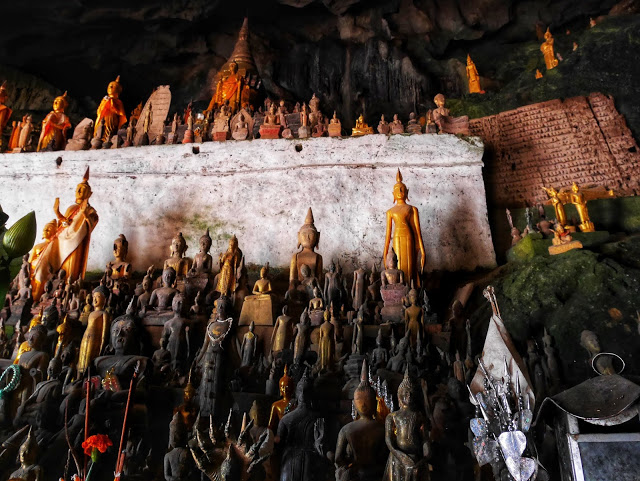
The caves serve as a sacred place where old and unused Buddha statues can be respectfully retired. The cave boasts over two thousand old, damaged, and retired Buddha images!
statues, amulets, and religious tablets
The cave is impressive, and the thousands of Buddha statues – each one unique – are fascinating to look at. It’s not a huge place though, and it only takes a few minutes to have a look around.
inside the cave at Pak Ou, Laos
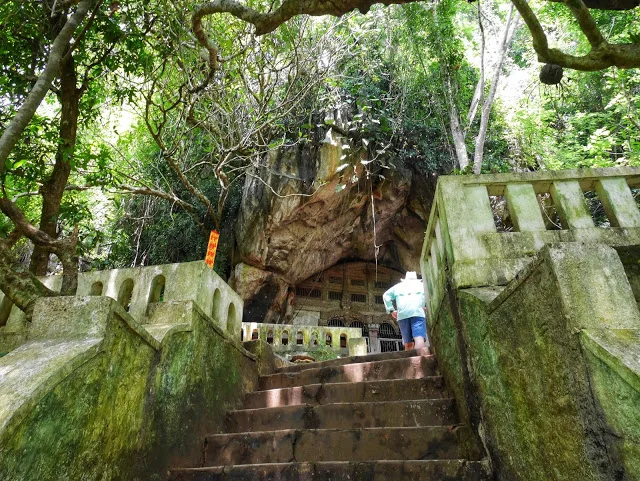
Leaving the lower cave, climb the steep stone stairs through the forest (be careful, as the stairs can be mossy and slippery!) and you’ll shortly arrive at the upper cave.
steep steps through the jungle
The upper cave is larger and deeper… and it’s dark! You can borrow a flashlight at the cave in exchange for a small donation. This cave was once used as a meditation spot for the kings of Laos! Today, it’s still used by Buddhist monks. The inside of the upper cave also has many Buddha statues, but not nearly as many as in the lower cave.
the upper cave temple at Pak Ou
Have a look around, but be careful not to trip in the dark! There are no lights or candles inside, and the only light is from the flashlights. The cave is interesting and historically significant, but a few minutes is probably enough to have a decent look around.
meditation area for monks inside the Pak Ou upper cave
When you take the tour to the Pak Ou Caves, the boat driver will stop at the caves for about 40 minutes. This was more than enough time, and all of the passengers on our boat tour had already arrived back at the boat before the whole time was up, content that they had already seen everything that there was to see.
stairs back down to the lower cave
How much does it cost to visit the Pak Ou Caves in Luang Prabang?
Admission fee at Pak Ou Cave
Admission to the caves is 20,000 kip per person (about $2.50). Every passenger must purchase a ticket upon arriving at the caves. You cannot buy a ticket in advance, and ticket costs are not included in the tour.
Taking a boat tour to Pak Ou Cave
You can book the Pak Ou Cave and Whisky Village tour from a travel agency in town, or from your hotel or guest house, for around 80,000 kip (about $10). This includes only the boat trip and maybe pickup from your hotel or guest house. Please not that admission to the caves is not included in this price. You must purchase a ticket to the caves when you arrive.
To save money, skip the middle man and head directly to the river docks at Luang Prabang. You can buy a ticket on the same tour directly from the boat driver for 50,000 kip (about $6).
What to know about the Pak Ou Cave tour
Admission to the caves is not included in the price of the tour
Purchase a ticket for the boat tour directly at the boat docks to save money
Bring water – water is not provided on the tour, and is not available for sale!
The tour takes around 4 hours
Lunch is not provided
Every tour includes a short 20-minute visit to the Whisky Village
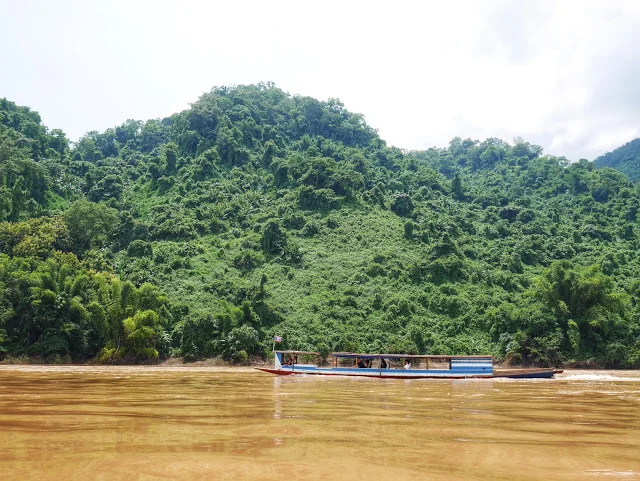
the boat ride on the river back to Luang Prabang after leaving the Pak Ou Caves
Should you visit the Pak Ou Caves? Is it worth it?
The entire round trip to and from the Pak Ou Caves, including a stop at the Whisky Village, takes about four hours. The boat ride is comfortable, especially when the wind is blowing, and it’s nice to have the chance to see some beautiful scenery and a look at local life along the river.
Ultimately, it takes a bit too long to reach the caves (2 hours) to make the short visit (30-minutes is plenty of time to see it all) completely worth it, although it is an interesting and fun escape from the city.
If you have enough time in Luang Prabang and are interesting in doing something a little bit off the beaten path, then definitely visit the Pak Ou Caves. If you only have a few days or a tight budget or schedule, maybe give it a miss.
Ban Xang Hai, commonly referred to as the “Whisky Village” sits about 30km north of Luang Prabang, and is a ubiquitous stop on any tour to the famous Pak Ou Caves. A visit to the village includes free shots of strong Lao whisky, the chance to buy lots of traditional handicrafts, and a short stop to explore the village. While the Whisky Village is a part of every trip to Pak Ou Caves, is it a worthwhile excursion? Is it worth it to visit the Whisky Village in Luang Prabang? Is the lao-lao rice whisky any good? Read on!
FREE SAMPLES! Watch out for that 100-proof moonshine!
Tasting and buying lao-lao at the Whisky Village
The boat departed from Luang Prabang at 9:00 in the morning, on the way to the sacred Pak Ou Caves. A ninety-minute journey along the slow-moving Mekong River brought us to Ban Xang Hai, the famous Whisky Village. While disembarking from the narrow longboat, hardly before stepping off of the rickety wooden plank that led to the village, a local man shoved a glass of red rice wine into our hands.
“Free whisky! Try it for free!” he encouraged us to give it a taste.
I took a sip of the dark red drink. It was surprisingly smooth and a bit sweet.
“It’s good”, I told him honestly.
“Only 15,000 kip! Now, try the white one.”
The old man handed me a thimble-sized glass of a clear white liquid. The Spanish guy next to me raised his glass, and we clinked them together. I took a sip.
I felt like I had been punched in the nose, and from the looks of things, so did my new Spanish drinking buddy.
“Wow.” was all he said.
“That’s the strong one” the old man looked proud of his product, and laughed as tears welled up in my eyes. “50% alcohol.”
The strong one… no kidding!
There’s no pressure to buy any of the whisky, although you have plenty of oprotunities to do so at the Whisky Village. A small bottle of the 15% rice wine or the 100-proof Lao moonshine will only set you back 15,000 to 30,000 kip. It’s incredibly cheap if you are brave enough!
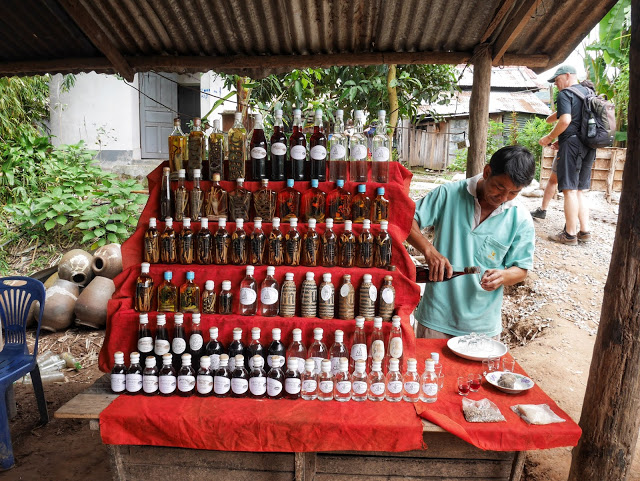
If you are even braver, why not try a bottle of local “snake wine”?
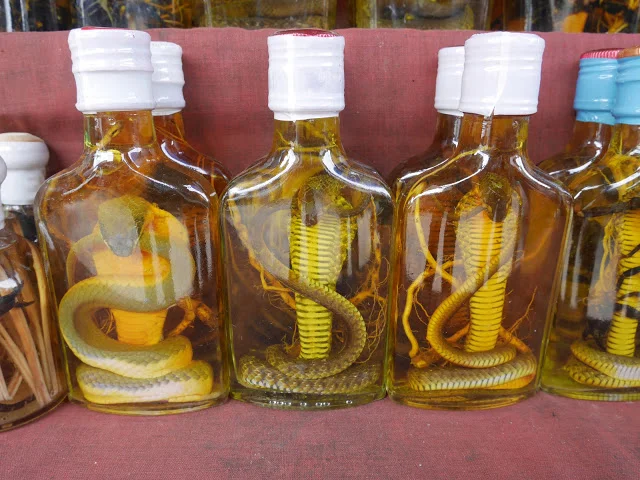
Lao snake whisky
Snake wine (really snake whisky) is made from preserving cobras, scorpions, spiders, and herbs inside small bottles of super strong whisky. Though the drink is a traditional health and energy drink, it’s now sold almost exclusively to tourists as a souvenir. I don’t necessarily recommend drinking it. The practice could be considered cruel and unethical, and who knows how safe it is to drink. Still, it’s a shocking souvenir to give to a friend back home.
various types of rice whisky for sale
How is rice whisky made?
The rice whisky, or lao-lao, for which the village is so well-known is made by first fermenting khao neaw (sticky rice) in large earthenware urns. As you walk through the village, you can see lots of rice being fermented at local workshops.
After the rice has been fermented into a rice wine, it’s then distilled in a large metal still, much like moonshine. While lao-lao has been produced this way for hundreds of years, I caution you to drink it at your own risk. There is no health standard or government organization that oversees the production of this alcohol.
lao-lao rice alcohol fermentation jugs
The tour to Pak Ou Caves includes a stop at the Whisky Village. The stop is usually short, 20 or 30 minutes. It’s enough time to explore the tiny village, which makes more than just whisky. If you are lucky, you might even see a local woman weaving silk in the traditional way. A number of other handicrafts besides whisky are available for sale at local souvenir stalls if you want to help support the village.
traditional weaving skills in Laos
How to get to the Whisky Village in Luang Prabang
The best way to reach the Whisky Village is by boat. It takes between 90 minutes and 2 hours to reach the Whisky Village from Luang Prabang. As the Whisky Village is always a stop on the Pak Ou Cave tour, combining both into one visit is the best way to see the village.
Is it worth it to visit the Whisky Village?
On its own? Maybe not. The village is interesting enough, if only to learn a little bit about traditional alcohol production, but the twenty minute stop on the Pak Ou Cave tour is plenty of time to see the entire village. Since it takes nearly two hours to reach by river, it’s not really worth it to visit the Whisky Village on its own.
As a part of the Pak Ou Cave tour? Absolutely! It’s an interesting diversion and a cool look at local life and traditional industry along the river.
























 LB convert