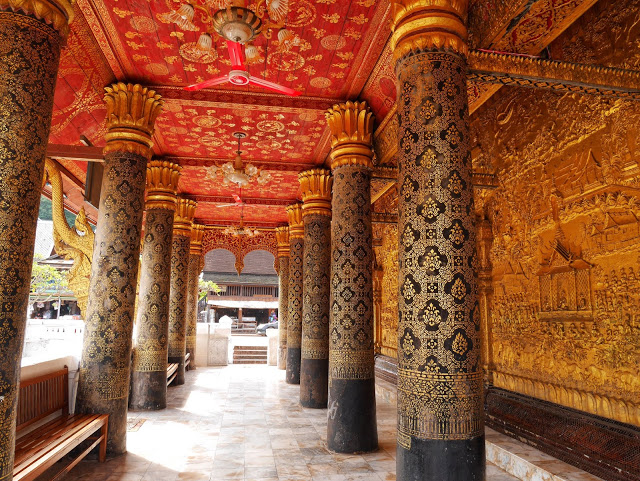
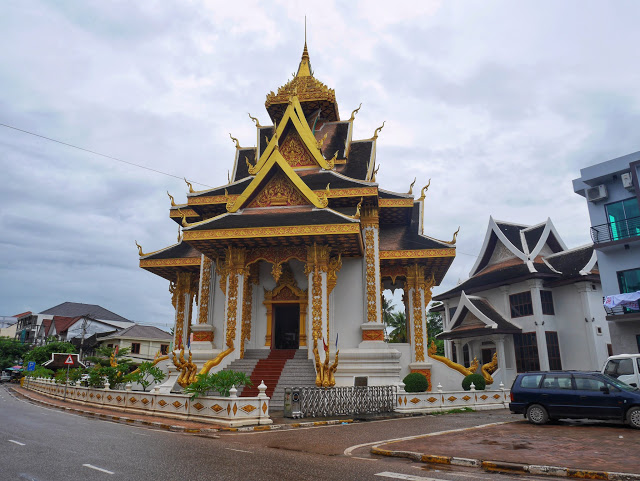
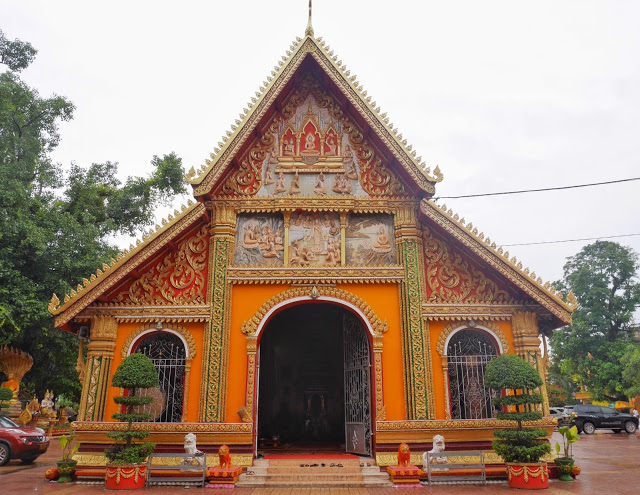
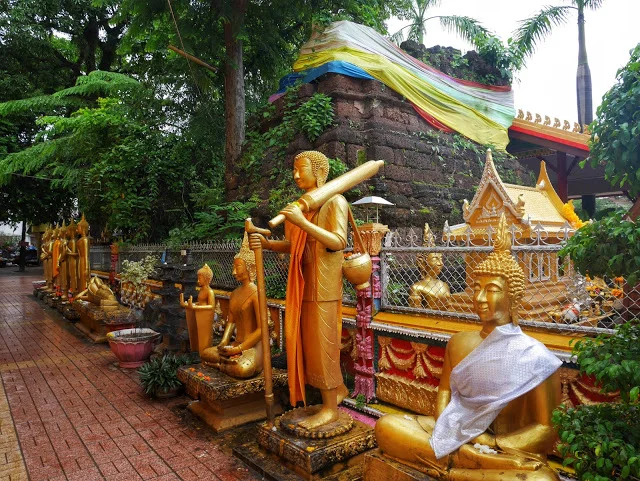
Just down the road from the Royal Palace is Wat Mai, one of the most important royal temples in Luang Prabang, and one that you mustn’t miss when touring the historic city in Laos.
Looking for a cool cafe where you can chill out in Luang Prabang, Laos? Scroll down 🙂
Luang Prabang is Laos’ funky UNESCO World Heritage City, full of temples, palaces, and lots of cool cafes. Here are some of the best cafes in the city, both the ones that are long-time tourist haunts and those that are more local and traditional. Lao coffee is world-famous, and you definitely must not miss enjoying a cafe or ten while you are in the country.
The best cafes in Luang Prabang, Laos, and what to order
1. Saffron Coffee’s Espresso, Brew Bar, & Roastery
cascara – coffee cherry tea
Saffron Cafe is a famous cafe among tourists in Luang Prabang. It’s a cool and atmospheric cafe on the riverside, and you can choose to sit inside the cafe in the calm atmosphere, or sit across the road by the river and admire its beauty. The cafe has wide variety of drinks, pasteries, and food. I ordered this pot of coffee cherry tea, and sat by the river in the morning. It’s such a serene and beautiful view of local Lao life. As I sat, I watched local people crossing the river on the old wooden ferries. The view is one of the best in the city.
Price : $
WIFI: yes
AC: no
Must-try: a pot of Saffron’s famous cascara, or coffee cherry tea, a strong and sweet brew made from the usually-discarded coffee cherry after the beans have been removed.
I had an amazing time at the Silk Road Cafe at Ock Pop Tok. I really like the idea that my money goes to help support the ethnic minority group of Laos. This is more than just a cafe. They also have showcase of traditional tribal handcrafts such as scarves, bags, clothes, etc. You can also help to support their organization by purchasing their products or enjoy drinks and food at the cafe. While we were there, we were lucky to see a weaving demonstration by Mrs. Kiang, a local master weaver. I ordered this refreshing glass of butterfly pea and ginger lemonade. It’s amazing! The cafe is very nice and well-decorated, and it’s like sitting in a colorful garden. I also tried a rich iced Lao coffee, which is also very good. They are also the only cinema in town! Op Pop Tok shows a second-run movie every Thursday night. Tickets are 70,000 kip per person, and include dinner.
Price: $
WIFI: yes
AC: no
Must-try: a cool glass of butterfly pea tea (bright purple, sweet, and served with a tiny bit of lime), or a glass of iced Cafe Lao
Another good cafe to try out in town is the Indigo Cafe, located just down the road from the Royal Palace. This cafe offers a wide variety of food and drinks, but what makes it so famous is its bakery, with its delicious fresh bread and pastries
I ordered a hot Lao coffee, which comes with condensed milk at the bottom (milk is optional), and a delicious buttery croissants. The coffee is great and has the nice, rich aroma that is so distinctive for Lao coffee. The croissant was very crispy on the outside but so soft and buttery on the inside. It’s so crispy that the flakes went everywhere, but I loved every bite!
Price: $ (15.000 kip for coffee/10.000 kip for croissant)
WIFI: yes
AC: no
Must-try: traditional Lao Coffee and a fresh croissant from the bakery (pay for coffee and pastries separately)
famous croissant at Le Banneton, Luang Prabang, Laos
This fine cafe and bakery shop makes a perfect croissant. This cafe is located in an ideal spot where you can indulge in temple views in the old historical town of Luang Prabang. I ordered a lemon iced tea which was very refreshing (and perfectly sour!), Lao coffee that was so smooth and rich, and of course, a croissant! These buttery, soft, warm croissants are what put Le Banneton on the map in Luang Prabang, and what keep travelers coming back again and again.
Price:$
WIFI: yes
AC: no
Must-try: a hot croissant fresh from the Le Banneton bakery
Lao Iced Coffee at Joma Bakery Cafe, Luang Prabang, Laos
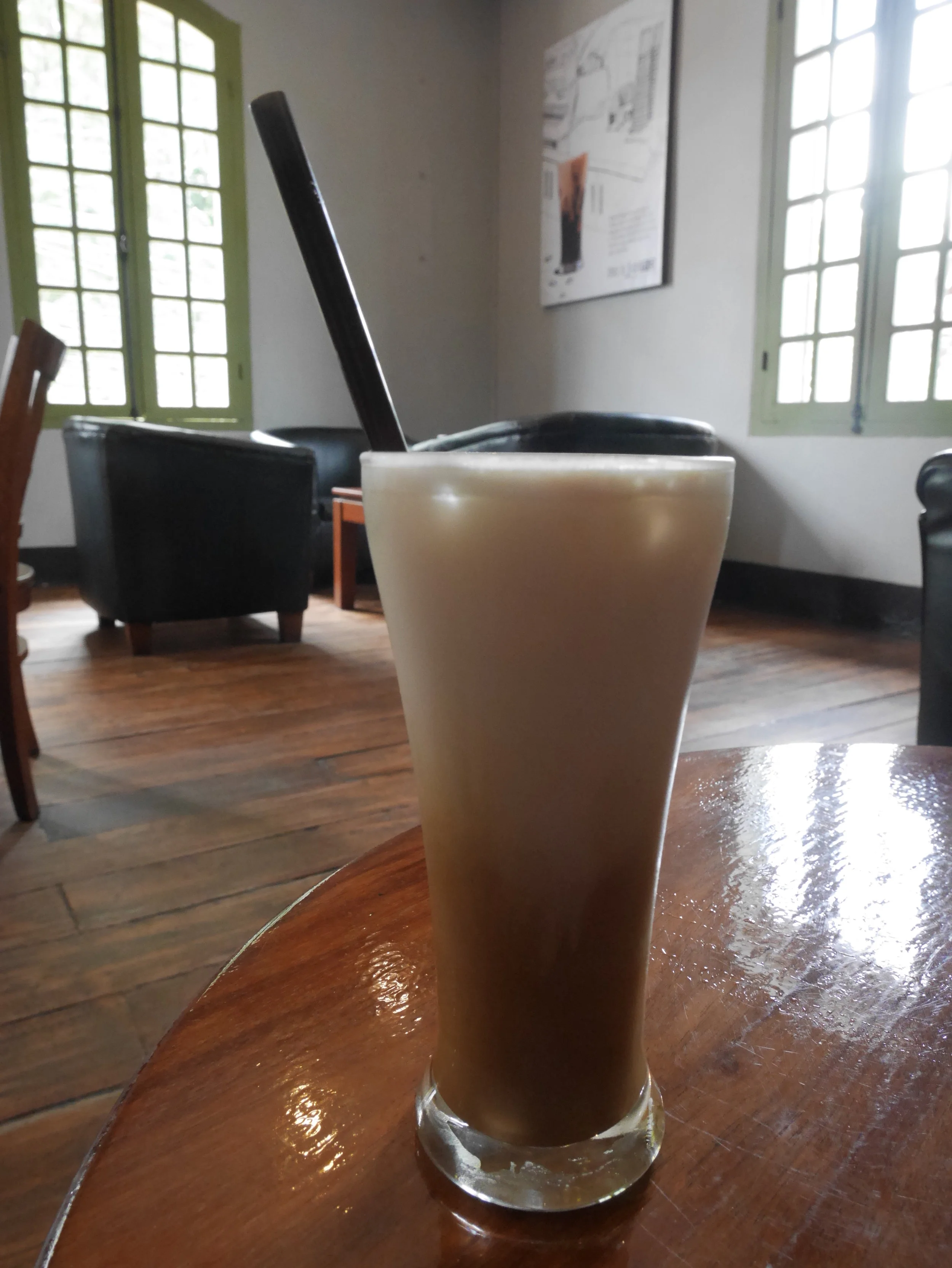
Joma Bakery Cafe has always been popular in Laos for their awesome coffee, delicious pastries, and relaxing atmosphere. They have two branches in Luang Prabang, and one in Vientaine as well. It’s a very nice cafe where you can chill, enjoy great coffee, and try a delicious pastry. I especially like their smooth Lao iced coffee. It’s not as strong or as rich as other iced coffees in Laos, but the flavor is very nice, and it’s a refreshing drink on a hot afternoon. Everything is yummy here! The price is a bit higher than at other coffee shop but it’s still a reasonable price, and you can feel good that all of their coffee is ethically produced.
Price $
WIFI: yes
AC: yes
Must-try: Traditional iced Lao coffee (25,000 kip)
Best Lao Coffee in Luang Prabang – very traditional cafe on the riverside
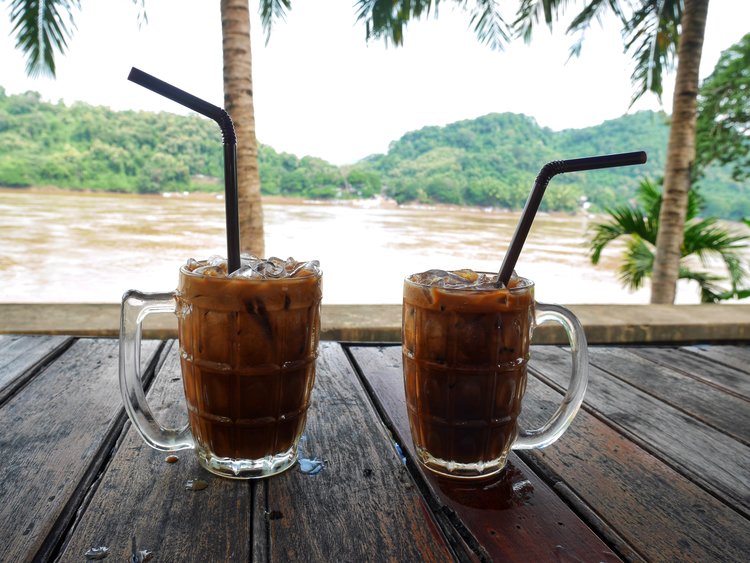
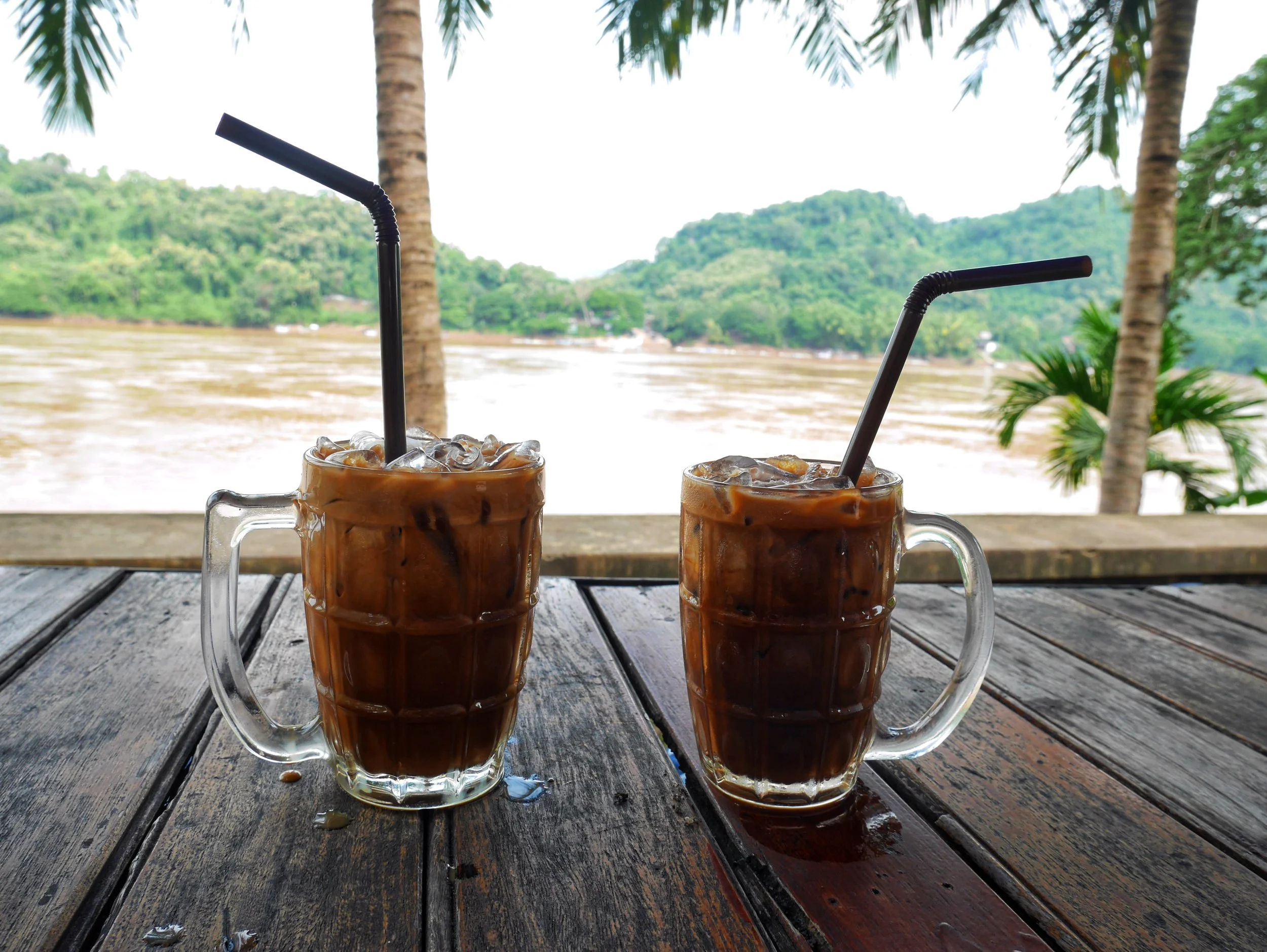
This is a true secret gem in Luang Prabang. Lao iced coffee is AMAZING. It’s so rich in taste and aroma, and the coffee at Prachaniyom is the best I’ve had so far! Their coffee is super rich and strong, and served over condensed milk and ice to be the perfect sweetness. Most importantly, I can a drink this cup of coffee and admire the serene morning views of the Mekong River and mountain for only 8.000 kip! The best coffee in the city is also the cheapest! I’m being honest by saying that this is even better than the coffee that you can get at an expensive cafe. I highly recommend you to try their pork porridge as well. It makes for a delicious (and super cheap) breakfast. This cafe is only open in the morning, from 4am until 11am, so get their early and enjoy some coffee with your new local friends along the river!
Price: $(8.000 kip for both coffee and porridge)
WIFI: no
AC: no
Must-try: traditional iced coffee and rice porridge
This cafe and tea room is so cool! It’s a cafe, restaurant, used book store, and Akha hilltribe traditional craft shop. The coffee is very good, and they offer a great selection of filling breakfasts (try the “Lao Farmer”, which comes with two eggs, cooked eggplant, and a basket of sticky rice). If you want to support traditional handicrafts, pick up a hand-made Akha scarf, blanket, or bead bracelet. They show a different movie at 7pm every night. There is no cost to watch the film, but you are expected to purchase a drink or meal.
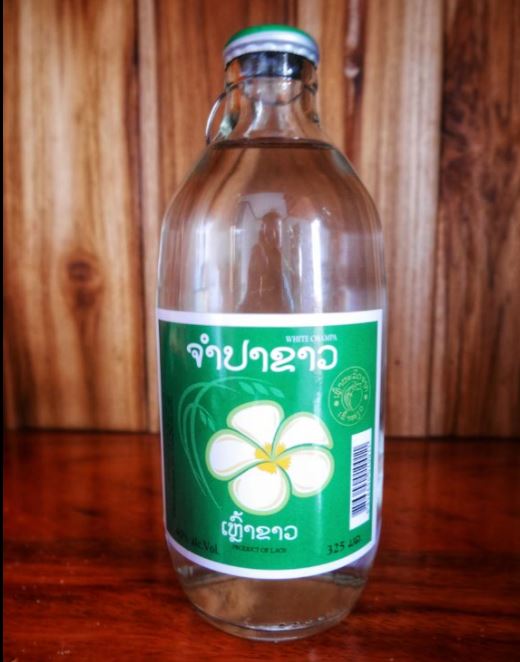
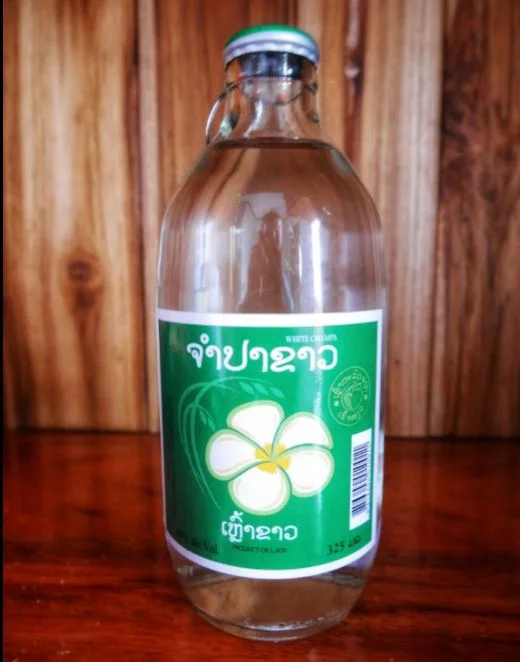
Lao-Lao, nearly as ubiquitous a drink as the ever-popular Beer Lao, can be found all over Laos. It’s hard to say which drink is more popular, the official national beer, or the home-brewed sticky rice moonshine that’s brewed in every village and town from high up in the Laotian mountains to the lowland river valleys.
Lao-Lao, despite the way it’s written, isn’t just the same word written twice. “Lao”, with a falling tone, means “alcohol”; while “Lao”, with a rising tone, means “Laotian”. Literally, the drink’s name means “Laotian alcohol”.
Lao-Lao has been brewed for hundreds of years. Made from fermented and distilled sticky rice, this clear rice “whisky”, Lao-Lao is sometimes added to Beer Lao to strengthen it, and is almost always served to guests at a traditional Laotian meal.
Tourists don’t usually drink much Lao-Lao, although the brands sold at the supermarkets and convenience stores in the country are safe to drink. A bottle of Lao-Lao with a preserved scorpion or snake is a popular tourist souvenir, and for many villages, it’s a big source of tourist income.
Lao-Lao is super cheap, just a few thousand kip per bottle (a few dollars). The taste and alcohol content ranges wildly, but is often slightly yeasty and sweet, like a Japanese sake.
Although today a Communist state and no longer a monarchy, Laos has preserved much of its royal history. A visit to Luang Prabang, the UNESCO World Heritage city in northern Laos is incomplete without a visit to the Luang Prabang National Museum, which is housed inside the old Luang Prabang Royal Palace. Just outside the palace is the Haw Phra Bang, the royal temple dedicated to house the Phra Bang, the royal Buddha image of Laos
Haw Phra Bang
The city of Luang Prabang is named for the very important Buddhist relic that is said to protect the city, the “Pra Bang”. Like Thailand’s Emerald Buddha (called the “Phra Keao”), the Pra Bang is the symbol of the country, said to give legitimacy to the monarchy and to protect the nation from invaders.
In the past, the Pra Bang was taken as loot twice by Siamh, and twice it supposedly brought disaster to the Siamese before it was returned. The Haw Phra Bang, the “House of the Pra Bang”, is the Lao royal temple that sits on the grounds of the Royal Palace.
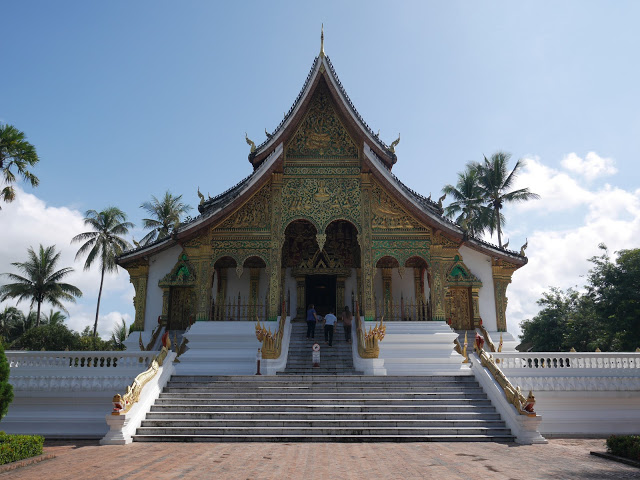
Haw Phra Bang, the royal temple of Luang Prabang, Laos
The Phra Bang is a standing image of the Buddha with his arms outstretched, said to have been cast in Ceylon sometime between the 1st and 9th centuries. The Phra Bang was a gift from the Khmer king to the King of Luang Prabang upon his marriage to the Khmer princess in 1359.
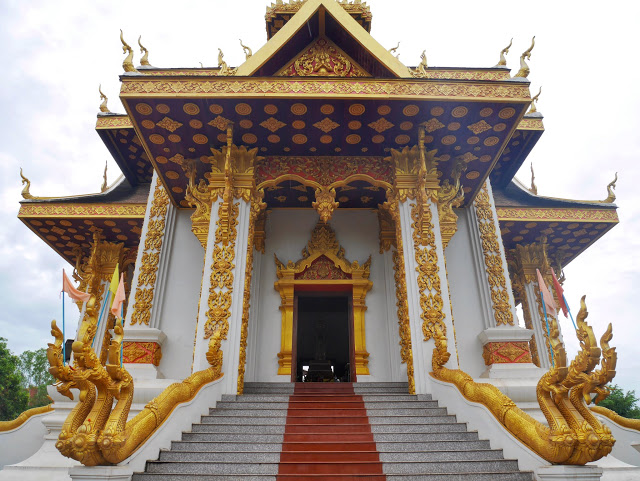
the exterior of the royal temple in Luang Prabang
Haw Phra Bang may look ancient – indeed it’s the symbol of Luang Prabang and the most ornate temple in the city – but it’s surprisingly new. The temple was ordered by the last King of Laos in the 1960s, but was abandoned when the kingdom fell to Communist forces. The temple wasn’t completed until 2006, when the Phra Bang was officially relocated to its place of honor.
No photos are allowed inside the temple.
Proper dress code is required inside the temple and palace.
Admission to the Haw Phra Bang is included with a ticket to the National Museum.
Luang Prabang Royal Palace (National Museum)
The Royal Palace was constructed in 1904 to celebrate the relationship between Laos and France. It’s fairly small, far smaller than the Grand Palace in Bangkok, but beautiful. Architecturally, it’s a very cool building, a distinct blend between European and traditional Laotian designs.
Luang Prabang Royal Palace; the National Musem
When you visit the National Museum, housed inside the old Royal Palace, you will be given a glimpse into royal life in Laos. If you want, you can hire a tour guide, though the exhibits are explained well by the information panels. Starting in the Throne Hall, visitors will have the chance to see beautiful mosaics depicting scenes from the Ramayana, along with the Crown Jewels of Laos and hundreds of royal artifacts from the Kingdom of Laos.
Interestingly, the receiving room is decorated in a beautiful mural depicting not Laotian legends or royal figures, but everyday village life throughout the kingdom.
Before you leave, don’t miss the exhibit displaying the numerous diplomatic gifts given to the Kingdom of Laos by various countries. Among these are sculptures, paintings, the keys to the cities of Tokyo and Bangkok, and more. Perhaps the coolest display was the tiny moonstone given to Laos by the USA after the Apollo 11 mission, along with a Laotian flag that was carried by the astronauts to the moon.
Location
The National Museum, including the Royal Palace and the Haw Phra Bang Temple, is located in the heart of Luang Prabang Old Town. It’s almost impossible to miss, so much so that it doesn’t even need its own address besides “Royal Palace”.
Hours
Open daily 8:00-11:30 and 1:30-4:00
Entrance Fees and additional costs
An entrance ticket, which includes admission to the National Museum (the Royal Palace) and the Haw Phra Bang costs 30,000 kip.
Tour guides are available for hire for an extra cost.
Weekly traditional dance shows are performed at the theater on the grounds. Tickets start at 100,000 kip.
Dress Code and regulations
A strict dress code is enforced.
No sleeveless shirts (men or women)
No shorts or short skirts (women)
Footwear is not allowed inside the temple or palace. There is a shoe rack where you can leave your shoes while you visit the museum.
There are lockers available for free.
Photography is not permitted inside the temple or museum, but is allowed in the grounds.
Vang Vieng may be known for its cheap booze and wild parties, but things are quickly changing in this small town in northern Laos. After government crackdowns and arrests a few years ago shut down most of Vang Vieng’s wildest bars and clubs, locals feel as if Vang Vieng is slowly beginning to regain its soul and culture from before it became known as a backpacker’s haven.
Today, Vang Vieng is becoming more well-known for its adventure travel and eco tourism than for its parties. Wile most of the town’s attractions are located along the Nam Song River, there’s a quieter cultural side to the town as well. Check out these two beautiful Buddhist temples located along Vang Vieng’s main road for a look at the spiritual side of Vang Vieng.
Wat Kang
The small and beautiful Buddhist temple Wat Kang is located right in the center of Vang Vieng along the main road and just past the K-Mart minimart. Wat Kang is a small temple, but it is colorful and atmospheric.
a statue of the Buddha at a temple in Vang Vieng, Laos
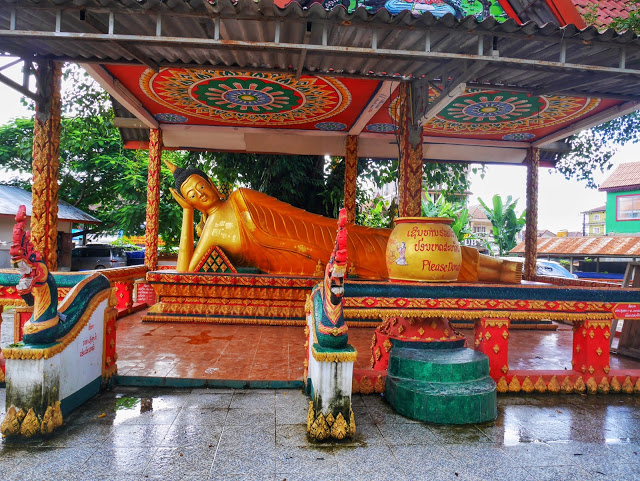
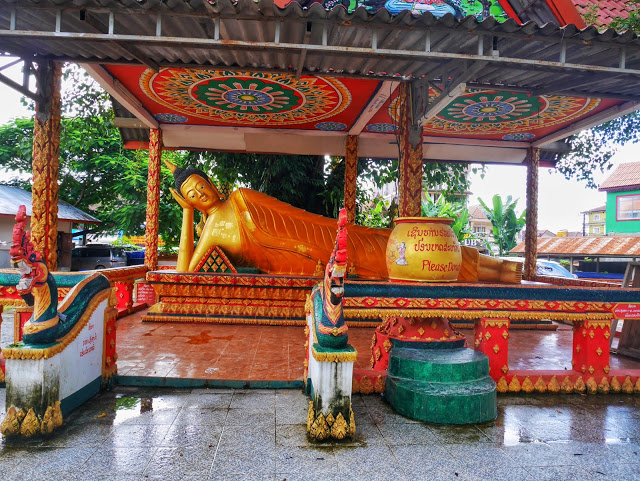
Often overlooked, Wat Kang is located in a field surrounded by amazing mountain scenery. There are several beautiful Buddha statues, including a large seated Buddha and a reclining Buddha.
Reclining Buddha statue
There is no entry fee to visit Wat Kang, and it’s almost always quiet and peaceful. Most foreign visitors tend to give Vang Vieng’s temples a miss, meaning you might have the whole temple to yourself – along with a monk or two! It’s a beautiful way to experience a bit of Lao culture in a town that has been suffering the “backpacker curse” and is struggling to recover some of its past charm.
a beautiful temple in Vang Vieng, Laos
Wat That
A few hundred meters down the road, you’ll come across the gates to Wat That, another serene and quiet temple in the center of Vang Vieng. Like Wat Kang, Wat That has no entry fee.
another beautiful and historic temple in Vang Vieng, Laos
The temple is built around an old stone chedi, or stupa, which houses a Buddhist holy relic. Although the surrounding temple buildings are fairly new, the chedi is much older, a remnant of an ancient temple built on the site.
big seated Buddha statue in Vang Vieng, Laos
Though these two temples are small, it’s worth spending an hour or two exploring both on foot. If you are lucky, you may be able to join in a Buddhist ceremony or receive a blessing from a monk. Just be sure to dress appropriately when visiting a temple – no sleveless shirts and no shorts for women.
There’s plenty to do in Vientiane for the budget traveler! This small and atmospheric city is full of interesting and exciting free things to see and do, from temples to museums to markets. Save money and visit these top 10 free sites in Vientiane, Laos.
Even decades after the end of the Vietnam War, there are more unexploded ordinances (UXO) leftover in Laos than there are people, and the poor infrastructure and rough terrain make it difficult to remove bombs. A visit to the informative and heartbreaking COPE Visitor’s Center in Vientiane, where you can learn about the NGO’s efforts to remove bombs and supply prosthetic limbs and rehabilitation services to those injured in explosions, is a worthwhile way to spend an hour or so during your visit to the Laotian capital.
examples of munitions found throughout Laos
2. Wat Si Mueang
Wat Si Mueang is a historic temple dating back to the 16th century, but its status as a holy site goes back a few hundred years earlier than that. Wat Si Mueang was built over the ruins of an ancient Khmer Hindu temple.
Visit the temple to see the beautiful Buddhist architecture, pray for good luck, and receive a blessing from a local monk.
Wat Si Mueang
3. City Pillar Shrine
Vientiane’s City Pillar Shrine, located just down the road from Wat Si Mueang, is a sacred site in the city, and Vientiane’s spiritual heart.
Vientiane’s historic city pillar is housed in a large and ornate shrine building. Like Wat Si Mueang, it’s free to visit. There is also a small City Pillar Museum located around the back of the shrine.
Vientiane City Pillar Shrine
4. Patuxai
Patuxai, the Laotian Arc de Triomphe, pays tribute to Laos’ French Indochinese past, but still embraces a uniquely Lao style. Nicknamed the “Vertical Runway”, it was built using concrete donated by the USA for the construction of a new airport. The monument was originally built to commemorate independence from France, but has since been co-opted by the Communist Party as a symbol of revolution and victory.
There’s a small fee to enter and climb to the roof of the Patuxai for views of surrounding Vientiane, but it’s completely free to visit the beautiful park and fountains that surround the huge monument.
Patuxai, the Laotian Arc de Triomphe
5. Vientiane Night Market
As long as you don’t buy anything, a visit to the Vientiane Night Market can be a free and very interesting experience. The Night Market along the Mekong riverfront opens every night around 6:00pm, and you can spend an hour or two browsing through the local goods, products, and souveniers.
If you do decide to buy something, don’t forget to bargain for the best deal! That’s all part of the fun at a Lao market.
6. Beer Lao Brewery Museum
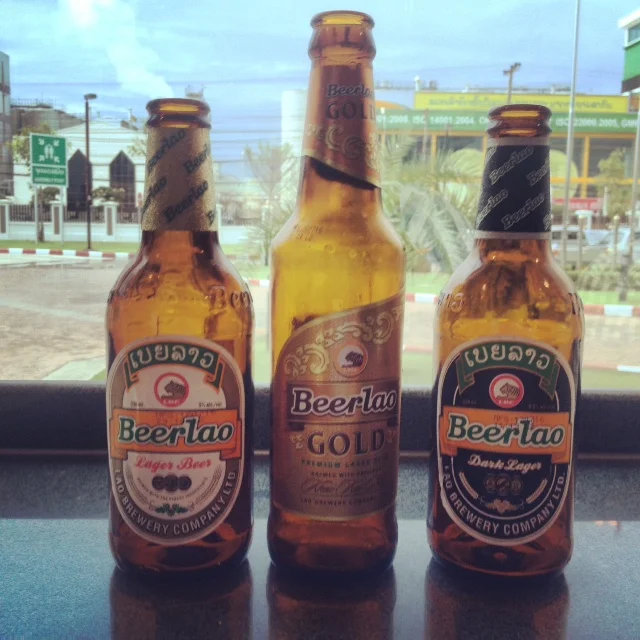
Just out of town on the main road, you can pay a visit to the Beer Lao Factory. Unfortunately, they’ve stopped giving tours (they might restart when renovations are complete), but you can visit the on-site museum for free. Also, visit the gift shop for some merchandise (like an awesome yellow hat!) and the “minibar” (ie the tasting room) where you can order a couple of bottles to try the three original flavors (Lager, Dark, and Gold) and the three brand-new craft-style lagers (Hoppy, Amber, and White).
three original Beer Lao varieties
7. That Dam Stupa
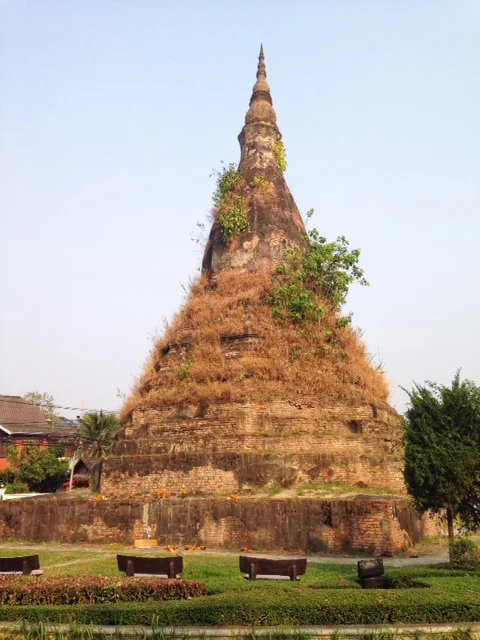
That Dam, meaning the Black Stupa, is a monument housing a Buddhist holy relic. This Thai-style chedi dates back to the Siamese occupation of the 17th century. Said to have been once covered in gold, the gold has long been stripped away, leaving a bare stone monument. Overgrown in moss and weeds, the stupa, which sits in a traffic circle near the US Embassy, looks mysterious and ancient.
That Dam Stupa, Vientiane, Laos
8. Mekong Riverfront
Take a walk through the long park that runs along the riverfront near the Mekong River. You can enjoy local life, join in a morning tai-chi session or an evening aerobics class, or just sit on a bench and watch the muddy waters slowly flow past.
Lao flags flying above the Mekong Riverfront in Vientiane
9. Visit the Temples
While some of the most popular temples like Wat Si Saket and That Luang have admission fees, Vientiane has dozens of smaller local temples, each one beautiful and peaceful, that visitors can explore for free. A visit to a Lao temple is a great way to experience local life and culture.
10. Explore the city by bike or on foot
Vientiane is small enough that you can easily get around by bicycle or on foot. The historic city is atmospheric enough to warrant a few hours just exploring the quiet roads lined with crumbling old colonial-era buildings and beautiful golden Buddhist temples. It’s a beautiful city for street photography, and one that almost demands a visitor to explore aimlessly by foot.
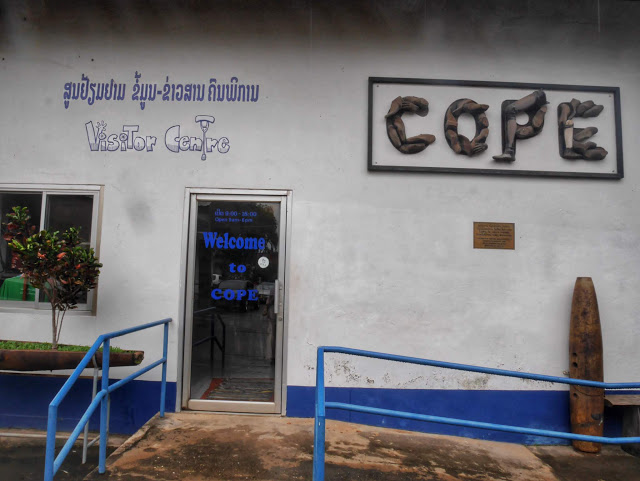
Laos, the most heavily bombed country in the history of the world, is still suffering after the Vietnam War. There are more unexploded ordinances (UXO) leftover in Laos than there are people, and the poor infrastructure and rough terrain make it difficult to remove bombs. The COPE Center, an NGO based in Vientiane, does a lot of work on UXO removal and providing prosthetic limbs to those who have been injured in explosions. A visit to the informative and heartbreaking COPE Visitor’s Center in Vientiane is a worthwhile way to spend an hour or so during your visit to the Laotian capital.
COPE Visitor’s Center in Vientiane
UXOs in Laos, and the “Secret War”
During the Vietnam War, the United States and its allies, suspecting Vietcong insurgents of hiding out in the Laotian jungles, carried out a heavy bombing campaign in Laos. While not officially an active participant in the war, in just five years, tiny, rural Laos became the most heavily bombed country in the history of the world.
While the US military had to follow certain rules of engagement in Vietnam – no bombing within X meters of a school, hospital, or temple, for example, due to the secret nature of the aptly named “Secret War”, the military was entirely unrestrained in its bombing of Laos. The war in Laos was kept secret from the American people during the war.
Today, while the war is long over, millions of UXOs still scatter the Lao jungles and mountains. Laos, with a small population of around 7 million, has many times more unexploded bombs in the country than people.
statues made out of bombs
The US government has since taken responsibility for its role in the Secret War, and USAID is one of the several sponsors and partners of COPE, the Cooperative Orthotic & Prosthetic Enterprise, an NGO based in Vientiane. COPE’s mission is to provide wheelchairs, prosthetic limbs, and rehabilitation services free of charge to the thousands of people every year who are injured after accidentally stumbling across a rusting 40 year-old bomb just waiting to go off.
COPE Visitor’s Center
No visit to Vientiane is complete without a visit to the COPE Visitor’s Center, a small but solemn and heartbreaking museum explaining the UXO situation in Laos and the efforts of the government and NGOs to try to remove the bombs.
The museum is free to visit, but before looking around, visit the small cinema at the museum to watch the documentary video. You can ask the staff to put the film on for you. The film follows an Australian bomb disposal expert as he trains a new team, and shows how difficult and dangerous it is to remove the old bombs. Watching the video before looking around the museum will give you a much deeper appreciation for COPE’s mission. Warning: parts of the video can be graphic.
examples of bombs found throughout Laos
UXO Removal
Laos is a poor and rural country, with mountainous jungle terrain and weak infrastructure. It can be very difficult to get to certain rural villages, much less be able to properly dispose of the bombs that are found.
Another problem in Laos is the illegal black market scrap metal trade, which encourages villagers to try to dig bombs up themselves. Even rusted bomb metal can be valuable. A single bomb can be worth as much as two months of food for a family. When even nine out of ten bombs may be inert, to a poor rural kid, digging up an old bomb may be worth the risk. This is a huge problem, especially as Laos has only a small bomb disposal squad and few resources.
examples of the illegal scrap metal trade
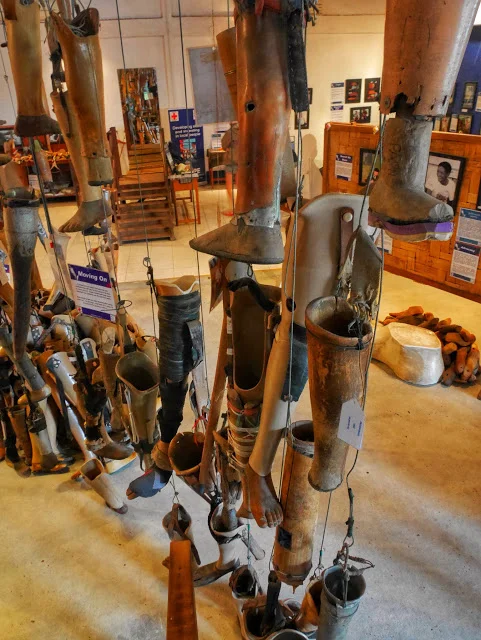
Prosthetic Limbs and Rehabilitation
COPE’s main mission is providing wheelchairs, prosthetic limbs, and rehabilitation free of charge to those thousands of people injured every year in a bomb explosion. This is no small task, as a single prosthetic leg can cost over $300 USD. COPE relies on government aid and private donations.
In addition to helping victims of UXOs, COPE also provides rehabilitation to people with other sorts of physical disabilities.
Gift Shop and Karma Coffee
As you are leaving the small and informative museum, make sure to visit the gift shop, where you can purchase handicrafts, coffee mugs, t-shirts, books, and more, with all proceeds going to support COPE’s mission.
As you leave the center, stop at the Karma Coffee cafe just outside for some delicious, organic, free-trade coffee and homemade ice cream. Proceeds from Karma Coffee go back to supporting COPE.
COPE Center Opening Hours
The COPE Visitor’s Center is open daily from 9:00am-6:00pm
COPE Center Location
The COPE Center is located on Khouvieng Road, at the Center for Medical Rehabilitation campus. It’s easy to find, but the exact address won’t always show up on apps. Every taxi or tuk-tuk driver in the city will know where it is, however. The COPE Center is just a few minutes away by foot from Wat Si Mueang.
COPE Center admission
There is no ticket cost to visit the COPE Center. It is a free museum. Donations are very welcome, and there is a small gift shop that sells things like books, handicrafts, and Laotian coffee, with proceeds going directly towards COPE’s projects.
Visit Wat Si Mueang and the nearby City Pillar Shrine, two of Vientiane’s most historic and important Buddhist landmarks. Both the temple and the city pillar are located in the eastern side of town, just a short walk past the Presidential Palace and Wat Si Saket, and easily reachable by foot. Both the temple and city pillar are free to visit.
Wat Si Mueang
Wat Si Mueang
Arriving at the temple, a woman standing by the gates will offer you candles and flowers for a couple thousand kip to give as an offering to the temple’s large Buddha statue. This statue depicts the Buddha deep in meditation, being shaded from the sun and rain by a mythical nine-headed Naga serpent. You can place the candles and flowers at the base of the statue.
statue of Buddha and Naga serpant
The temple dates back to the 16th century, but its status as a holy site goes back a few hundred years earlier than that. Wat Si Mueang was built over the ruins of an ancient Khmer Hindu temple. Today, only one original stone chedi, or stupa, remains standing. Now, it’s wrapped in blessed cloth and surrounded by dozens of Buddhist statues.
original Khmer stupa
At the back of the temple is a small public park and a tall statue of King Sisavang Vong (1904–1959), one of the last kings of Laos. Today, Laos is a Communist country, and no longer has a monarchy.
statue of King Sisavang Vong (1904–1959)
Before leaving Wat Si Mueang, enter the main wat building and receive a blessing and a blessed string from a monk! The monk will chant and tie the string around your wrist. To receive a blessing, just put a small donation (a few thousand kip is fine) in the plate at the monk’s feet, then kneel and extend your wrist to him. After he gives you the string and the blessing, be sure to wai – press your hands together like a prayer and make a bow.
There’s another popular ritual at the temple. To one side of the main temple hall sits a smooth stone Buddha image resting on a pillow. The statue is made of solid stone and is very heavy. People can pray and ask a question or make a wish. If they are able to lift the statue three times above their head, the answer is “yes”. If they can’t, the answer is “no”.
While I was at the temple, I watched a strong-looking young Lao man bow to the statue and try to lift it. He wasn’t able to. He bowed again, presumably asking another quesiton, and this time was able to lift it as if it were made of paper…
fortune-telling ritual
Vientiane City Pillar Shrine
Just down the road from Wat Si Mueang is the Vientiane City Pillar Shrine. Most towns and cities in both Thailand and Laos will have a city pillar – a shrine steeped in ancient folk religion and animism. The shrine is built to honor the spirits of the city, and is blessed in a complex ritual.
Vientiane City Pillar Shrine
Vientiane’s city pillar is housed in a large and ornate shrine building. Like Wat Si Mueang, it’s free to visit. There is also a small City Pillar Museum located around the back of the shrine.
There’s plenty of cheap alcohol in Southeast Asia; $1 bottles of Chang from Thailand, $0.50 Angkor Beers in Cambodia, and even $0.20 bia hoi in Vietnam.
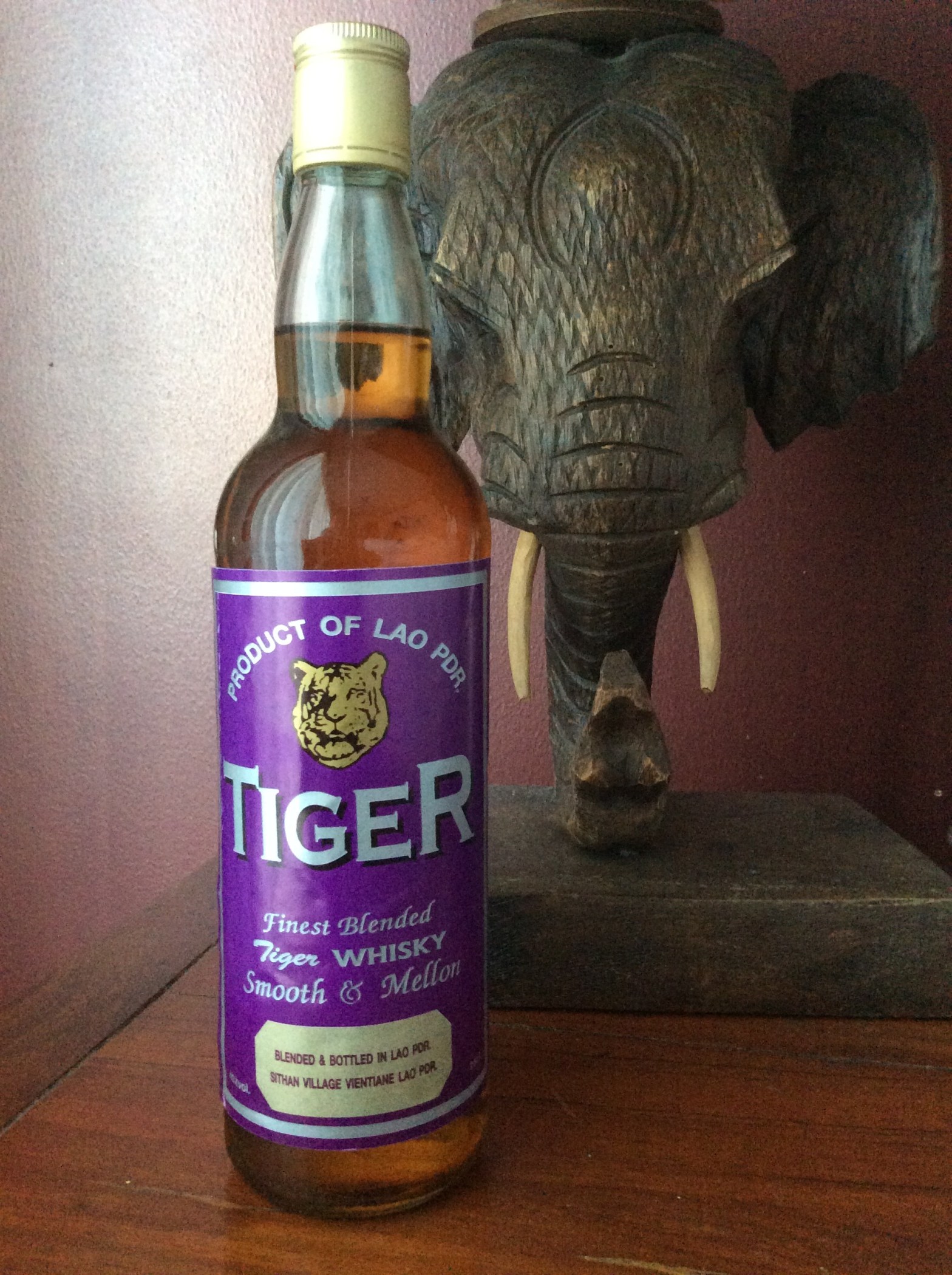
None are quite as infamous though, than Vang Vieng’s own Tiger Whisky, the 10,000 kip (about $1) bottle of 80-proof Lao whisky that fuels the wild and funky party town’s crazy reputation.
Here in Vang Vieng, this ubiquitous whisky fills up party buckets, but is it worth tasting neat? For the price, it’s at least worth checking out.
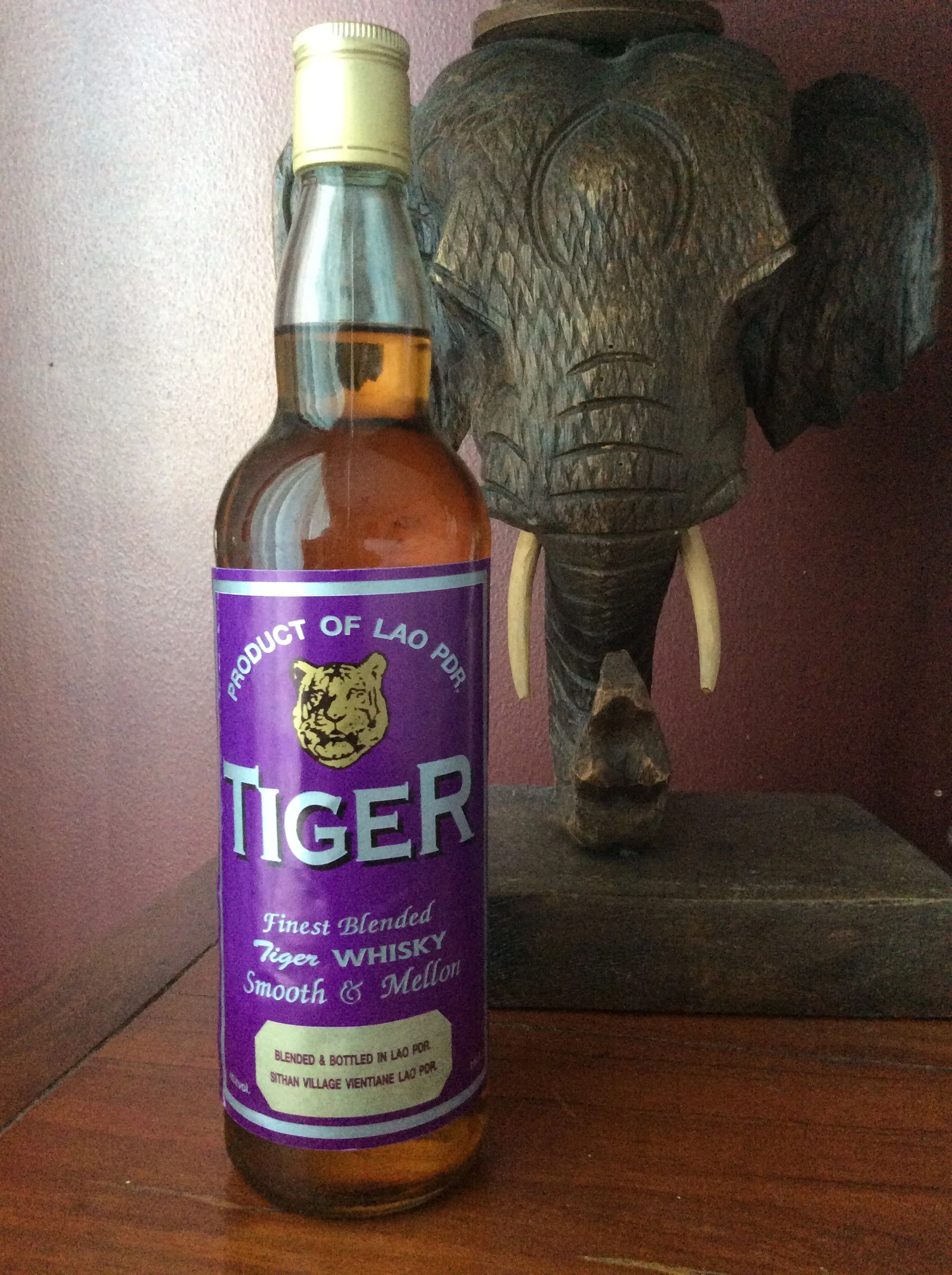
The label looks… unofficial and a bit crudely-made. The whisky claims to be “smooth and mellon”, which is good for a chuckle at least.
The whisky is a very fake-looking caramel color, and since there is absolutely no age statement, I can only imagine that the whisky has been colored artificially.
So is it really “smooth and mellon”? Well, there’s hardly any flavor to speak of, actually. It’s almost watery, which is weird. There’s no smokiness, no peat, no cream, nothing that would set apart any moderately-good drink. It’s just booze with a weird sweetness, probably from the caramel coloring.
Try it out for yourself, and let us know what you think.
After a few days in Vientiane, it’s time to head further north to see the rest of Laos. These are our experiences taking a bus between Vientiane to Vang Vieng, two of the country’s most popular tourist destinations.
Taking the bus in Laos
How much does a ticket cost?
A ticket from Vientiane to Vang Vieng cost us 40,000 kip per person (just over $4).
Where to buy a ticket in Vientiane
We booked our bus directly from our guest house. Every hotel, hostel, and guest house will have a tour booking desk, so just ask around. Prices will be the same everywhere.
a bus ticket from Vientiane to Vang Vieng, Laos
What is it like riding the bus between Vientiane and Vang Vieng?
We booked the earliest bus from Vientiane to Vang Vieng. The company would pick up up around 9:00, and we were told the bus would take about three hours. Here is our experience:
9:00 – we sit in the lobby of our guest house waiting to be picked up
9:30 – an electric golf cart arrives in front of our guesthouse to take up to the bus station
10:00 – we board the bus, but have to wait for the golf cart to go back and pick up the rest of the travelers from their hotels
pick up by electric golf cart
10:30 – we are on our way!
1:00 – we take a 30-minute break to use the toilet and buy snacks at a rest area
3:00 – we finally arrive in Vang Vieng
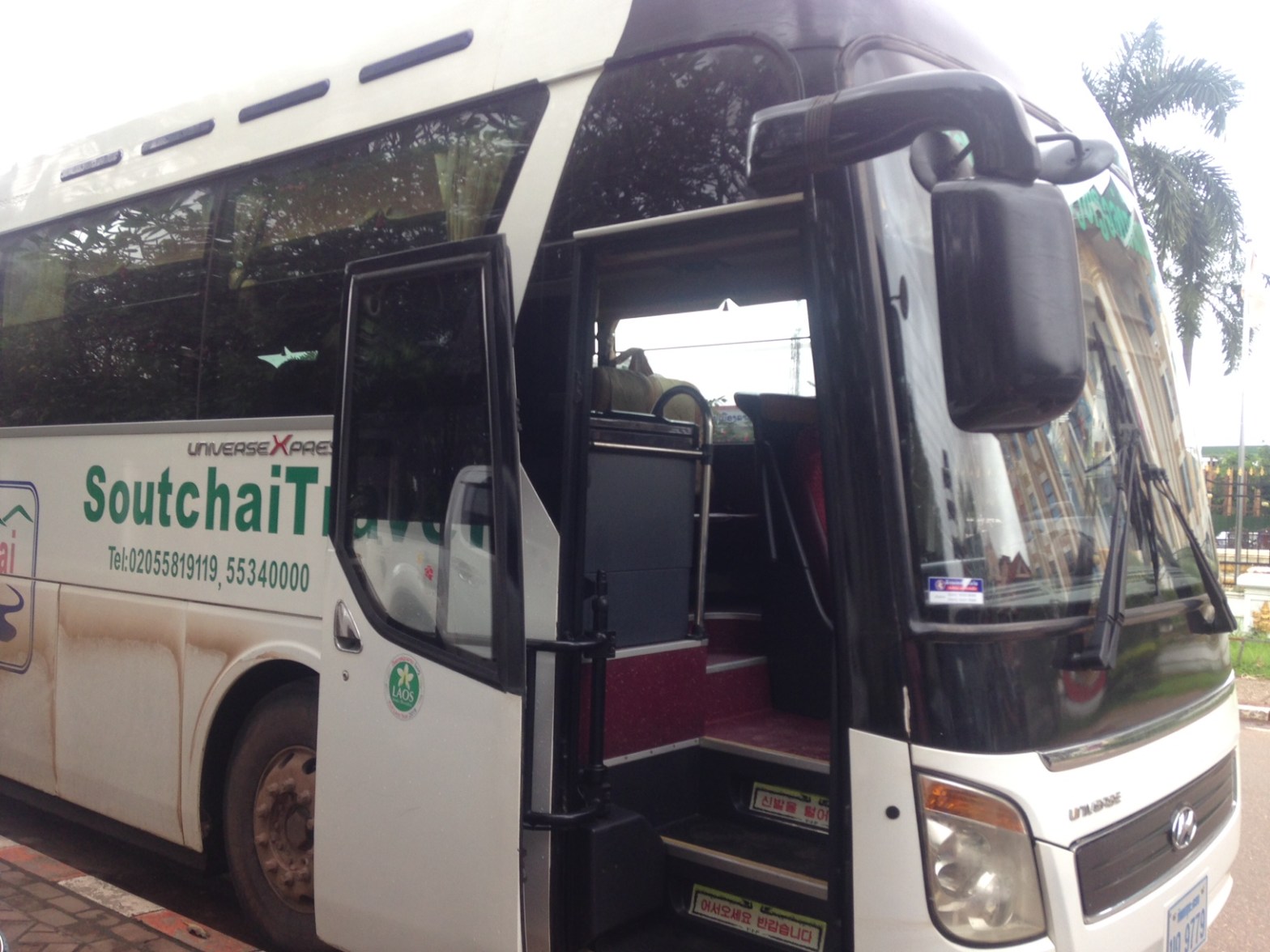
Soutchai Travel Bus, Laos
How long does it take to get from Vientiane to Vang Vieng?
Although we were told the trip would only take three hours (from 9:00 am to noon), we didn’t leave until after 10:00, and didn’t arrive until 3:00, three hours later than we were told. We have come to expect this while traveling in southeast Asia, though. Be sure to add a few extra hours to any travel time that you are quoted.
leaving Vientiane
What is the bus like?
We were very happy to be riding on a regular coach-style VIP bus, and not a minivan. The minivans are small, cramped, travel too fast, and result in a lot more accidents than the regular size buses.
The bus we were on was new, comfortable, and modern. It was nothing special, but completely comfortable for the long journey.
Is it safe to travel by bus in Laos?
As long as you are traveling by day, it should be ok. The roads are terrible – even the best roads, such as the national highway between Vientiane and Luang Prabang are muddy and potholed at the best of times. All of the trucks, buses, and cars slow to a crawl while navigating the potholes in the road, adding hours to driving time.
The roads in the mountains can be winding, and drivers will accelerate through the wrong lane to try to pass others who they deem are going too slow.
The bus we were on never drove too fast or recklessly. Overall, as long as you are on a bus and not a minivan, you should be ok. Just make sure that you are traveling with a reputable company.
even the best roads tend to be muddy and potholed
Does the bus stop between Vientiane and Vang Vieng?
The bus makes a stop at a rest area about halfway between Vientiane and Vang Vieng. The bus stops for about half an hour, giving riders time to stretch their legs, visit the toilet, and grab a snack or a drink at the little minimart at the rest area.
rest area halfway between Vientiane and Vang Vieng
Pick up a “khao ji” (the Laotian version of a Banh Mi) and a can of Beer Lao for only 20,000 kip (just over $2). A khao ji is a baguette sandwich stuffed with barbecued pork, pate, cilantro, chili paste, veggies, and more!
Laotian sandwich “khao ji” and a can of Beer Lao Dark – a nice lunch on the road
Overall, it was a fairly comfortable and stress-free experience. Yes, the roads are bad and VERY winding, so you might want to take a Dramamine if you happen to be prone to motion sickness.
The driver drove slowly and carefully, and we felt safe on the entire trip.
The journey did take longer than we were quoted, but it was about as long as we expected it to take.
There is NO TOILET on board the bus.
The bus is comfortable and air-conditioned.
Ticket prices are reasonable and easy to book.
There was amazing scenery outside the window as we drove through the countryside.






















 LB convert