Almost everyone needs a visa to visit Laos. The good news is that many nationalities are able to apply for visas-upon-arrival at certain international airports and border crossings in Laos. Make sure that you are able to receive a visa on arrival, or else risk being turned away at immigration.
Wattay International Airport, Vientiane, Laos
Who can get a visa upon arrival in Laos?
Visa-free entry to Laos
ASEAN countries
Russia
Mongolia
Denmark
Finland
Japan
Luxembourg
Norway
South Korea
Sweden
Switzerland
Brunei
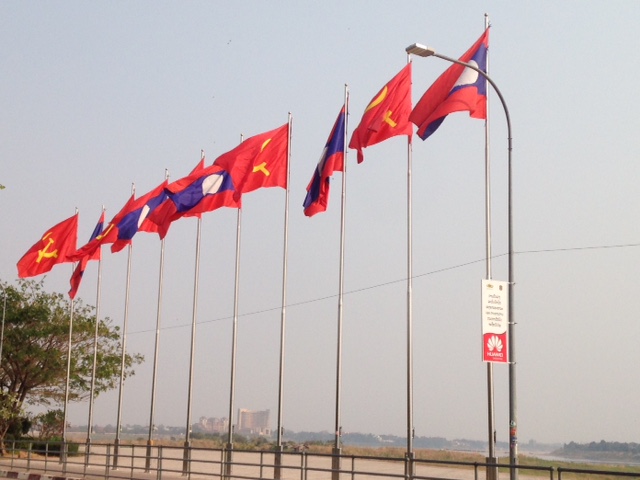
Flags of Laos along the Vientiane riverfront
Visa upon arrival in Laos
Most nationalities can apply for a visa upon arrival at any of Laos’ international airports and most land border crossings.
USA
UK
Canada
Australia
New Zealand
South Africa
China
Brazil
India
and many others
The visa application is only one page long and is processed as you pass through immigration. The visa fee is between $30 and $45, with nearly every nationality being required to pay $35. The visa fee is payable in USD only, so make sure that you’ve prepared the proper currency. A passport photo is required to apply for a visa, but they can take a photo of you at the airport for an additional $1.
Apply for a visa in advance
Holders of passports from certain nationalities are required to apply for a visa in advance at the nearest embassy. If you are already traveling in Southeast Asia, your best bet is to visit the Laotian embassy in Bangkok, where a visa costs around 1500 Thai Baht, and can usually be processed in one day.
Holders of Turkish passports, among others are required to apply for a visa in advance
If you are unsure whether your passport entitles you to a visa on arrival, check the official list on the government’s immigration department website. >>http://www.immigration.gov.la/visas.html
When you arrive in Vientiane, Laos at Wattay International Airport, you have a few options of how to get to the city. Vientiane is a small city with a population just over 200,000, and the airport is only 4km away from the city center along the main road. It’s possible to walk, although maybe a bit difficult with luggage. You can also take a taxi or songtaew for $5-$10 depending on your bargaining skills.
Now, there’s a new option, the Vientiane City Bus and Wattay Airport Shuttle!
Wattay International Airport, Vientiane, Laos
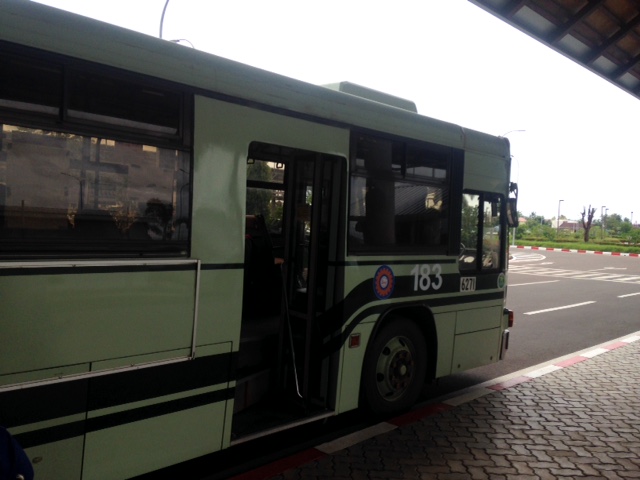
Vientiane Airport Shuttle Bus
The Wattay International Airport bus stop is just outside the arrivals terminal at the capital’s airport. Just step outside and look to your right; the airport bus stop is just 25m from the exit! If the bus isn’t there, just have a seat and wait – it departs every 15 minutes and will be there soon!
airport bus station at Wattay Airport, Vientiane
You can pay for a ticket on board. There is an English-speaking staff member who will collect your money (15,000 kip per ticket) and ask where you want to go. Then, the attendant will announce each bus stop and let you know when to get off.
Vientiane City Bus
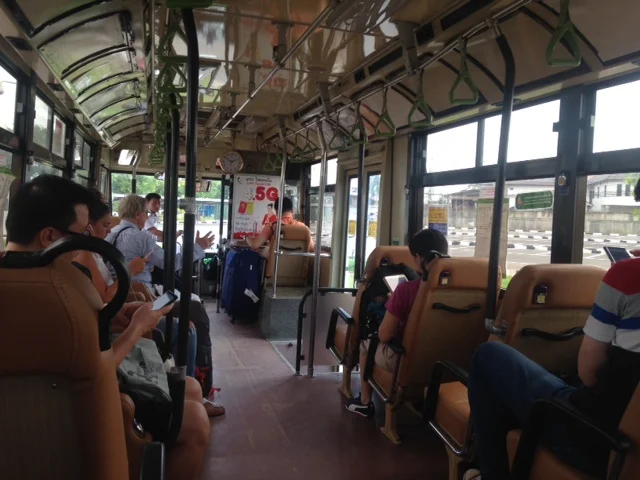
The bus only stops at a bus stop if someone is waiting to get on or off. When the attendant announces the next stop, just stand up and push the button by the door to ring the bell, singaling the driver that you want to get off.
inside the Vientiane City Bus
The airport shuttle bus runs in a loop through Vientiane, stopping at the city’s main attractions, and the areas where most hotels, guest houses, and hostels are located. The bus eventually terminates at the Vientiane bus station, before heading back to the airport.
Vientiane city center airport bus map
How much does the Vientiane City Bus cost?
The airport shuttle bus costs 15,000 kip (about $1.75) per ride.
Regular city bus lines cost only 4,000 kip (about $50) per ride, making it a cheap and easy way to get around the city.
a bus ticket costs 15,000 kip
Where does the Vientiane City Bus go?
information board at a Vientiane bus stop
There are several numbered bus lines running through Vientiane, hitting all of the most popular sites. The Vientiane City Bus stops at:
Wattay International Airport
That Luang
Patuxai
Vientiane Bus Station
Thai-Lao Friendship Bridge (the border between the two countries)
Buddha Park
and much more
Check out these maps to help you plan your budget visit to Vientiane – a trip by bus is much easier and cheaper than travel by local songtaew or tuk tuk.
Beer Lao, the national beer of Laos, is widely considered to be among the best – if not THE best – beers in Asia.
the classic Beer Lao selection
Beer Lao is a well-rounded, relatively light European-style lager that goes perfect with a plate of spicy Laotian food and a beautiful sunset along the Mekong River.
This year, Visit Laos Year 2018, the Lao Brewery Company has released three brand-new flavors to compliment their small but trusty selection. These three new flavors are the brewery’s first time dipping their toe into the world of craft beer, which is still an almost unknown industry in Asia.
Review of 3 New Beer Lao Flavors
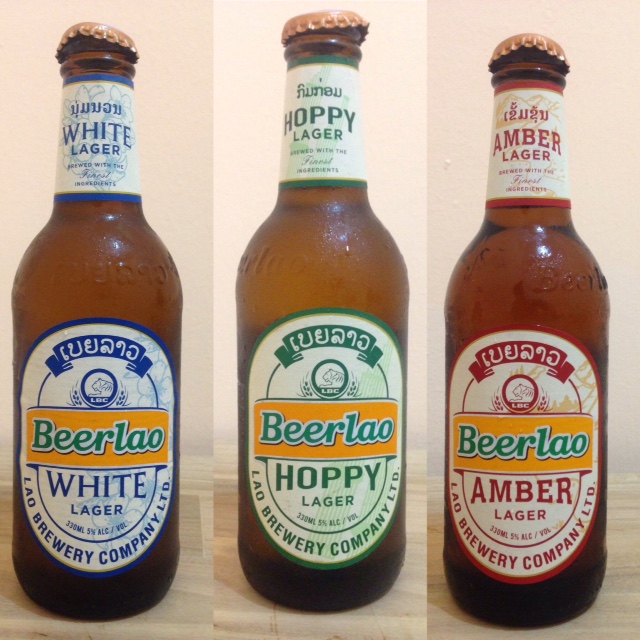
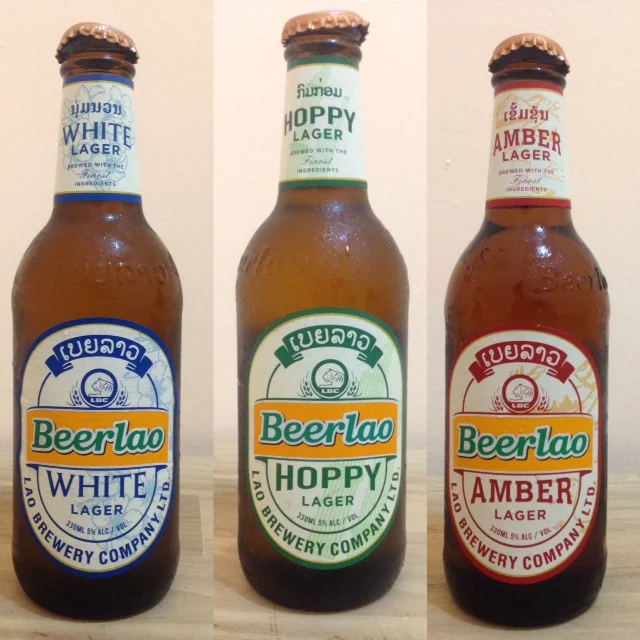
Beer Lao has released three new lagers: White Lager, Hoppy Lager, and Amber Lager. All three of these trendy new brews can be found at shops throughout Laos, costing around 8,000 kip ($1) per bottle.
three brand-new flavors of Beer Lao
While the previous selection of Beer Lao Lager, Beer Lao Dark, and Beer Lao Gold are always refreshing and dependable, how do these three new flavors of Beer Lao hold up? This is Beer Lao’s first attempt at a more exciting lager, and one of the first mass-produced craft-style beers in Asia.
Beer Lao White Lager
Beer Lao’s new white lager is an attempt at a Belgian-style witbier. The beer is light and smooth, and very drinkable. Maybe a little too drinkable! Like the rest of the Beer Lao range, Beer Lao White Lager goes down smoothly and quickly.
Beer Lao White Lager is light and mild, with a slight fruity taste and a very mellow and sweet finish.
NEW Beer Lao White Lager
Beer Lao Hoppy Lager
Don’t expect an IPA from Beer Lao’s new hoppy lager. While distinctly hoppy – very hoppy in fact, by Asian beer standards – Beer Lao Hoppy Lager is a lot more mild than the typical British or American IPA. If hops aren’t quite your thing, you might consider giving Hoppy Lager a try. The hops are delicate and mild, but still give the beer a nice bitter kick. It’s surprisingly smooth, and I can see this beer being very refreshing on a hot Laotian afternoon.
Beer Lao Hoppy Lager is malty, and lightly hoppy. It doesn’t pack a hugely bitter punch, but the flavor of the hops aren’t allowed to overpower the light citrus flavor of the lager.
NEW Beer Lao Hoppy Lager
Beer Lao Amber Lager
The third beer in Beer Lao’s new selection is Beer Lao Amber Lager. Personally, I thought that Beer Lao Amber Lager had the most personality of the three new beers. Like all Beer Lao, it’s quite light and pretty crisp and easy to drink fast.
Beer Lao Amber Lager has a gentle fruit flavor and a light almost floral aroma. It’s very smooth, and the flavor comes on quickly and fades into a gentle finish.
NEW Beer Lao Amber Lager
So, are these three new flavors of Beer Lao worth checking out?
ABSOLUTELY! Like all Beer Lao, these are really solid and very drinkable beers. Though not overly bold, it’s exciting to begin seeing craft-style options popping up in Asia. I’ll definitely be trying all three of these beers again… and again… and again…
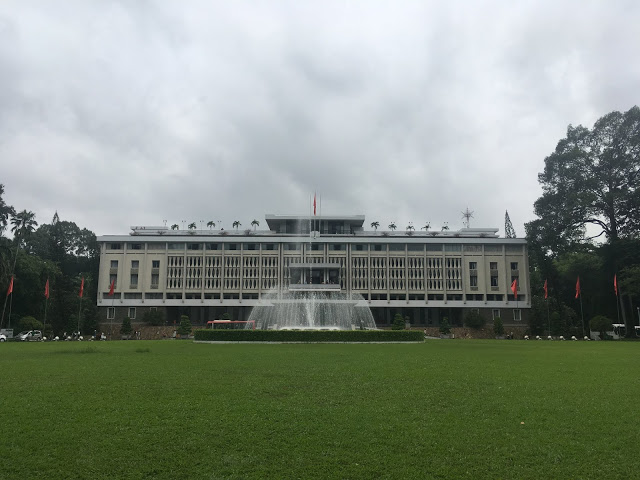
Independence Palace (re-named Reunification Palace after the Fall of Saigon), the former residence and seat of power for the South Vietnamese President, is a relic of the wild glory days of 1960’s South Vietnam.
The former presidential palace is open to visitors, and is possibly the best and most interesting attraction in Saigon for those with an interest in history, espianage, and war-era Saigon.
Independence (Reunification) Palace, Saigon
Independence Palace
Originally built as Nordorom Palace as the residence of the French governor-general of Cochinchina, the palace was rebuilt into a massive 1960’s retro-futuristic feng-shui fortress after Vietnam gained independence from France.
looking out from the palace
The State of Vietnam, a constitutional monarchy with the last emperor Bao Dai as Head of State nominally ruled all of Vietnam for a short time from 1949 until 1955, although Ho Chi Min’s Communist forces effectively controlled the northern half of the country. In 1955 the country split in two, and the Democratic Republic of Vietnam broke away from the Republic of Vietnam.
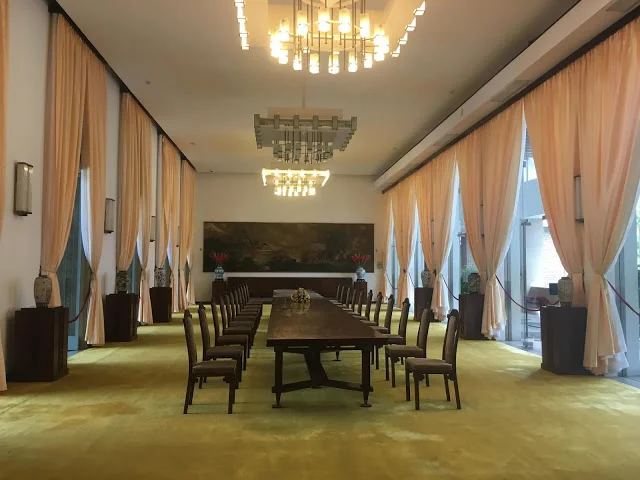
official state dining room
Independence Palace is much larger, more modern, and more impressive than the Presidential Palace in the north. In fact, everything about it shows a South Vietnam that was stronger and much richer than its northern rival.
Every room in Independence Palace is huge, with an open floor plan, tall windows, and elegant furnishings. The entire building was designed by a Feng Shui master, and from the air the building forms a Chinese character meaning “good fortune”.
Every furnishing in the palace was built with feng shui in mind. All the luck didn’t seem to help the Republic of Vietnam in the end, however. Independence Palace was the site of the final attack during the Fall of Saigon in 1975, when a pair of tanks smashed through the palace gates, forcing the surrounded government to officially surrender.
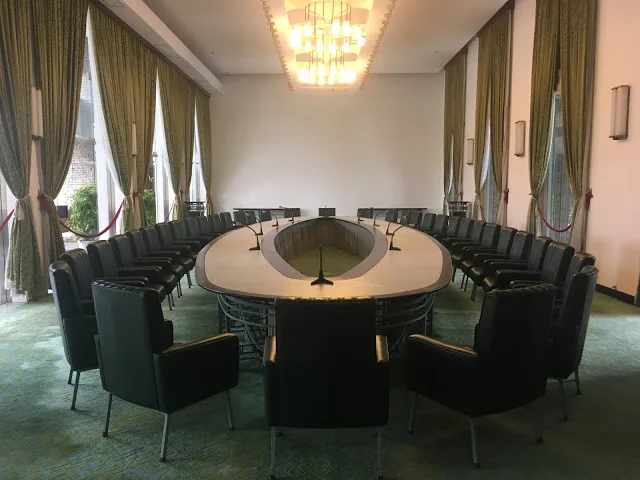
South Vietnam Cabinet Meeting Room
South Vietnamese President’s Private Quarters
The lower floors of the palace contain the cabinet chambers, official government meeting rooms, and offices for high-level ministers. The third floor, however, was the president’s private chambers.
president’s living quarters
The living quarters are still decorated with original furniture. It’s very 60s and very cool. Past the president’s bed room, you’ll find a private cinema, large game room complete with casino tables, dining room, bar, and plenty of places for entertaining.
Saigon was southeast Asia’s party capital back in the day, and Independence Palace, it seemed, was the place to be. The president even renovated the designated rooftop meditation room to be a dance floor.
president’s private cinema
Make your way up to the roof, where the meditation room/dance hall has been replaced with a small souvenir and snack shop.
During the war, a North Vietnamese spy infiltrated the South Vietnamese Air Force and stole a fighter jet which he used to drop two bombs on the palace. Three place staff were killed, but the president and his family were safe. The bombing shook confidence in the South Vietnamese government. If they couldn’t protect the president, how could they protect the country? Today, the roof of the palace is marked where the two bombs fell.
palace rooftop helipad
South Vietnam’s War Bunker
Just past the helicopter is a fortified stairway leading directly underground to the president’s secure bunker. Like everything else in Saigon, the South Vietnamese bunker was much larger, more comfortable, and more modern than the secret underground bunker in Hanoi.
rooftop stairway to the president’s bunker
The stairs lead down into a blast-proof underground bunker – the command center for South Vietnamese military operations. There, the president had another fortified bedroom, surrounded by military communications equipment, military barracks, and emergency meeting rooms.
communications center
The president’s desk inside the war bunker had a direct line to the US Embassy in Saigon.
desk of the South Vietnamese President in the underground bunker at the palace
Explore the Grounds of the Independence Palace
Vietnamese tanks
Outside, you can see one of the tanks that smashed through the palace gates on the day that Saigon fell to Communist forces. When the attacking army arrived, the new president (who had only assumed the post just hours before) was waiting patiently inside the palace to surrender. It was inevitable. By 1975, after the US withdrew from southern Vietnam, it was only a matter of months before the Communists were able to conquer all of South Vietnam.
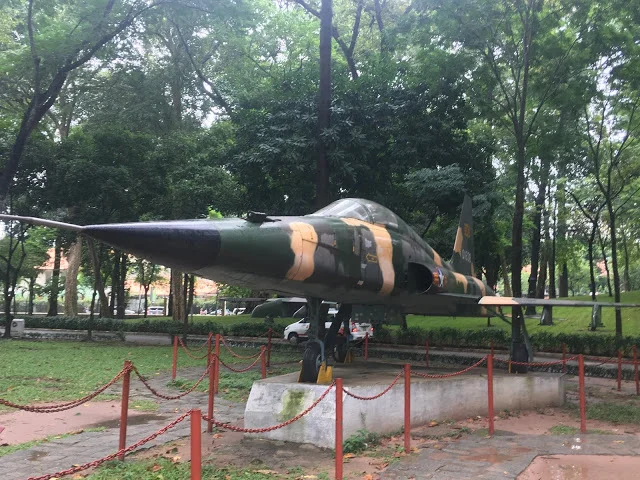
South Vietnamese fighter
There is also a small collection of aircraft, including the place that dropped two bombs on the palace. Have a look at the insignia on the aircraft. The South Vietnamese insignia and flag have been crossed out.
the South Vietnam flag and insignia have been crossed out
Independence Palace Location
The palace is located in Ho Chi Minh City District 1, very close to may of the city’s most popular museums and landmarks.
135 Nam Kỳ Khởi Nghĩa, Phường Bến Thành, Quận 1, Hồ Chí Minh 700000, Vietnam
Opening Hours
Independence Palace is open daily from 7:30am-11:00am and 1:00pm-4:00pm
Tickets and Entry Fees
An entry ticket costs 40,000 VND
You can also purchase a ticket to the palace museum and gallery, which gives a lot of valuable and interesting information about the history, politics, and government of South Vietnam, with a focus on the biography of the South Vietnamese leaders. It’s well-worth the extra cost, and goes a long way towards helping a visitor understand the background of the palace.
If you are lucky, you might catch one of the fairly frequent FREE guided tours that meet in the palace lobby. Ask for more information at the ticket office.
The Saigon Museum of Fine Arts has an impressive collection, but the building itself is something of a work of art as well. Originally built as a villa for the wealthy Hua family in 1929. The building was designed by a French architect, and is one of the most beautiful old buildings in District 1. Although it had fallen into a state of slight disrepair, the old villa was re-purposed in the 1980s to house the city’s museum of fine arts, considered second only to the National Museum of Fine Arts in Hanoi.
The Ho Chi Minh City Museum of Fine Arts
Although the old mansion has been redesigned into an art museum, many of the original fittings and fixtures were preserved. A particular favorite of mine is the original 1920s-era box elevator.
an antique elevator in the old mansion
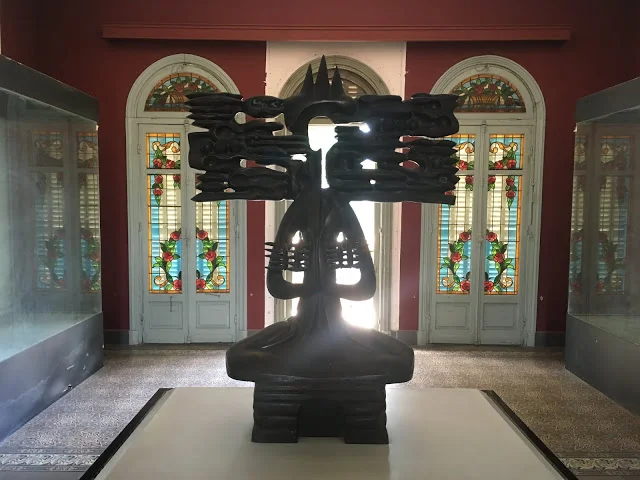
The museum boasts a great collection of ancient Buddhist artifacts, but the biggest exhibits are those of 20th-century art. Modern Vietnamese art is heavily influenced by both traditional rural life and the many wars that the country underwent during the 19th and 20th centuries.
Vietnamese war-era art
The museum is located in District 1, the center of the city. Walk along the wide, busy roads jammed with motorbikes to the old villa, which offers visitors a quiet place of peace and tranquility in the busy heart of Ho Chi Minh City.
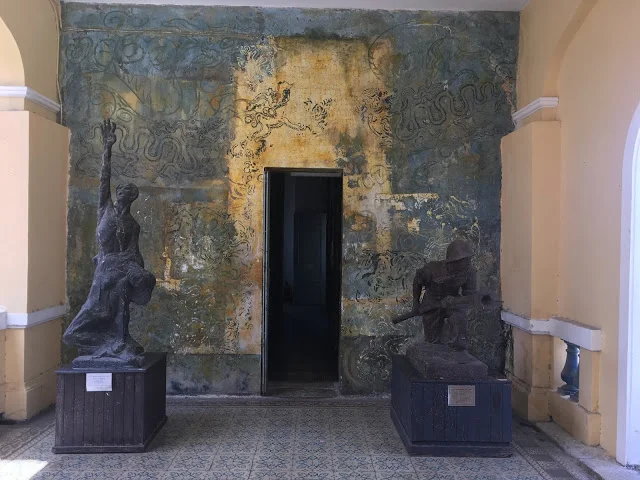
statue in front of original stained glass
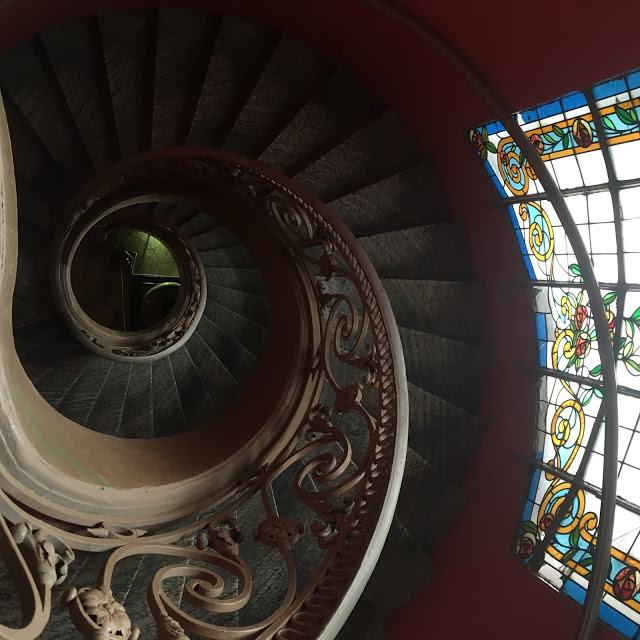
he museum has tried hard to preserve a lot of the original architecture, most impressively the original stained glass! It adds some color and a unique atmosphere to the exhibits.
original chandalier
Even if you aren’t that interested in art, it’s worth it to visit this beautiful museum even if only to see the antique fixtures and historic architecture.
The Saigon Zoo and Botanical Gardens – once considered to have been the pearl of Indochina with one of the world’s largest collections of tropical plants and animals – was established in 1865 by Admiral Pierre-Paul de La Grandière, commander of French Cochinchina. Today, Vietnam’s largest zoo, it contains over 125 different species of animals.
While the zoo is definitely fun to visit, its botanical gardens are the more impressive part.
Saigon Zoo Fountain
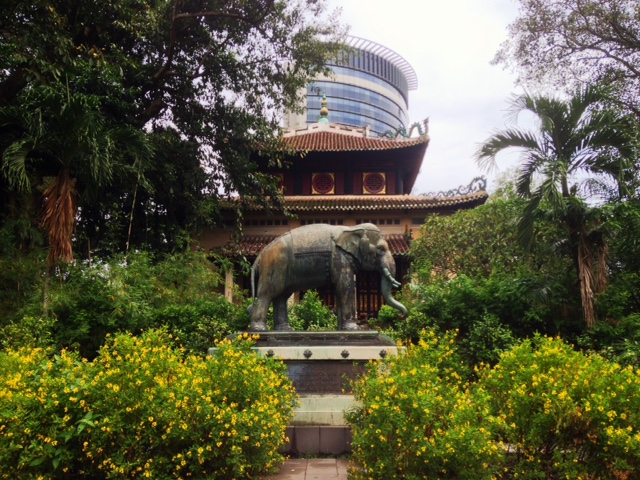
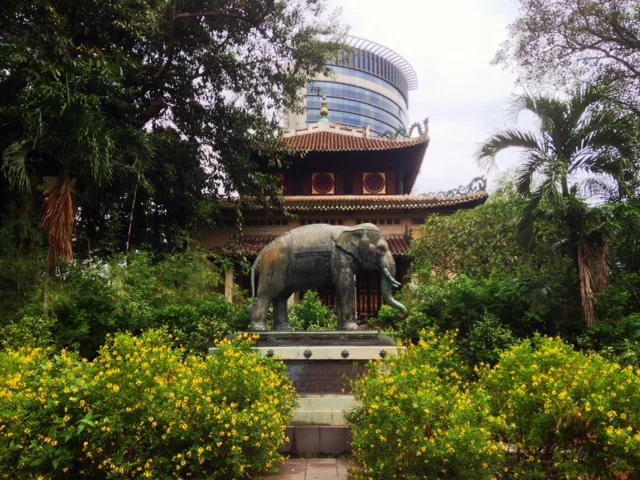
Just near the exit is a two-story pagoda, a memorial to those Vietnamese killed during the First World War. It’s surrounded by beautiful flowers and lush gardens. It’s tranquil and beautiful.
memorial shrine at Saigon Zoo
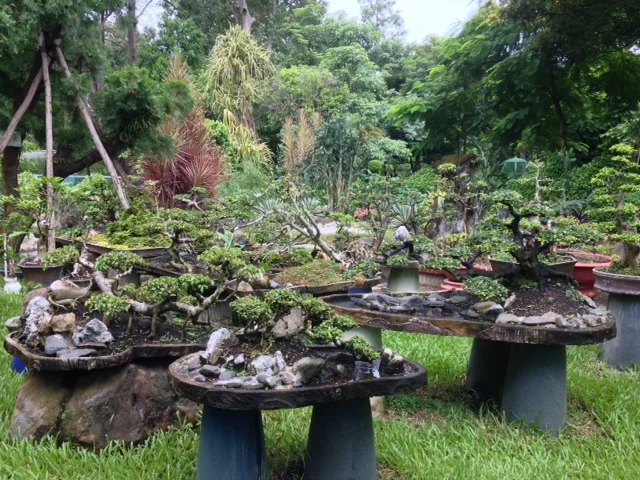
The gardens are especially famous for their extensive collection of bonsai trees and orchids, all catalogued and collected from all across Asia. Although neglected a bit during the war, the gardens are once again the pride of Vietnam.
bonsai trees at the Saigon Botanical Gardens
You can spend all day wandering through the extensive gardens. There are lots of activities along the way too, including some rides, snack areas, and places for kids to play. Though the zoo doesn’t seem that well organized, it’s easy to find your way around.
greenhouse at the Saigon Botanical Gardens
The zoo itself is huge, but nothing too impressive. The animals seem to be well-cared for, and the exhibits, while not super large, are big enough that the animals have space to roam around a bit.
sun bear
Opening hours
daily 7:00am – 5:00pm
Entrance fee
Admission to the zoo and botanical gardens is 50,000 VND
Nha Trang is a coastal city in south-central Vietnam. Nha Trang is a small resort town, known for its incredible beaches and upscale resorts, though there are plenty of budget options as well. Though its just a small town, Nha Trang has more than its share of attractions within the city itself, all of which can fit into the plan of a budget traveler.
Nha Trang is a fairly walkable city, and it’s not too hard to get around on foot.
How to get to Nha Trang
You can reach Nha Trang by night bus from Hoi An or Saigon (Ho Chi Minh City). It’s located about halfway between both cities. Strangely, there aren’t many buses that depart from Da Nang to Nha Trang, but it’s easy enough to get to nearby Hoi An to catch the night bus.
You can also take the train. Nha Trang is located along Vietnam’s main railroad line.
What to do in Nha Trang
Although Vinpearl Land, a private resort island and amusement park just off the coast, may be a bit expensive, check out these cheap or free things to do in Nha Trang instead.
Many people visit Nha Trang to visit the Vinpearl Land amusement park and resort, but that doesn’t mean that visiting Nha Trang is expensive. Check out these FREE or budget-friendly attractions instead.
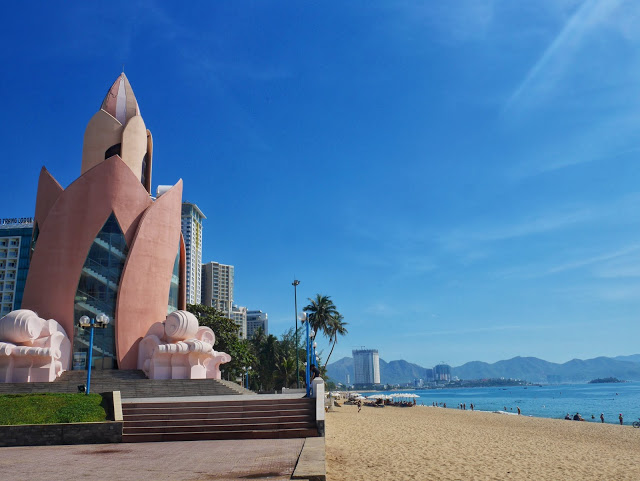
Tram Huong Tower
The Tram Huong Tower is the symbol of Nha Trang. Built in 2008 and designed to look like a lotus flower, the Tram Huong Tower sits right on the beach along Nha Trang’s main road. The tower is a small art museum, displaying local art and photographs, though it’s main purpose is to be photographed itself!
The Tram Huong Tower is completely FREE to visit.
Nha Trang Cathedral
The Cathedral of Christ the King in Nha Trang is famous for its beautiful stained glass windows. The cathedral is located near Vincom Plaza shopping mall.
Built in 1886, this beautiful and historic cathedral is a great example of French colonial architecture in Vietnam.
The cathedral is open to visitors, and is completely FREE to visit.
Cathedral of Christ the King, Nha Trang, Vietnam
Nha Trang Beach
beach in Nha Trang, Vietnam
The most popular thing to do in Nha Trang, of course, is to go to the beach! The beaches are beautiful, and as such can be very popular, especially during the high tourist seasons. Many locals avoid the sun during the day, however, so you’ll find the beach much less crowded if you visit from late morning through early afternoon.
The beach is totally FREE to visit.
National Oceanographic Museum
The National Oceanographic Museum of Vietnam, located just south of the city, is an interesting aquarium and oceanographic research station. The museum is fairly small, but has an extensive collection of marine specimens preserved in its library, which visitors can see as they walk through the museum.
The most interesting part of the museum is the sea turtle breeding area.
While it’s possible to reach the museum on foot from the city center (we did it, but the walk took well over an hour), it’s advised to rent a motorbike or bicycle, or even to take the frequent public bus that runs up and down Nha Trang’s main road. The museum is about 5km south of the city center, located on the main road right on the coast.
The National Oceanographic Museum costs only 30,000 VND per ticket.
The Po Nagar ruins, located about 5km north of the city center, are one of Nha Trang’s biggest attractions. These khmer-style ruins date back nearly a thousand years! Though the site is fairly small, it’s a fascinating look at the history of the Champa Kingdom that once ruled central Vietnam.
The entrance fees to Po Nagar ruins cost 22,000 VND
Exploring the city on foot
a statue at a temple along the beach
Nha Trang is not a big city. It’s easy enough to walk from place to place, though if you are going to the Oceanographic Museum or to the Po Nagar Ruins, you might want to take the city’s public bus or hire a taxi.
Traffic in Nha Trang is not bad at all, and there are decent sidewalks and plenty of areas for pedestrians. Nha Trang is one of the more pedestrian-friendly cities in Vietnam.
I’ll never forget my first day of work in Thailand. It was scary and exciting. I had never taught before, and the morning had been so busy “learning the ropes” of working in a school. By lunchtime, I was tired and hungry and ready to sit down and eat! I sat down at a table in the teacher’s dining room, and couldn’t believe my eyes. There in front of me was a bowl of fruit… but I didn’t recognize a single item!
There were these weird red spiky things, strange purple fruits that looked like bombs from the Zelda games, and more. And you know what? It turns out that all of thfe fruit in Thailand is amazing! Here are 10 delicious, exotic, strange, and amazing fruits that I had never seen before I came to Thailand.
10 Amazing Thai Fruits
Durian
Durian, the “King of Fruit”
In Thailand, durian is called the “King of Fruit”. Although this super stinky fruit is banned from Bangkok’s MRT and most public places, once you acquire a taste for it, durian will really begin to grow on you.
Durian has been described as a fruit that “smells like hell but tastes like heaven”, and that’s a pretty good description. Durian really stinks. People say that it smells like everything from stinky old shoes to gasoline, but it tastes rich and creamy, like vanilla ice cream! Durian is soft, mushy, stinky, and delicious. Give it a try for yourself, and let us know what you think.
Mangosteen
purple mangosteen
Mangosteen is called the “Queen of Fruit”, and it’s easy to find in the spring and summer in Thailand. This dark purple fruit hides a deliciously sweet interior, and stains the fingers bright purple when you crack it open. In my opinion, mangonsteen is the most delicious fruit in Thailand.
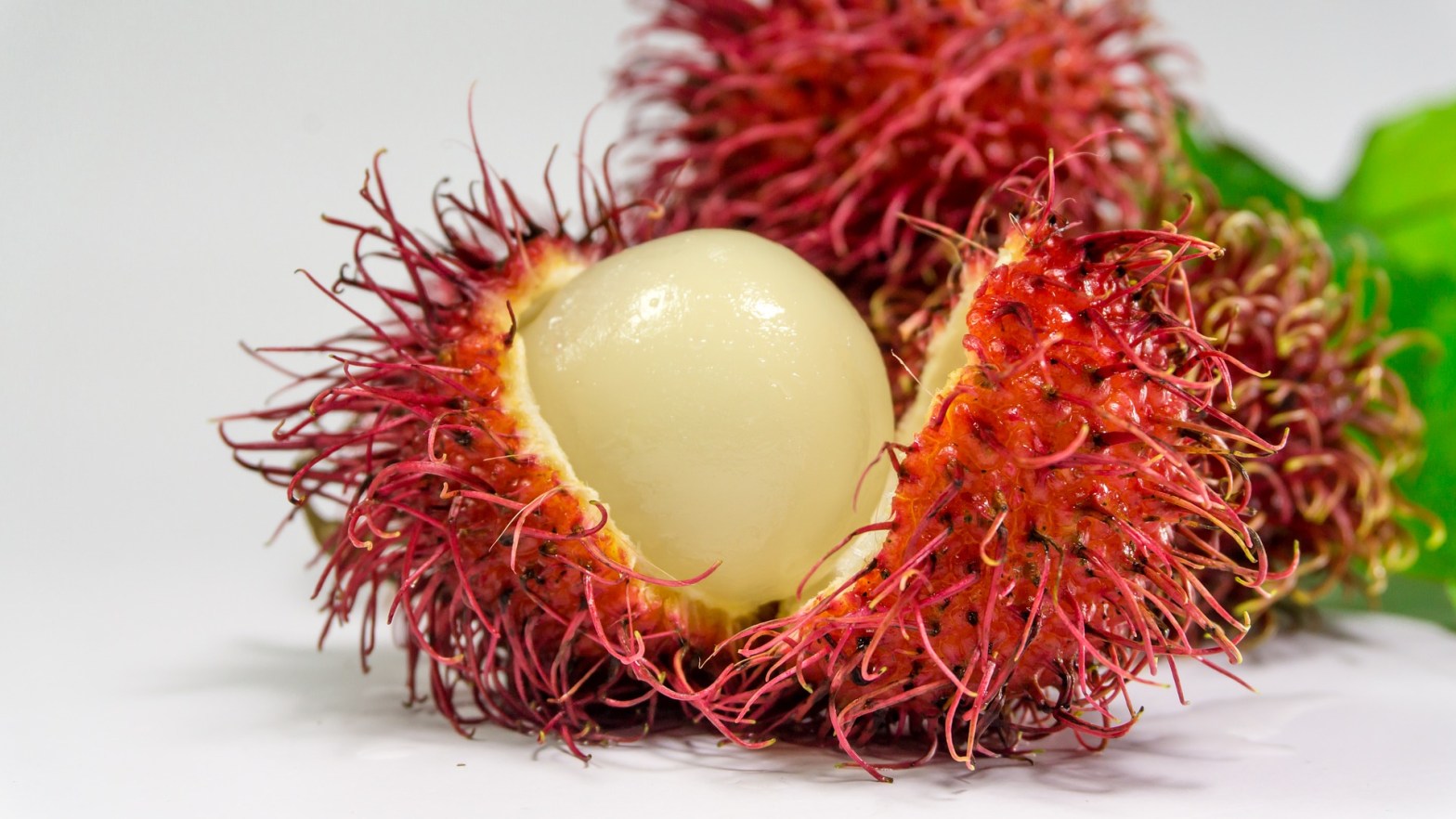
Rambutan
rambutan – “ngaw”
Rambudan is a funky and spiky fruit with a nice, sweet interior beneath a weird thick skin. Rambutan has been described as tasting something like a mix between a grape and an apple. Eat around the big, woody seed hidden inside the fruit for the tastiest flavor of the rambutan. Rambutan is one of Thailand’s summer fruits.
Lychee
lychee
The sweet lychee is a popular flavor throughout Asia, used to add a sweet taste to everything from bubble tea to iced desserts. Open up this pink fruit to discover a sweet white interior surrounding a single solid seed. Lychee is so sweet and delicious, but it can be a bit hard to find out of season.
Jackfruit
Thai jackfruit
Jackfruit looks something like durian, and it smells just a bit like it too! Jackfruit is chewy and kind of rubbery, but the inside is sweet and tasty. Admittedly, it’s an acquired taste. Jackfruit is used as a flavoring and added texture to a number of popular Thai desserts.
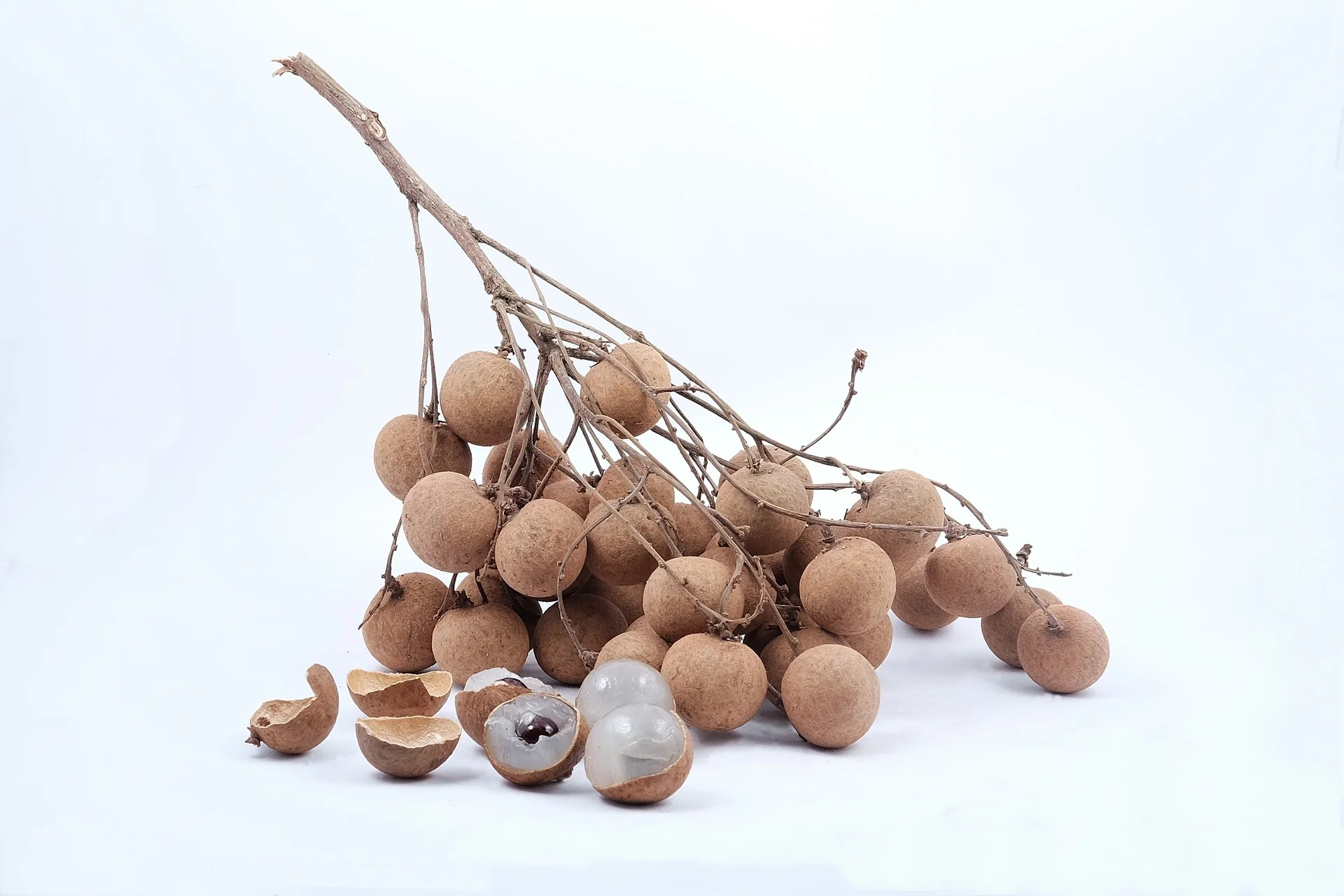
Longan
Longan means “dragon’s eye”. The semi-transclucent interior surrounds a single black seed (some say it looks like the eye of a Chinese “lung” dragon) and tastes amazing! Simply use your thumb to peel off the fruit’s thick shell, and spit out the hard black seed. Longan is a popular autumn and winter fruit in Thailand.
Dragonfruit
Pitaya, “dragonfruit”
Dragonfruit, or “pitaya”, comes in two varieties; white and pink. Though the pink and green scaly exterior looks the same, the soft and juicy interior – soft, sweet, and full of chewy seeds – comes in a white or pink variety. Eat dragonfruit with a spoon, scooping out the juicy and tasty inside of the strange exotic fruit. It’s really amazing, and can be found throughout Thailand year-round. Dragonfruit is an especially good way to cool off when it’s super hot outside,
Starfruit
starfruit
The appropriately-named starfruit is a weird five-pointed fruit that is usually served sliced into star-shaped pieces. The fruit is a little bitter, a little sweet, and a little sour, and is found at nearly all Thai markets and supermarkets.
Snakefruit
Thai snakefruit
Just one look at the snakefruit’s skin, and you’ll understand where it got its name. Though it’s not as common in Thailand as some of the other fruits on this list, it’s easy enough to find at markets and supermarkets throughout the country. The snakefruit is a little tart and a little sour, and goes really well with a Thai dessert.
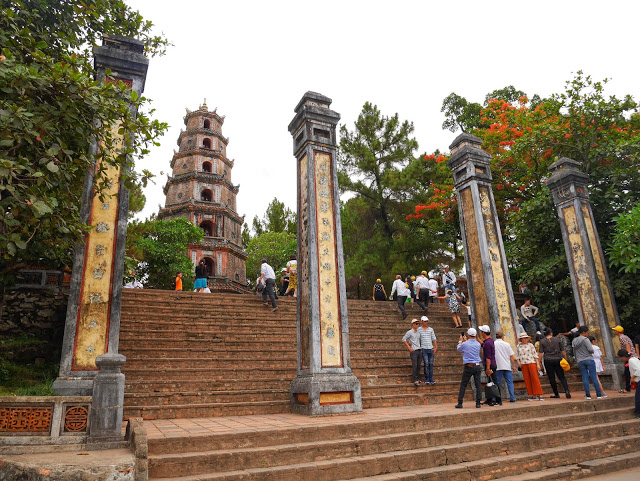
Thien Mu Pagoda, the Temple of the Celestial Lady, sits along the banks of the Perfume River in Hue, Vietnam. The temple lies about 4 kilometers west of the Imperial Citadel. While it’s possible to walk (that’s what we did!), you might want to rent a motorbike or even a bicycle for the trip to the temple. If you do choose to walk, you will be treated to some amazing views of the beautiful Perfume River.
Thien Mu Pagoda, Hue
The seven-story pagoda is a symbol of Hue, and one of the city’s famous landmarks. The pagoda dates back to 1601, and has a famous story associated with it. Those were the final days of the Le Dynasty, when the Nguyen Lords ruled central Vietnam in tribute to the north before ascending the throne and establishing the Nguyen Dynasty.
One day a Nguyen Lord was riding in the countryside, he met an old lady dressed in red and blue (the “Celestial Lady”) who predicted that a lord would build a pagoda and become a great ruler. Then, she mysteriously vanished! The lord constructed the pagoda, and 200 years later, his family would rise up to become the imperial family of the last dynasty of Vietnam.he Thien Mu Pagoda is named after
incense burner at the Celestial Lady Pagoda, Hue
Thien Mu Pagoda is heavily influenced by the Zen school of Buddhism. The main statue inside the pagoda is of Maitriya, the “Future Buddha”, who is supposed to come to the world in the future to bring Buddhist teachings when most have been forgotten.
The temple also has a garage holding an important Vietnamese relic: the automobile that carried Buddhist monk Thich Quang Duc to Saigon in 1963, where he self-immolated in protest. This moment was captured on film by an American journalist, and became an important symbol of anti-war protest. We’ve all see that famous photograph, a symbol that helped turn the tide of support against the war.
an important historical relic
The temple is situated in a beautiful garden in the forests of central Vietnam. The air there is cool and fresh, and the scenery is incredible – some of the most beautiful in the whole country.
overlooking the river
asdf
forest pagoda shrine
Thien Mu Pagoda is totally free to visit, and worth spending a few hours exploring. As you leave the temple, there are plenty of souvenir shops selling local items and goods to tourists. There are also a lot of boats waiting to offer you a tour of the river through Hue, or a ride back to your hotel down the Perfume River. You’ll have to bargain, though. The best price we were able to get back to the Imperial Citadel was around 200.000 VND (about $10).
boats along Hue’s Perfume River
There is no admission to the Thien Mu Pagoda
The Thien Mu Pagoda is open from 8:00am-6:00pm daily
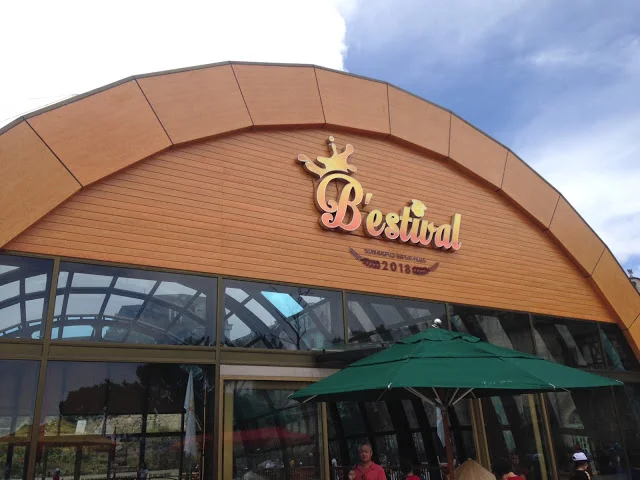
I love beer, but I really love FREE BEER! And after all, isn’t the best beer free? The Mercure Da Nang French Village is a four-star hotel on top of Ba Na Hill, a cool, misty mountain outside of Da Nang in central Vietnam. We visited during the B’estival, a huge beer festival held atop the perpetually chilly mountain at the world-famous European-style resort.
B’estival on Ba Na Hill
The Mercure Ba Na Hills Resort in Da Nang, Vietnam is a gorgeous European-style village built atop a mountain. Long ago it was a retreat for the French colonists from the heat and humidity of Indochina. Now, it’s a high-class and beautiful resort reached by the world’s longest cable car. As we sat down in the glass-bottomed cable car for a ride up to the resort, a hotel employee stuffed a stack of coupons for FREE BEER at the ongoing B’estival into my hand. Free beer? Well, count me in!
Beer Hall at Ba Na Hill’s French Village
The three-story beerhall atop Ba Na Hill is dug into the mountain. There’s seating outdoors and indoors, and beer service both inside and outside. If the weather is nice (it usually is!) why not sit outside and look out over the misty mountains with a cold mug of beer?
You can buy beer, of course, but if you are staying at the Ba Na Hills Mercure Resort, you probably won’t have to! They give out tickets for free beer liberally at reception upon check-in. A coupon is redeemable for a mug of beer. They offer two different types of beer – light and dark – both are German-style and delicious!
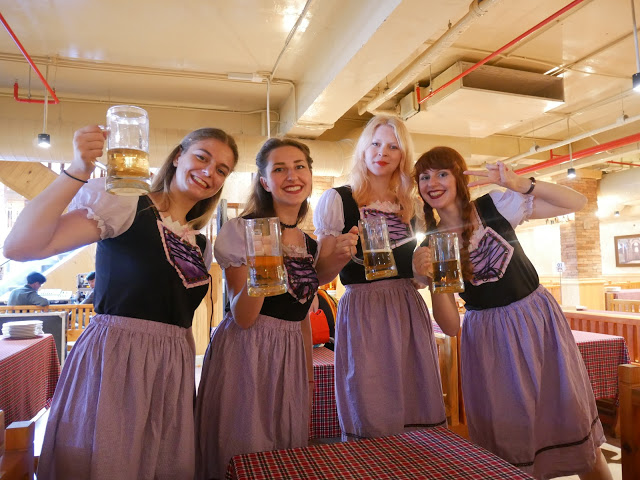
friendly staff at the B’estival
There is a group of Germans that the hotel hired to do my dream job – wander through the beer hall drinking, chatting, and toasting with guests!































 LB convert