

Spend a weekend – or longer – in one of Thailand’s most scenic provinces, Kanchanaburi.

The province is probably most famous internationally as the site of the infamous “Burmese Death Railway”, built by the Imperial Japanese Army using Allied POW labor during the Second World War. This tragic period has been made famous thanks to films such as Bridge on the River Kwai starring Sir Alec Guinnes, and The Railway Man starring Colin Firth.
Getting there
Getting to Kanchanaburi from Bangkok is easy; it’s just a short ride west by bus, although by far the more atmospheric, scenic, and meaningful experience is to take the train, which still travels along the Death Railway itself.
Train
You can get to Kanchanaburi easily by bus, but going by train is an infinitely better experience. As the train leaves Bangkok and heads west, the city slowly gives way to villages and fields, which in turn give way to mountains and jungles as you get closer to Kanchanaburi.
 See More from The Man in Seat 61
The journey from Bangkok to Kanchanaburi is one of the most atmospheric and enjoyable rail journeys in Thailand. As you ride along, spare a moment to think of the POWs who toiled building the first railway west through the country.
Bus
If you don’t like trains, or if you can’t make one of the departure times, you can easily reach Kanchanaburi by bus. It’s not nearly as fun, nor scenic, but it’s fast and easy.
Buses depart from Mo Chit Bus Terminal fairly frequently, and cost 100-200 baht, depending on class. The journey by bus takes around three hours.

Where to stay
There is no shortage of hostels and guesthouses in town.
Some of the best lodgings are found along the river! There are several “floatels” in Kanchanaburi, which are built on barges on the banks of the river. Facing west, you can watch the stunning views as the sun sets behind the river and mountains.
What to see and do
Bridge on the River Kwai
 *novel or seen the 1957 *film starring Sir Alec Guinness, you’ll know the significance of this bridge. During the Second World War, Allied prisoners of war, mostly British, Australian, and Dutch, along with captured Asian laborers from Singapore, were forced under extremely brutal conditions to construct a railway across Thailand to Burma, which the Japanese occupied.
The bridge still stands, although two sections of it were destroyed in an Allied bombing during the war. Those two sections are constructed with straight spans, rather than curved, to differentiate between the original bridge and the sections that have been rebuilt.
Just on the other bank, across the bridge, is a Chinese temple. Feel free to explore.

Thai-Burma Railway Museum
Next to the cemetery in the town’s center, you’ll find the excellent Thailand-Burma Railway Museum. Entry costs 80 baht, and is well worth it.
The two-floor museum is full of interesting displays and artifacts from the workers on the Death Railway.
The second-floor has a small cafe and beautiful views looking out over the cemetery. Pay special attention to the magnificent stained-glass windows depicting the lives of the POWs and laborers on the railway.
It’s a somber experience, but something very much worth seeing.
Mueang Sing Historical Park
If you are more interested in ancient history, take a trip to the Prasat Mueang Sing Historical Park, about an hour outside of town. You can go by motorbike or hire a driver.

Admission costs 100 baht and goes towards maintaining and protecting the ancient ruins. As of now, visitors are still allowed to enter, climb on, and explore the ruins. Be respectful, especially in the central shrine area of the ruined temple, which still holds a statue where locals leave offerings and make prayers.

You can reach the park by motorbike or hire a driver. Alternately, you can catch a direct bus to the national park from Kanchaburi bus station. This is cheaper, but you will be constrained to the bus schedule. If you want to go early, stay late, or go at your own pace, it’s easiest to take your own transportation.
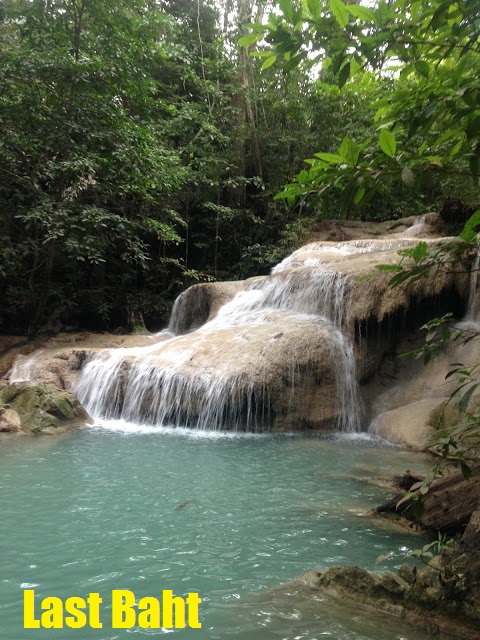
The best hike at the park is a trail that takes you past all seven tiers of the waterfall! The hike isn’t too hard, but takes 1-2 hours, depending on how long you stop at each tier. After the fifth tier, going gets a bit more tricky, but nothing too technical.
You can stop and swim at most of the clear, cool pools beneath each tier.

If you have time, it’s worth it to spend at least a day at Erawan. Besides the falls, there are plenty of hiking trails to explore.
You can buy water at the park. You can expect the weather to be generally warm and humid year-round. Bring a swimsuit and take a dip in the cold water beneath the falls!

You are free to walk along the tracks, but be careful! There is no railing!
Certain trains still run along this stretch of the railway.

 LB convert
Thanks for sharing the useful info here. Keep up the good work.Andaman tour packages
LikeLike
Thanks a lot for checking out our Kanchanaburi travel guide. It is a beautiful province full of tons of exciting stuff to see and do. We hope we can encourage and inspire more people to visit this beautiful country!
LikeLike